Taifa of Majorca
Taifa of Majorca | |||||||||||
|---|---|---|---|---|---|---|---|---|---|---|---|
| 1018–1203 | |||||||||||
 | |||||||||||
| Capital | Palma | ||||||||||
| Common languages | |||||||||||
| Religion |
| ||||||||||
| Government | Monarchy | ||||||||||
| Historical era | Middle Ages | ||||||||||
• Established | 1018 | ||||||||||
• Conquered by the Almohad Caliphate | 1203 | ||||||||||
| Currency | Dirham and Dinar | ||||||||||
| |||||||||||
| Today part of | Spain | ||||||||||

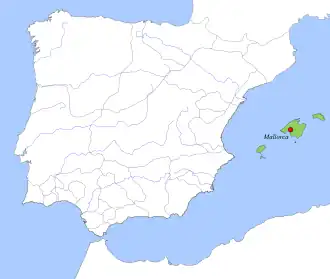
The Taifa of Majorca was a medieval Islamic taifa which existed from 1018 to 1203. It had all of the land of the Balearic Islands, an archipelago which is in modern-day Spain. The first ruler was a slavic warlord who was named Mujāhid al-ʿĀmirī.
The was independent for almost 50 years before falling to a small crusade. After that, it was occupied by the much stronger Almoravids who came from modern-day Morocco. After this, from 1076-1126 it was ruled by the Aglabid dynasty, a dynasty from the Najd. From 1126-1203, it was ruled by the Banu Ghaniya dynasty.[1]In 1203, it was conquered by the much stronger Almohad Caliphate, and ceased to exist.
References
- ↑ Abun-Nasr, Jamil M. (1987). A history of the Maghrib in the Islamic period. Cambridge ; New York: Cambridge University Press. ISBN 978-0-521-33184-5.