Symphony No. 10 (Mahler)
| Symphony No. 10 | |
|---|---|
| by Gustav Mahler | |
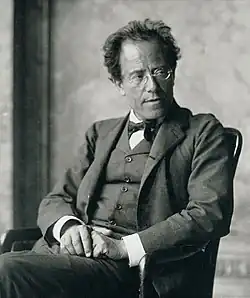 Gustav Mahler in 1907 | |
| Key | F-sharp major |
| Composed | 1910 – Unfinished: Toblach |
| Published | 1924
|
| Recorded | Eugene Ormandy, Philadelphia Orchestra, 1965 |
| Movements | 5 |
| Premiere | |
| Date | 13 August 1964 |
| Location | Royal Albert Hall, London |
| Conductor | Berthold Goldschmidt |
| Performers | London Symphony Orchestra |
The Symphony No. 10 in F-sharp minor is a piece of orchestral music by Gustav Mahler. The composer started the symphony in 1910 but died before he could finish it.[1]
When Mahler died, parts of the symphony were finished. There was no orchestration, so it could not be played. Only the first movement, Adagio, can be played the way Mahler wanted it.[2]
Instrumentation
Because the work is not finished, it is hard to find out what instruments would have been used. Deryck Cook's version is played most often, and it is written for:
- Woodwinds
- 4 flutes (4th doubling piccolo)
- 4 oboes (4th doubling cor anglais)
- 3 B♭ and A clarinets
- E♭ clarinet (doubling 4th clarinet)
- bass clarinet
- 4 bassoons (3rd and 4th doubling contrabassoons)
- Brass
- 4 horns
- 4 trumpets
- 4 trombones
- tuba
- Percussion
- 6 timpani (two players)
- bass drum
- large muffled military drum
- cymbals
- triangle
- tam-tam
- rute
- glockenspiel
- Strings
- harp
- 1st violins
- 2nd violins
- violas
- cellos
- double basses
Versions
Deryck Cooke used Mahler's work to create four "performing versions" of the symphony. The first two were not made public, but the others were printed in 1976 and 1989.[3]
Clinton Carpenter created a version of the symphony, finishing it in 1949. It was first played in 1983. Some say that Carpenter wrote his own symphony based on Mahler.[4]
Joseph Wheeler made four versions from 1953 to 1965.
Michelle Castelletti wrote a chamber orchestra version of the symphony. It was first played in November 2012 in Canterbury, England by the Canterbury Chamber Orchestra.
References
- ↑ "Gustav Mahler | Symphony No. 10 in F-sharp minor". www.nashvillesymphony.org. Retrieved 2026-02-21.
- ↑ Journey, Educator Asadour Santourian explores Gustavo Conducts Mahler's. "Adagio from Symphony No. 10, Gustav Mahler". LA Phil. Retrieved 2026-02-21.
- ↑ Symphony No. 10 by Gustav Mahler by Michael Steinberg
- ↑ Mahler Symphony No. 10 Carpenter completion, MusicWeb (UK), review by Tony Duggan
Further Reading
- Becqué, Robert (1991). Paul Op de Coul (ed.). "Die Korrespondenz zwischen Alma Mahler und Willem Mengelberg über die Niederländische Erstaufführung von zwei Sätzen der Zehnten Symphonie". Fragment or Completion. Proceedings of the Mahler X Symposium. The Hague: University Press Rotterdam.
- Bloomfield, Theodore. "In Search of Mahler's Tenth: The Four Performing Versions as Seen by a Conductor", The Musical Quarterly, Vol. 74, No. 2 (1990), pp. 175–196
- Chew, Teng-Leong. "Performing Versions of the Tenth Symphony." Naturlaut, vol. 1, no. 2 (2002), pp. 7–10 (online)
- Rothkamm, Jörg. Gustav Mahlers Zehnte Symphonie. Entstehung, Analyse, Rezeption, Frankfurt: Peter Lang, 2003 (Reprint and e-book 2012).
- Rothkamm, Jörg. "The Tenth Symphony: Analysis of its Composition and 'Performing Versions'", The Cambridge Companion to Mahler, ed. Jeremy Barham. Cambridge: University Press, 2007, pp. 150–161.
- Rothkamm, Jörg. "Five-Movement Orchestral Versions of Gustav Mahler’s Tenth Symphony", News about Mahler Research, vol. 53 (2006), pp. 48–66.
- Rothkamm, Jörg. "Berthold Goldschmidt und Gustav Mahler. Zur Entstehung von Deryck Cookes Konzertfassung der X. Symphonie", Hamburg: von Bockel, 2000.
- Vernon, David (19 May 2022). Beauty and Sadness: Mahler's 11 Symphonies. Edinburgh: Candle Row Press, 2022. ISBN 978-1739659905.
- Gantz, Jeffrey (November 23, 1982). "What's the score?: Attempts at Mahler's Tenth". The Boston Phoenix. Retrieved October 5, 2024.
- Matthews, Colin. "Tempo Relationships in the Adagio of Mahler's Tenth Symphony; and two wrong notes." The Musical Times, Vol. 151, No. 1910 (Spring 2010), pp. 3–8.
Outside links
- Deryck Cooke's original 1960 radio broadcast on 'Mahler's Unfinished Tenth Symphony'
- Discography of the Tenth Symphony including incomplete versions, with commentary. (in French)
- Schott Music, "Work of the Week: Gustav Mahler/Yoel Gamzou, 10th Symphony", 1 September 2010
- Canterbury Christ Church University, concert announcement, 23 November 2012 Archived 24 December 2012 at Archive.today
- Symphony No. 10: Scores at the International Music Score Library Project
- Orchestral score of the Adagio and Purgatorio movements Archived 2015-11-23 at the Wayback Machine, New York Philharmonic's digital archives