Stephenson 2-18
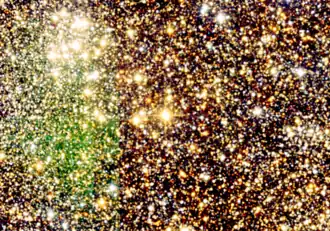 Dense starfield around the red supergiant star St2-18 (brightest star in the image) as seen from the 2MASS astronomical survey. The picture was published in 2003. Credit: Université de Strasbourg/CNRS | |
| Observation data Epoch J2000 Equinox J2000 | |
|---|---|
| Constellation | Scutum |
| Right ascension | 18h 39m 02.3709s |
| Declination | −06° 05′ 10.5357″ |
| Characteristics | |
| Evolutionary stage | Red supergiant |
| Spectral type | ~M6[1] |
| Apparent magnitude (G) | 15.2631±0.0092 |
| Apparent magnitude (J) | 7.150 |
| Apparent magnitude (H) | 4.698 |
| Apparent magnitude (K) | 2.9 |
| Astrometry | |
| Proper motion (μ) | RA: −3.045±0.511 mas/yr Dec.: −5.950±0.480 mas/yr |
| Parallax (π) | −0.0081 ± 0.3120 mas |
| Distance | 19,560 ly (6,000 pc) |
| Details | |
| If likely a Stephenson 2 member | |
| Radius | 2,150 R☉ |
| Luminosity | 90,000–440,000; 630,000[2] L☉ |
| Temperature | 3,200 K |
| Other designations | |
| Database references | |
| SIMBAD | data |
Stephenson 2-18 (St2-18, also known as Stephenson 2 DFK 1 and RSGC2-18)[3] is a red supergiant (RSG) or red hypergiant (RHG) star. It is close to, and a possible member of, the open cluster Stephenson 2. It is about 6,000 parsecs (20,000 ly) away from Earth in the constellation of Scutum and one of the largest known stars.
It is also possibly one of the most luminous of its type, if it is a member of the cluster. It is estimated to have a radius of 2,150 times that of the Sun,[4] and a volume 10 billion times that of the Sun. However, these parameters are unreliable and it is likely not a member of Stephenson 2.[4][5]
The star's distance from Earth is still debated, and its size was calculated using the estimates of its distance, brightness, and temperature. If those change, the calculated radius could also change. Some studies suggest that the star could be smaller than the commonly quoted value, because current models of how largest stars form and evolve usually predict a maximum size of around 1,500 times the solar radii, known as the Hayashi limit.[1]
This star has a spectral type of M6,[1] which is pretty unusual for a supergiant star (below the Hayashi limit) and corresponds to its cool temperature of 3,200 Kelvin.[4]
The star and the open cluster Stephenson 2 was discovered in 1990 by an American astronomer Charles Bruce Stephenson.[3] The clear single image of Stephenson 2-18 was first taken in the year 2007 using 2MASS All-Sky Survey camera from Cerro Tololo Inter-American observatory in Chile.[6]
References
- 1 2 3 Negueruela, I.; González-Fernández, C.; Dorda, R.; Marco, A.; Clark, J.S. (2013). "The population of M-type supergiants in the starburst cluster Stephenson 2". Eas Publications Series. 60: 279–285. arXiv:1303.1837. Bibcode:2013EAS....60..279N. doi:10.1051/eas/1360032. S2CID 119232033.
- ↑ Humphreys, Roberta M.; Helmel, Greta; Jones, Terry J.; Gordon, Michael S. (2020). "Exploring the Mass-loss Histories of the Red Supergiants". The Astronomical Journal. 160 (3): 145. arXiv:2008.01108. Bibcode:2020AJ....160..145H. doi:10.3847/1538-3881/abab15. S2CID 220961677.
- 1 2 Stephenson, C. B. (June 1990). "A possible new and very remote galactic cluster". The Astronomical Journal. 99: 1867. Bibcode:1990AJ.....99.1867S. doi:10.1086/115464. ISSN 0004-6256.
- 1 2 3 Fok, Thomas K. T.; Nakashima, Jun-ichi; Yung, Bosco H. K.; Hsia, Chih-Hao; Deguchi, Shuji (2012-11-05). "Maser Observations of Westerlund 1 and Comprehensive Considerations on Maser Properties of Red Supergiants Associated with Massive Clusters". The Astrophysical Journal. 760 (1): 65. arXiv:1209.6427. Bibcode:2012ApJ...760...65F. doi:10.1088/0004-637x/760/1/65. hdl:10722/181706. ISSN 0004-637X. S2CID 53393926.
- ↑ Humphreys, Roberta M.; Helmel, Greta; Jones, Terry J.; Gordon, Michael S. (2020-09-01). "Exploring the Mass-loss Histories of the Red Supergiants*". The Astronomical Journal. 160 (3): 145. Bibcode:2020AJ....160..145H. doi:10.3847/1538-3881/abab15. ISSN 0004-6256.
- ↑ "Stephenson 2-18: Everything About This Largest Star - Planets Order". 2023-05-29. Archived from the original on 2023-12-07. Retrieved 2023-10-07.