Stefania tamacuarina
| Stefania tamacuarina | |
|---|---|
Scientific classification  | |
| Kingdom: | Animalia |
| Phylum: | Chordata |
| Class: | Amphibia |
| Order: | Anura |
| Family: | Hemiphractidae |
| Genus: | Stefania |
| Species: | S. tamacuarina |
| Binomial name | |
| Stefania tamacuarina Myers and Donnelly, 1997 | |
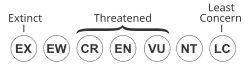
Stefania tamacuarina is a frog. It lives in Brazil and Venezuela.[2][3][1]
Home
This frog is awake at night. People see it on the ground and on low plants in forests on the tepui high places. Scientists found this frog in exactly one place, between 300 and 1,270 m (980 and 4,170 ft) above sea level.[2][1]
There are two protected places in the frog's home: Parque Nacional Parima-Tapirapecó and Alto Orinoco–Casiquiare Biosphere Reserve.[1]
Young
Scientists believe the female frogs carry their eggs on their backs.[1]
Danger
Scientists from the IUCN say they do not know if the frog is in danger of dying out. People have only seen it in forests that human beings have not changed much. Climate change could hurt this frog.[1]
References
- 1 2 3 4 5 6 IUCN SSC Amphibian Specialist Group (2020). "Stefania tamacuarina". IUCN Red List of Threatened Species. 2020: e.T56038A109538034. doi:10.2305/IUCN.UK.2020-3.RLTS.T56038A109538034.en. Retrieved June 25, 2026.
- 1 2 Frost, Darrel R. "Stefania tamacuarina Myers and Donnelly, 1997". Amphibian Species of the World, an Online Reference. Version 6.0. American Museum of Natural History, New York. Retrieved June 25, 2026.
- ↑ "Stefania tamacuarina Myers and Donnelly, 1997". AmphibiaWeb. University of California, Berkeley. Retrieved June 25, 2026.