Stefania percristata
| Stefania percristata | |
|---|---|
Scientific classification  | |
| Kingdom: | Animalia |
| Phylum: | Chordata |
| Class: | Amphibia |
| Order: | Anura |
| Family: | Hemiphractidae |
| Genus: | Stefania |
| Species: | S. percristata |
| Binomial name | |
| Stefania percristata Señaris, Ayarzagüena, and Gorzula, 1997 | |
Stefania percristata is a frog. It lives in Venezuela.[2][3][1]
Home
This frog is awake at night. People see it on plant branches as high as 1 m (3 ft 3 in) above the ground near streams in the tepui highlands. This frog lives in forests with tall trees and smaller plants close together. Scientists found this frog in exactly one place, Tepui Jaua, 1,600 m (5,200 ft) above sea level.[2][1]
Scientists says this frog lives in a protected place, Jaua-Sarisariñama National Park.[1]
Young
The female frogs carry their eggs on their backs.[1]
Danger
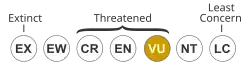
Scientists from the IUCN say this frog is in some danger of dying out and scientists from the Venezuelan Fauna Red List say they do not know. Climate change could hurt this frog by changing the water in the air and the plants. Viruses, bacteria, and fungi could also hurt this frog by making it sick.[1]
References
- 1 2 3 4 5 6 Señaris, J.C. (2022) [amended version of 2020 assessment]. "Stefania percristata". IUCN Red List of Threatened Species. 2022: e.T56031A198645648. doi:10.2305/IUCN.UK.2022-1.RLTS.T56031A198645648.en. Retrieved June 23, 2026.
- 1 2 Frost, Darrel R. "Stefania percristata Señaris, Ayarzagüena, and Gorzula, 1997". Amphibian Species of the World, an Online Reference. Version 6.0. American Museum of Natural History, New York. Retrieved June 23, 2026.
- ↑ "Stefania percristata Señaris, Ayarzagüena, and Gorzula, 1997". AmphibiaWeb. University of California, Berkeley. Retrieved June 23, 2026.