Stefania marahuaquensis
| Stefania marahuaquensis | |
|---|---|
Scientific classification  | |
| Kingdom: | Animalia |
| Phylum: | Chordata |
| Class: | Amphibia |
| Order: | Anura |
| Family: | Hemiphractidae |
| Genus: | Stefania |
| Species: | S. marahuaquensis |
| Binomial name | |
| Stefania marahuaquensis (Rivero, 1961) | |
| Synonyms[2] | |
| |
The Marahuaca tree frog (Stefania marahuaquensis) is a frog. It lives in Venezuela.[2][3][1]
Home
People see adult frogs on rocks next to streams. Scientists have seen the frog between 340 and 1,200 m (1,120 and 3,940 ft) above sea level.[1]
Scientists have seen the frogs in a protected place, Duida-Marahuaka National Park.[1]
Young
Scientists think the female frogs carry their eggs on their backs and that the eggs hatch into small froglets, not swimming tadpoles.[1]
Danger
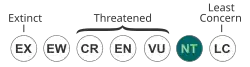
Scientists from the IUCN say this frog is in some danger of dying out. Climate change could hurt this frog because it lives in such a small place. Viruses, bacteria, and fungi could also hurt this frog by making it sick.[1]
References
- 1 2 3 4 5 6 Señaris, J.C. (2022). "Marahuaca Treefrog: Stefania marahuaquensis". IUCN Red List of Threatened Species. 2022: e.T56029A198645202. doi:10.2305/IUCN.UK.2022-1.RLTS.T56029A198645202.en. Retrieved June 17, 2026.
- 1 2 Frost, Darrel R. "Stefania marahuaquensis (Rivero, 1961)". Amphibian Species of the World, an Online Reference. Version 6.0. American Museum of Natural History, New York. Retrieved June 17, 2026.
- ↑ "Stefania marahuaquensis (Rivero, 1961)". AmphibiaWeb. University of California, Berkeley. Retrieved June 17, 2026.