Squatting (Australian history)
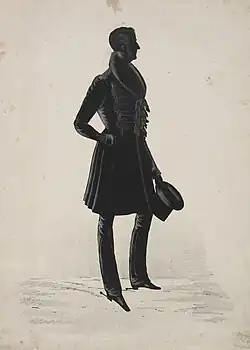
In Australian history, squatting means living on and using land owned by the government (called Crown land) to raise animals like sheep or cattle. At first, most squatters did not have legal rights to use the land. But over time, the government accepted many squatters as the rightful owners because they were often the first white settlers in those areas. The word "squattocracy" was made to describe squatters as a powerful social class, like aristocrats.[1]
Name
The word "squatter" originally meant someone who lived somewhere without legal rights. When British people first settled in Australia, it meant someone who used land without permission from the government.[1]
From the 1820s, more people, often rich and important ones, started using land without legal rights. Wool became an important product to sell to England. More people came to Australia, to make money by sheep farming. By the 1830s, the government stopped fighting squatting and started controlling it instead. By then, squatters often had leases or licenses from the government, so the word "squatter" did not sound bad anymore.
The word "squatter" also came to mean someone rich and successful. By 1840, many squatters were some of the richest men in New South Wales. They were often from wealthy English or Scottish families. Good land with water was harder to find, so squatters needed money to get it. A "run" was land used by squatters for sheep, left mostly natural without many changes.[2] In 1853 a Melbourne newspaper reported a squatter could have a farm as large as 500,000 acres (200,000 ha).[3]
A squatter became a person with high social status. They raised many animals on large land areas, whether they owned the land or leased it. Today, "squatter" still means a big landowner in rural Australia. The word "squattocracy" was used as a joke or insult to show how powerful squatters were, like a ruling class.
References
- 1 2 "Squattocracy". State Library of NSW. 2016-02-12. Archived from the original on 6 December 2022. Retrieved 2022-10-11.
- ↑ Hodgson, Christopher Pemberton (1846). Reminiscences of Australia with Hints on the Squatter's Life. Pall Mall: W.N. Wright. p. 13. Retrieved 9 February 2018.
- ↑ Unknown Journalist. (1st February 1853). The Argus. Melbourne, Australia. https://www.historyskills.com/finding-sources/modern-history/squatters-and-selectors-sources/