Smart manufacturing
| History of technology |
|---|
Smart manufacturing[1] is a broad type of manufacturing that uses computer-integrated manufacturing, high adaptability and fast design changes, digital information technology, and more flexible training for technical workers.[2] Other common goals are fast changes in production levels based on demand,[3][1] optimization of the supply chain,[3] efficient production and better recyclability.[4] In this idea, a smart factory has systems that can work together, use models and simulations at different scales, rely on intelligent automation, maintain strong cyber security, and use many networked sensors.
The broad definition of smart manufacturing includes many different technologies. Some important technologies are big data processing, industrial connectivity devices and services, and advanced robotics.[5]
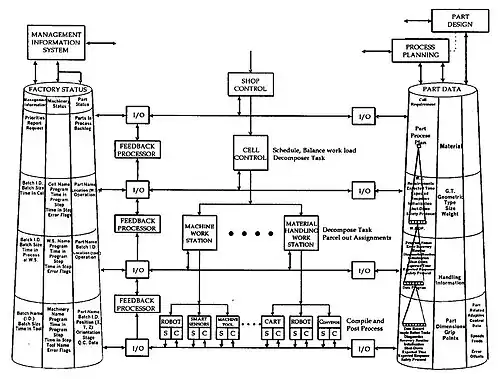
Big data processing
Smart manufacturing uses big data analytics to improve complex production processes and strengthen supply chain management.[7] Big data analytics is a way of collecting and understanding very large sets of data. It is often described using three features called the three V's: velocity, variety and volume. Velocity is how fast the data is collected, often at the same time as earlier data is being used. Variety is the different kinds of data that are handled. Volume is the total amount of data.[8] With big data analytics, a company using smart manufacturing can predict demand and needed design changes instead of only reacting to orders.[2]
Some products contain built-in sensors. These sensors create large amounts of data that can be used to understand how customers use products and to improve future versions.[9][10][11]
Supply Chain Autonomy
A major expected use of big data processing is the move towards full supply chain autonomy. Supply chain autonomy is a new concept in operations and logistics. It describes supply chains that can work on their own with little or no human input by using data. Autonomous supply chains (ASCs) are systems that can manage themselves across functions such as planning, coordination and execution. How far autonomy is used in these activities shows the level of autonomy reached.
These systems use technologies such as digital twins, AI-driven agents and real-time data. These technologies support three main abilities: self-configuration, which means adjusting operations dynamically; self-optimisation, which means constantly improving performance; and self-healing, which means responding to problems without manual intervention. Conceptual frameworks describe how these elements work together in loops of sensing, processing, decision-making and learning.[12] These ideas provide a basis for understanding how future supply chains can become more resilient, efficient and adaptable in complex and changing environments.
Advanced robotics
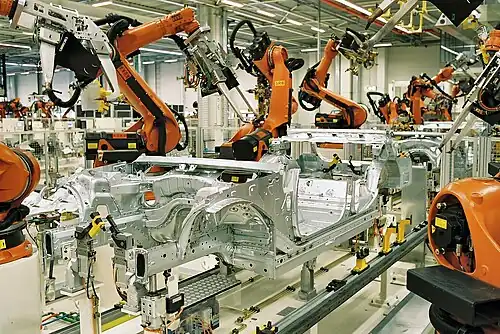
Advanced industrial robots, sometimes called smart machines, can work autonomously and communicate directly with manufacturing systems. In some advanced manufacturing situations, they can work together with people on shared assembly tasks.[13] By using sensory input and telling different product configurations apart, these machines can solve problems and make some decisions without human help. They can perform work beyond their original programming and use artificial intelligence to learn from their experience.[5] They can also be reconfigured and re-purposed, which lets them respond quickly to design changes and innovation. This is an advantage compared to more traditional manufacturing systems.[14]
One concern about advanced robotics is the safety and health of human workers who interact with robots. Traditionally, robots were kept separate from the human workforce. New advances in robotic intelligence and sensing, however, have created opportunities for collaboration, for example with cobots that work side by side with humans.[15]
Cloud computing allows large amounts of data storage and computational power to be quickly applied to manufacturing. It also allows the collection of detailed data on machine performance and product quality. This can improve machine configuration, predictive maintenance and fault analysis, and can lead to better strategies for ordering raw materials and planning production.
3D printing
As of 2019, 3D printing is mainly used for rapid prototyping, design changes and small-scale production. Improvements in printing speed, quality and materials may make it useful for mass production[16][17] and for mass customization.[17]
3D printing has developed to the point where it is no longer used only as a prototyping technology. It is increasingly common in supply chains. The industries where digital manufacturing with 3D printing is most widely used include automotive, industrial and medical sectors. In the auto industry, 3D printing is used not only for prototypes but also for full production of final parts and products. 3D printing has also been used by suppliers and digital manufacturers working together to help respond to COVID-19.[18]
3D printing allows more successful prototyping, so companies can save time and money by producing many parts in a short period of time. There is major potential for 3D printing to change supply chains, so more companies are adopting it.[18] A key challenge is changing people’s attitudes. Some workers also need to learn new skills to manage and operate 3D printing technology.
Eliminating workplace inefficiencies and hazards
Smart manufacturing can also be used to analyse workplace inefficiencies and improve worker safety. Many users of smart systems focus on optimizing efficiency through data analysis and intelligent automated systems. For example, operators can carry personal access cards with built-in Wi-Fi and Bluetooth that connect to machines and a cloud platform. This allows the system to know in real time which operator is working on which machine.[19] An intelligent, interconnected smart system can set performance targets, check if these targets are realistic, and detect inefficiencies when targets are missed or delayed.[20] In general, automation can reduce inefficiencies caused by human error, and more advanced AI can reduce inefficiencies in older systems.
As robots perform more of the physical manufacturing tasks, workers do not need to be present in as many hazardous situations and are therefore exposed to fewer risks.[21]
Impact of Industry 4.0
Industry 4.0 is a project in the high-tech strategy of the German government that supports the computerization of traditional industries such as manufacturing. Its goal is the intelligent factory (Smart Factory), which is characterized by adaptability, resource efficiency and ergonomics, and by the involvement of customers and business partners in business and value-creation processes. The technological basis of Industry 4.0 is made up of cyber-physical systems and the Internet of Things.[22]
Intelligent manufacturing under Industry 4.0 makes extensive use of wireless connections during product assembly and for long-distance interactions with products, of modern sensors placed along the supply chain and in the products themselves (Internet of things), and of the processing of very large amounts of data to control all stages of design, production, distribution and product use.
European and German roadmaps such as "Factories of the Future" and "Industrie 4.0" describe several lines of action and related benefits. They present advanced manufacturing processes and rapid prototyping as ways to let each customer order a unique product without a large increase in cost. They discuss collaborative virtual factory platforms, which can greatly reduce the cost and time of new product design and production engineering by using complete simulation and virtual testing throughout the product life cycle. Advanced human–machine interaction and augmented reality devices are seen as ways to increase safety in production plants and to reduce the physical strain on workers. Machine learning is expected to be key for optimizing production processes, both by shortening lead times and by cutting energy use. Cyber-physical systems and machine-to-machine communication should allow real-time data to be collected and shared from the shop floor, helping to reduce downtime and idle time by enabling highly effective predictive maintenance.
Statistics
The Ministry of Economy, Trade and Industry in South Korea announced on 10 March 2016 that it had supported the construction of smart factories in 1,240 small and medium enterprises. According to the ministry, these factories saw an average 27.6% drop in defective products, 7.1% faster production of prototypes, and 29.2% lower costs.[23]
Related pages
Open manufacturing is a related concept that promotes open sharing of designs and processes in manufacturing. The idea of the Fourth Industrial Revolution is closely connected to smart manufacturing and Industry 4.0, focusing on digital and cyber-physical changes across the economy. Urban manufacturing refers to manufacturing activities located in or near cities, which can also make use of smart manufacturing technologies.
References
- 1 2 Lu, Yuqian; Xu, Xun; Wang, Lihui (July 2020). ["Smart manufacturing process and system automation – A critical review of the standards and envisioned scenarios". Journal) of Manufacturing Systems. 56: 312–325. doi:10.1016/j.jmsy.2020.06.010. S2CID 225557967.
{{cite journal}}: Check|url=value (help) - 1 2 Davis, Jim; Edgar, Thomas; Porter, James; Bernaden, John; Sarli, Michael (2012-12-20). "Smart manufacturing, manufacturing intelligence and demand-dynamic performance". Computers & Chemical Engineering. FOCAPO 2012. 47: 145–156. doi:10.1016/j.compchemeng.2012.06.037.
- 1 2 SMLC 2011
- ↑ Shipp, Stephanie S. (March 2012). [(https://web.archive.org/web/20120606110910/https://www.wilsoncenter.org/sites/default/files/Emerging_Global_Trends_in_Advanced_Manufacturing.pdf) "Emerging) Global Trends in Advanced Manufacturing"]. Emerging Global Trends in Advanced Manufacturing. Institute for Defense Analysis. Archived from [the original (PDF) on 2012-06-06. Retrieved 2020-04-12.
{{cite web}}: Check|archiveurl=value (help); Check|url=value (help) - 1 2 ["On the Journey to a Smart Manufacturing Revolution". 2015-12-30. Retrieved 2016-02-17.
{{cite web}}: Check|url=value (help); Unknown parameter|website)=ignored (help); Unknown parameter|website](http://www.industryweek.com/systems-integration/journey-smart-manufacturing-revolution?page=ignored (help) - ↑ Albus, James S. (1995-01-01), [(https://commons.wikimedia.org/wiki/File):Automated_Manufacturing_Research_Facility.jpg English: Architecture for the NBS Automated Manufacturing Research Facility (AMRF).], retrieved 2016-03-04
{{citation}}: Check|url=value (help) - ↑ Rachuri, Sudarsan (February 4, 2014). National Institute of Standards and Technology [[https://www.nist.gov/el/msid/syseng/upload/SMSDAFY2014.pdf. Retrieved February 16, 2016.
{{cite web}}: Check|url=value (help); Missing or empty|title=(help); Text "title](https://www.nist.gov/el/msid/syseng/upload/SMSDAFY2014.pdf" ignored (help) - ↑ Leveling, J.; Edelbrock, M.; Otto, B. (2014-12-01). "Big data analytics for supply chain management". 2014 IEEE International Conference on Industrial Engineering and Engineering Management. pp. 918–922. doi:10.1109/IEEM.2014.7058772. ISBN 978-1-4799-6410-9. S2CID 31872187.
- ↑ Yang, Chen; Shen, Weiming; Wang, Xianbin (January 2018). "The Internet of Things in Manufacturing: Key Issues and Potential Applications". IEEE Systems, Man, and Cybernetics Magazine. 4 (1): 6–15. doi:10.1109/MSMC.2017.2702391. S2CID 42651835.
- ↑ Porter, Michael E. (November 2014). ["How) Smart, Connected Products Are Transforming Competition". Harvard Business Review. April 2016.
{{cite journal}}: Check|url=value (help) - ↑ ["Building) Smarter Manufacturing With The Internet of Things (IoT)". IT World Canada. Lopez Research. 2014. Retrieved 2020-04-12.
{{cite web}}: Check|url=value (help) - ↑ Xu, Liming; Mak, Stephen; Proselkov, Yaniv; Brintrup, Alexandra (November 2024). "Towards autonomous supply chains: Definition, characteristics, conceptual framework, and autonomy levels". Journal of Industrial Information Integration. 42 (100698). arXiv:2401.14183. doi:10.1016/j.jii.2024.100698.
- ↑ Wang, W.; Li, R.; Chen, Y.; Diekel, Z.; Jia, Y. (2019). "Facilitating Human-Robot Collaborative Tasks by Teaching-Learning-Collaboration From Human Demonstrations". IEEE Transactions on Automation Science and Engineering. 16 (2): 640–653. doi:10.1109/tase.2018.2840345. ISSN 1545-5955.
- ↑ ["Robotic) Systems for Smart Manufacturing". [www.nist.gov. US Department of Commerce. October) 2013. Retrieved 2016-03-04.
{{cite web}}: Check|url=value (help); Check date values in:|date=(help) - ↑ Bicchi, Antonio; Peshkin, Michael A.; Colgate, J. Edward (2008-01-01). "Safety for Physical Human–Robot Interaction". In Siciliano, Bruno; Khatib, Oussama Khatib (eds.). Springer Handbook of Robotics. Springer Berlin Heidelberg. pp. 1335–1348. doi:10.1007/978-3-540-30301-5_58. ISBN 9783540239574.
- ↑ Zimmermann, Stefan (March 26, 2018). [(https://atos.net/en/blog/industry-4-0-3d-printing-manufacturing-industries) "Industry 4.0 – 3D Printing in Manufacturing Industries"]. Atos Blog. Atos SE. Retrieved 2019-06-09.
{{cite web}}: Check|url=value (help) - 1 2 Hughes, Andrew (Mar 23, 2017). ["Industry) 4.0 is About More Than Data: 3D Printing in Manufacturing". Digital Transformation and Operational Excellence Blog. LNS Research. Retrieved 2019-06-09.
{{cite web}}: Check|url=value (help) - 1 2 Wilson, Georgia (May 16, 2020). [(https://manufacturingglobal.com/technology/evolution-3d-printing-manufacturing) "The evolution of 3D printing in manufacturing"]. Manufacturing Global. BizClick Medial Limited. Retrieved 2021-06-04.
{{cite magazine}}: Check|url=value (help) - ↑ ["ThingTrax". ThingTrax) Connected Manufacturing. London. Archived from [the original on 2017-04-12. Retrieved 2020-04-12.
{{cite web}}: Check|archive-url=value (help); Check|url=value (help); Invalid|url-status=dead)(help) - ↑ Jung, Kiwook (2015-03-16). "Mapping Strategic Goals and Operational Performance Metrics for Smart Manufacturing Systems". Procedia Computer Science. 44 (44 p.184–193): 184–193. doi:10.1016/j.procs.2015.03.051.
- ↑ Louchez, Alain (January 6, 2014). ["From) Smart Manufacturing to Manufacturing Smart". [www.automationworld.com. Automation) World. Retrieved 2016-03-04.
{{cite web}}: Check|url=value (help) - ↑ Jacinto, Joan (July 31, 2014). ["Smart) Manufacturing? Industry 4.0? What's It All About?". The Vault - Siemens Totally Integrated Automation.
{{cite web}}: Check|url=value (help) - ↑ Jung Min-hee (March 11, 2016). ["Smart) Factories Improving Productivity of SMEs".
{{cite news}}: Check|url=value (help)
Other websites
- CESMII - US National Institute on Smart Manufacturing
- Factories of the Future
- Agnieszka Radziwon, Arne Bilberg, Marcel Bogers, Erik Skov Madsen. The Smart Factory: Exploring Adaptive and Flexible Manufacturing Solutions – Proceedings of the 24th DAAAM International Symposium on Intelligent Manufacturing and Automation, 23–26 October 2013, Zadar, Croatia. – Elsevier, Procedia Engineering, ISSN 1877-7058, 69 (2014), 1184–1190
- Agnieszka Radziwon, Marcel Bogers, Arne Bilberg. The Smart Factory: Exploring an Open Innovation Solution for Manufacturing Ecosystems Date Written: May 28, 2014. Available at SSRN, 11 Pages. Posted: 1 Oct 2014
- GE launches 'microfactory' to co-create the future of manufacturing
- Smart Machines & Future Factories
Industrial and technological revolution | ||
|---|---|---|
| Themes |
|  |
| People/ groups |
| |
| Places |
| |
| Invention/ technology |
| |
| Social impact |
| |
| Reference |
| |
| ||


:Automated_Manufacturing_Research_Facility.jpg)