Shock tactics
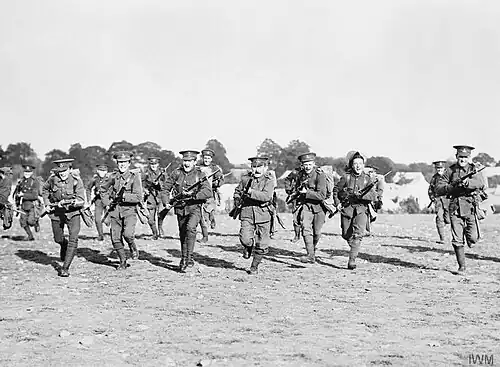
Shock tactics are those military tactics designed to overwhelm an enemy with fear, causing panic and confusion.[1] Shock tactics are as old as warfare itself. The Mongols got their reputation for being invincible by the use of shock tactics.[2] Numbers of Medieval knights mounted on their warhorses made coordinated shock attacks into the ranks of enemy soldiers.[3] Robert E. Lee saw the advantage of the shock attack as not so much killing enemy soldiers, but to "create a panic and virtually destroy the [enemy] army."[4] The disadvantage of a shock attack is that the attacker may suffer heavy casualties. During World War I, for example, Germany suffered great losses with its use of the shock attack.[5]
Historic examples

Ancient armies often defeated their enemy through the psychological impact of shock tactics.[6]
- The Hittites and Ancient Egyptians used the first mobile tool for shock tactics; the war Chariot.[6] Charioteers were the elite branch of most armies of the time. But by the beginning of the classical period they were no longer effective.[6] Armies had developed ways to defeat the chariots in battle.[6] Even the infamous scythed chariots used by Darius I of Persia [a] could be easily defeated by the infantry.[6] They changed to a wider spacing of their phalanx formation. This allowed the soldiers to avoid the blades and let the scythed chariots to go right through.[6] They then ran directly into the long pike formations directly behind each phalanx which impaled the chariots and their riders.[6]
- Philip II of Macedon and his son Alexander the Great depended on their elite Companion cavalry for their shock tactics to help win nearly every one of their battles.[8] While the Macedonian phalanx units would engage the enemy, the cavalry was held in reserve.[9] Once the phalanx broke up the lines, the Companion cavalry would act as shock troops and scatter the enemy soldiers.[9]
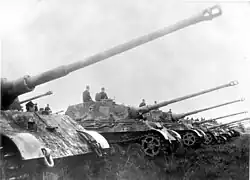
- The German Blitzkrieg (lightning war) of World War II was a shock tactic that was used to great effect against their enemies.[10] The Blitzkrieg concentrated its forces behind offensive weapons such as tanks, artillery and airplanes to quickly push through enemy lines.[10] The tanks would then be free to cause shock and confusion behind the enemy lines.[10] They would interrupt supply lines, and prevent reinforcements from sealing the breach in their lines.[10] The Germans would then envelop the enemy troops and force them to surrender (military).[b][10]
Notes
- ↑ These were chariots that had blades attached to the wheels that could cut a man in half.[7] They also had blades under the chariot pointing down almost touching the ground that would cut to pieces any soldiers caught under the chariot.[7]
- ↑ One place this tactic did not work was at the Battle of the Bulge.[11] While the initial shock pushed the Allied lines back, after a month they had only been able to push a large "bulge" in defensive lines.[12] In particular, at the Belgian town of Bastogne, the Germans surrounded the Americans and demanded their surrender.[12] But the 501st Infantry Regiment refused to surrender.[12] The Germans were unable to defeat the defenders and withdrew after the town was relieved by the tanks of General George S. Patton's 4th Armored Division.[12]
Related pages
- Flanking maneuver
- Pincer movement (also called a double-envelopment)
- Turning movement
- Ambush
- Envelopment
- Pincer movement
- Rearguard
- Attrition warfare
- Feigned retreat
- Preemptive war
- Oblique order
References
- ↑ Michiko Phifer, A Handbook of Military Strategy and Tactics (New Delhi: Vij Books India Private Limited, 2012), p. 162
- ↑ Clifford Jeffrey Rogers, The Oxford Encyclopedia of Medieval Warfare and Military Technology, Vol. 1 (Oxford: Oxford University Press, 2010), p. 19
- ↑ Sean McGlynn. "The Myths of Medieval Warfare". De Re Militari. Retrieved 28 August 2016.
- ↑ Richard Rollins, Pickett's Charge: Eyewitness Accounts at the Battle of Gettysburg (Mechanicsburg, PA: Stackpole Books, 2005), pp. 8–9
- ↑ Gustave Le Bon, The Psychology of the Great War (New York: Macmillan, 1916), p. 301
- 1 2 3 4 5 6 7 Vincent Lopez. "Shock Tactics on the Ancient Battlefield". Armchair General L.L.C. Retrieved 28 August 2016.
- 1 2 "The Scythed Chariot". University of Chicago. Retrieved 28 August 2016.
- ↑ Partha Bose, Alexander the Great's Art of Strategy (New York: Gotham Books, 2004), p. 10
- 1 2 "Companion Cavalry Elite Cavalry Force". MilitaryFactory.com. Archived from the original on 22 April 2016. Retrieved 28 August 2016.
- 1 2 3 4 5 "Blitzkrieg (Lightning War)". Holocaust Museum. United States Holocaust Memorial Museum. Retrieved 28 August 2016.
- ↑ "Germany's last second world war offensive". Second World War. The Guardian. 10 September 2009. Retrieved 28 August 2016.
- 1 2 3 4 "The Siege and Relief of Bastogne During the Battle of the Bulge". Hugh M. Cole, The Ardennes: Battle of the Bulge (Washington, D.C.: Office of the Chief of Military history, 1965), pp.445-481, 509-555. Sam Houston State University. Archived from the original on 15 August 2016. Retrieved 28 August 2016.