Sexagenary cycle
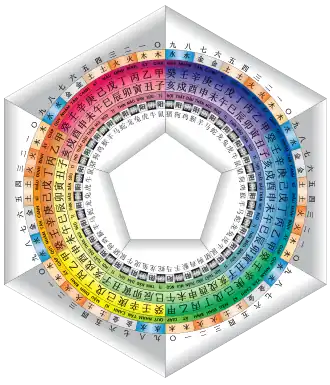
The sexagenary cycle (六十花甲 liùshí huājiǎ), also known as the "stems-and-branches" or "trunks-and-branches" (干支 gānzhī), is a traditional Chinese calendar system. It is a list of sixty terms which are used for identifying days or years.[1]
History
The oldest Chinese system for recording and organizing time uses repeated periods of 60 days.[2]
Ancient records show that the sexagenary cycle was used to count years in the 3rd century B.C.[2]
The repeating series of 60 terms has been an important part of historical calendar systems in East Asia, including China, Japan, Korea, Tibet and Vietnam.
Overview
Each term in the sexagenary cycle is made up of two Chinese characters:
- One character is taken from a list of "heavenly stems" or "trunks" (天干 tiāngān), including wood, fire, earth, metal and water.[3]
- The other character is taken from a list of "earthly branches" (地支 dìzhī) or animal signs, including Rat, Ox, Tiger, Rabbit, Dragon, Snake, Horse, Goat, Monkey, Rooster, Dog, and Pig.[4]
- The combinations make up a total of 60 different names for a period of time.
Heavenly stems
| No. | Heavenly Stem |
Chinese name |
Japanese name |
Korean name |
Vietnamese name |
Yin yang | Wu xing | |||
|---|---|---|---|---|---|---|---|---|---|---|
| Mandarin (Pinyin) |
Cantonese (Jyutping) |
Onyomi | Kunyomi with corresponding kanji |
Romanized | Hangul | |||||
| 1 | 甲 | jiǎ | gaap3 | kō (こう) | kinoe (木の兄) | gap | 갑 | giáp | yang | wood |
| 2 | 乙 | yǐ | jyut3 | otsu (おつ) | kinoto (木の弟) | eul | 을 | ất | yin | |
| 3 | 丙 | bǐng | bing2 | hei (へい) | hinoe (火の兄) | byeong | 병 | bính | yang | fire |
| 4 | 丁 | dīng | ding1 | tei (てい) | hinoto (火の弟) | jeong | 정 | đinh | yin | |
| 5 | 戊 | wù | mou6 | bo (ぼ) | tsuchinoe (土の兄) | mu | 무 | mậu | yang | earth |
| 6 | 己 | jǐ | gei2 | ki (き) | tsuchinoto (土の弟) | gi | 기 | kỷ | yin | |
| 7 | 庚 | gēng | gang1 | kō (こう) | kanoe (金の兄) | gyeong | 경 | canh | yang | metal |
| 8 | 辛 | xīn | san1 | shin (しん) | kanoto (金の弟) | shin | 신 | tân | yin | |
| 9 | 壬 | rén | jam4 | jin (じん) | mizunoe (水の兄) | im | 임 | nhâm | yang | water |
| 10 | 癸 | guǐ | gwai3 | ki (き) | mizunoto (水の弟) | gye | 계 | quý | yin | |
Earthly branches
| No. | Earthly Branch |
Chinese name |
Japanese name |
Korean name |
Vietnamese name |
Vietnamese zodiac |
Chinese zodiac |
Corresponding hours | |||
|---|---|---|---|---|---|---|---|---|---|---|---|
| Mandarin (pinyin) |
Cantonese (Jyutping) |
Onyomi | Kunyomi | Romanized | Hangul | ||||||
| 1 | 子 | zǐ | zi2 | shi | ne | ja | 자 | tý | Rat (chuột) | Rat (鼠) | 11 p.m. to 1 a.m. |
| 2 | 丑 | chǒu | cau2 | chū | ushi | chuk | 축 | sửu | Water Buffalo (trâu) | Cow (牛) | 1 to 3 a.m. |
| 3 | 寅 | yín | jan4 | in | tora | in | 인 | dần | Tiger (hổ/cọp) | Tiger (虎) | 3 to 5 a.m. |
| 4 | 卯 | mǎo | maau5 | bō | u | myo | 묘 | mẹo/mão | Cat (mèo) | Rabbit[5] (兔) | 5 to 7 a.m. |
| 5 | 辰 | chén | san4 | shin | tatsu | jin | 진 | thìn | Dragon (thuồng luồng) | Dragon (龍) | 7 to 9 a.m. |
| 6 | 巳 | sì | zi6 | shi | mi | sa | 사 | tỵ | Snake (rắn) | Snake (蛇) | 9 to 11 a.m. |
| 7 | 午 | wǔ | ng5 | go | uma | o | 오 | ngọ | Horse (ngựa) | Horse (馬) | 11 a.m. to 1 p.m. |
| 8 | 未 | wèi | mei6 | mi or bi | hitsuji | mi | 미 | mùi | Goat (dê) | Goat (羊) | 1 to 3 p.m. |
| 9 | 申 | shēn | san1 | shin | saru | shin | 신 | thân | Monkey (khỉ) | Monkey (猴) | 3 to 5 p.m. |
| 10 | 酉 | yǒu | jau5 | yū | tori | yu | 유 | dậu | Chicken (gà) | Chicken (雞) | 5 to 7 p.m. |
| 11 | 戌 | xū | seot1 | jutsu | inu | sul | 술 | tuất | Dog (chó) | Dog (狗) | 7 to 9 p.m. |
| 12 | 亥 | hài | hoi6 | gai | i | hae | 해 | hợi | Pig (lợn/heo) | Pig (豬) | 9 to 11 p.m. |
Conversion tables
Tables show specific years in the context of a repeating sexagenary cycle.
1804–1923
| No. | 1804–1863 | Heavenly stem | Earthly branch | 1864–1923 |
|---|---|---|---|---|
| Year | (Elements) | (Animals) | Year | |
| 1 | ~~ 1804 – ~~ 1805 | 甲 Yang Wood | 子 Rat | Feb 8 1864 – Jan 26 1865 |
| 2 | ~~ 1805 – ~~ 1806 | 乙 Yin Wood | 丑 Ox | Jan 27 1865 – ~~ 1866 |
| 3 | ~~ 1806 – ~~ 1807 | 丙 Yang Fire | 寅 Tiger | ~~ 1866 – ~~ 1867 |
| 4 | ~~ 1807 – ~~ 1808 | 丁 Yin Fire | 卯 Rabbit | ~~ 1867 – ~~ 1868 |
| 5 | ~~ 1808 – ~~ 1809 | 戊 Yang Earth | 辰 Dragon | ~~ 1868 – ~~ 1869 |
| 6 | ~~ 1809 – ~~ 1810 | 己 Yin Earth | 巳 Snake | ~~ 1869 – Jan 30 1870 |
| 7 | ~~ 1810 – ~~ 1811 | 庚 Yang Metal | 午 Horse | Jan 31 1870 – Feb 18 1871 |
| 8 | ~~ 1811 – ~~ 1812 | 辛 Yin Metal | 未 Goat | Feb 19 1871 – ~~ 1872 |
| 9 | ~~ 1812 – ~~ 1813 | 壬 Yang Water | 申 Monkey | ~~ 1872 – ~~ 1873 |
| 10 | ~~ 1813 – ~~ 1814 | 癸 Yin Water | 酉 Rooster | ~~ 1873 – ~~ 1874 |
| 11 | ~~ 1814 – ~~ 1815 | 甲 Yang Wood | 戌 Dog | ~~ 1874 – ~~ 1875 |
| 12 | ~~ 1815 – ~~ 1816 | 乙 Yin Wood | 亥 Pig | ~~ 1875 – ~~ 1876 |
| 13 | ~~ 1816 – ~~ 1817 | 丙 Yang Fire | 子 Rat | ~~ 1876 – ~~ 1877 |
| 14 | ~~ 1817 – ~~ 1818 | 丁 Yin Fire | 丑 Ox | ~~ 1877 – ~~ 1878 |
| 15 | ~~ 1818 – ~~ 1819 | 戊 Yang Earth | 寅 Tiger | ~~ 1878 – ~~ 1879 |
| 16 | ~~ 1819 – ~~ 1820 | 己 Yin Earth | 卯 Rabbit | ~~ 1879 – ~~ 1880 |
| 17 | ~~ 1820 – ~~ 1821 | 庚 Yang Metal | 辰 Dragon | ~~ 1880 – ~~ 1881 |
| 18 | ~~ 1821 – ~~ 1822 | 辛 Yin Metal | 巳 Snake | ~~ 1881 – ~~ 1882 |
| 19 | ~~ 1822 – ~~ 1823 | 壬 Yang Water | 午 Horse | ~~ 1882 – ~~ 1883 |
| 20 | ~~ 1823 – ~~ 1824 | 癸 Yin Water | 未 Goat | ~~ 1883 – ~~ 1884 |
| 21 | ~~ 1824 – ~~ 1825 | 甲 Yang Wood | 申 Monkey | ~~ 1884 – ~~ 1885 |
| 22 | ~~ 1825 – ~~ 1826 | 乙 Yin Wood | 酉 Rooster | ~~ 1885 – ~~ 1886 |
| 23 | ~~ 1826 – ~~ 1827 | 丙 Yang Fire | 戌 Dog | ~~ 1886 – ~~ 1887 |
| 24 | ~~ 1827 – ~~ 1828 | 丁 Yin Fire | 亥 Pig | ~~ 1887 – ~~ 1888 |
| 25 | ~~ 1828 – ~~ 1829 | 戊 Yang Earth | 子 Rat | ~~ 1888 – Jan 30 1889 |
| 26 | ~~ 1829 – ~~ 1830 | 己 Yin Earth | 丑 Ox | Jan 31 1889 – Jan 20 1890 |
| 27 | ~~ 1830 – ~~ 1831 | 庚 Yang Metal | 寅 Tiger | Jan 21 1890 – Feb 08 1891 |
| 28 | ~~ 1831 – ~~ 1832 | 辛 Yin Metal | 卯 Rabbit | Feb 09 1891 – ~~ 1892 |
| 29 | ~~ 1832 – ~~ 1833 | 壬 Yang Water | 辰 Dragon | ~~ 1892 – ~~ 1893 |
| 30 | ~~ 1833 – ~~ 1834 | 癸 Yin Water | 巳 Snake | ~~ 1893 – ~~ 1894 |
| 31 | ~~ 1834 – ~~ 1835 | 甲 Yang Wood | 午 Horse | ~~ 1894 – ~~ 1895 |
| 32 | ~~ 1835 – ~~ 1836 | 乙 Yin Wood | 未 Goat | ~~ 1895 – Feb 12 1896 |
| 33 | ~~ 1836 – ~~ 1837 | 丙 Yang Fire | 申 Monkey | Feb 13 1896 – Feb 01 1897 |
| 34 | ~~ 1837 – ~~ 1838 | 丁 Yin Fire | 酉 Rooster | Feb 02 1897 – Jan 21 1898 |
| 35 | ~~ 1838 – ~~ 1839 | 戊 Yang Earth | 戌 Dog | Jan 22 1898 – Feb 09 1899 |
| 36 | ~~ 1839 – ~~ 1840 | 己 Yin Earth | 亥 Pig | Feb 10 1899 – Jan 30 1900 |
| 37 | ~~ 1840 – ~~ 1841 | 庚 Yang Metal | 子 Rat | Jan 31 1900 – Feb 18 1901 |
| 38 | ~~ 1841 – ~~ 1842 | 辛 Yin Metal | 丑 Ox | Feb 19 1901 – Feb 07 1902 |
| 39 | ~~ 1842 – ~~ 1843 | 壬 Yang Water | 寅 Tiger | Feb 08 1902 – Jan 28 1903 |
| 40 | ~~ 1843 – ~~ 1844 | 癸 Yin Water | 卯 Rabbit | Jan 29 1903 – Feb 15 1904 |
| 41 | ~~ 1844 – ~~ 1845 | 甲 Yang Wood | 辰 Dragon | Feb 16 1904 – Feb 03 1905 |
| 42 | ~~ 1845 – ~~ 1846 | 乙 Yin Wood | 巳 Snake | Feb 04 1905 – Jan 24 1906 |
| 43 | ~~ 1846 – ~~ 1847 | 丙 Yang Fire | 午 Horse | Jan 25 1906 – Feb 12 1907 |
| 44 | ~~ 1847 – ~~ 1848 | 丁 Yin Fire | 未 Goat | Feb 13 1907 – Feb 01 1908 |
| 45 | ~~ 1848 – ~~ 1849 | 戊 Yang Earth | 申 Monkey | Feb 02 1908 – Jan 21 1909 |
| 46 | ~~ 1849 – ~~ 1850 | 己 Yin Earth | 酉 Rooster | Jan 22 1909 – Feb 09 1910 |
| 47 | ~~ 1850 – ~~ 1851 | 庚 Yang Metal | 戌 Dog | Feb 10 1910 – Jan 29 1911 |
| 48 | ~~ 1851 – ~~ 1852 | 辛 Yin Metal | 亥 Pig | Jan 30 1911 – Feb 17 1912 |
| 49 | ~~ 1852 – ~~ 1853 | 壬 Yang Water | 子 Rat | Feb 18 1912 – Feb 05 1913 |
| 50 | ~~ 1853 – ~~ 1854 | 癸 Yin Water | 丑 Ox | Feb 06 1913 – Jan 25 1914 |
| 51 | ~~ 1854 – ~~ 1855 | 甲 Yang Wood | 寅 Tiger | Jan 26 1914 – Feb 13 1915 |
| 52 | ~~ 1855 – ~~ 1856 | 乙 Yin Wood | 卯 Rabbit | Feb 14 1915 – Feb 02 1916 |
| 53 | ~~ 1856 – ~~ 1857 | 丙 Yang Fire | 辰 Dragon | Feb 03 1916 – Jan 22 1917 |
| 54 | ~~ 1857 – ~~ 1858 | 丁 Yin Fire | 巳 Snake | Jan 23 1917 – Feb 10 1918 |
| 55 | ~~ 1858 – ~~ 1859 | 戊 Yang Earth | 午 Horse | Feb 11 1918 – Jan 31 1919 |
| 56 | ~~ 1859 – ~~ 1860 | 己 Yin Earth | 未 Goat | Feb 01 1919 – Feb 19 1920 |
| 57 | ~~ 1860 – ~~ 1861 | 庚 Yang Metal | 申 Monkey | Feb 20 1920 – Feb 07 1921 |
| 58 | ~~ 1861 – ~~ 1862 | 辛 Yin Metal | 酉 Rooster | Feb 08 1921 – Jan 27 1922 |
| 59 | ~~ 1862 – ~~ 1863 | 壬 Yang Water | 戌 Dog | Jan 28 1922 – Feb 15 1923 |
| 60 | ~~ 1863 – Feb 7 1864 | 癸 Yin Water | 亥 Pig | Feb 16 1923 – Feb 04 1924 |
1924–2043
| No. | 1924–1983 | Heavenly stem | Earthly branch | 1984–2043 |
|---|---|---|---|---|
| Year | (Elements) | (Animals) | Year | |
| 1 | Feb 05 1924 – Jan 23 1925 | 甲 Yang Wood | 子 Rat | Feb 02 1984 – Feb 19 1985 |
| 2 | Jan 24 1925 – Feb 12 1926 | 乙 Yin Wood | 丑 Ox | Feb 20 1985 – Feb 08 1986 |
| 3 | Feb 13 1926 – Feb 01 1927 | 丙 Yang Fire | 寅 Tiger | Feb 09 1986 – Jan 28 1987 |
| 4 | Feb 02 1927 – Jan 21 1928 | 丁 Yin Fire | 卯 Rabbit | Jan 29 1987 – Feb 16 1988 |
| 5 | Jan 22 1928 – Feb 08 1929 | 戊 Yang Earth | 辰 Dragon | Feb 17 1988 – Feb 05 1989 |
| 6 | Feb 09 1929 – Jan 28 1930 | 己 Yin Earth | 巳 Snake | Feb 06 1989 – Jan 26 1990 |
| 7 | Jan 29 1930 – Feb 16 1931 | 庚 Yang Metal | 午 Horse | Jan 27 1990 – Feb 14 1991 |
| 8 | Feb 17 1931 – Feb 05 1932 | 辛 Yin Metal | 未 Goat | Feb 14 1991 – Feb 03 1992 |
| 9 | Feb 06 1932 – Jan 24 1933 | 壬 Yang Water | 申 Monkey | Feb 04 1992 – Jan 22 1993 |
| 10 | Jan 25 1933 – Feb 13 1934 | 癸 Yin Water | 酉 Rooster | Jan 23 1993 – Feb 09 1994 |
| 11 | Feb 14 1934 – Feb 02 1935 | 甲 Yang Wood | 戌 Dog | Feb 10 1994 – Jan 30 1995 |
| 12 | Feb 03 1935 – Jan 23 1936 | 乙 Yin Wood | 亥 Pig | Jan 31 1995 – Feb 18 1996 |
| 13 | Jan 24 1936 – Feb 10 1937 | 丙 Yang Fire | 子 Rat | Feb 19 1996 – Feb 06 1997 |
| 14 | Feb 11 1937 – Jan 30 1938 | 丁 Yin Fire | 丑 Ox | Feb 07 1997 – Jan 27 1998 |
| 15 | Jan 31 1938 – Feb 18 1939 | 戊 Yang Earth | 寅 Tiger | Jan 28 1998 – Feb 15 1999 |
| 16 | Feb 19 1939 – Feb 07 1940 | 己 Yin Earth | 卯 Rabbit | Feb 16 1999 – Feb 04 2000 |
| 17 | Feb 08 1940 – Jan 26 1941 | 庚 Yang Metal | 辰 Dragon | Feb 05 2000 – Jan 23 2001 |
| 18 | Jan 27 1941 – Feb 14 1942 | 辛 Yin Metal | 巳 Snake | Jan 24 2001 – Feb 11 2002 |
| 19 | Feb 15 1942 – Feb 04 1943 | 壬 Yang Water | 午 Horse | Feb 12 2002 – Jan 31 2003 |
| 20 | Feb 05 1943 – Jan 24 1944 | 癸 Yin Water | 未 Goat | Feb 01 2003 – Jan 21 2004 |
| 21 | Jan 25 1944 – Feb 12 1945 | 甲 Yang Wood | 申 Monkey | Jan 22 2004 – Feb 08 2005 |
| 22 | Feb 13 1945 – Feb 01 1946 | 乙 Yin Wood | 酉 Rooster | Feb 09 2005 – Jan 28 2006 |
| 23 | Feb 02 1946 – Jan 21 1947 | 丙 Yang Fire | 戌 Dog | Jan 29 2006 – Feb 17 2007 |
| 24 | Jan 22 1947 – Feb 09 1948 | 丁 Yin Fire | 亥 Pig | Feb 18 2007 – Feb 03 2008 |
| 25 | Feb 10 1948 – Jan 28 1949 | 戊 Yang Earth | 子 Rat | Feb 07 2008 – Jan 25 2009 |
| 26 | Jan 29 1949 – Feb 16 1950 | 己 Yin Earth | 丑 Ox | Jan 26 2009 – Feb 13 2010 |
| 27 | Feb 17 1950 – Feb 05 1951 | 庚 Yang Metal | 寅 Tiger | Feb 14 2010 – Feb 02 2011 |
| 28 | Feb 06 1951 – Jan 26 1952 | 辛 Yin Metal | 卯 Rabbit | Feb 03 2011 – Jan 22 2012 |
| 29 | Jan 27 1952 – Feb 13 1953 | 壬 Yang Water | 辰 Dragon | Jan 23 2012 – Feb 09 2013 |
| 30 | Feb 14 1953 – Feb 02 1954 | 癸 Yin Water | 巳 Snake | Feb 10 2013 – Jan 30 2014 |
| 31 | Feb 03 1954 – Jan 23 1955 | 甲 Yang Wood | 午 Horse | Jan 31 2014 – Feb 18 2015 |
| 32 | Jan 24 1955 – Feb 11 1956 | 乙 Yin Wood | 未 Goat | Feb 19 2015 – Feb 07 2016 |
| 33 | Feb 12 1956 – Jan 30 1957 | 丙 Yang Fire | 申 Monkey | Feb 08 2016 – Jan 27 2017 |
| 34 | Jan 30 1957 – Feb 17 1958 | 丁 Yin Fire | 酉 Rooster | Jan 28 2017 – Feb 15 2018 |
| 35 | Feb 18 1958 – Feb 07 1959 | 戊 Yang Earth | 戌 Dog | Feb 16 2018 – Feb 04 2019 |
| 36 | Feb 08 1959 – Jan 27 1960 | 己 Yin Earth | 亥 Pig | Feb 05 2019 – Jan 24 2020 |
| 37 | Jan 28 1960 – Feb 14 1961 | 庚 Yang Metal | 子 Rat | Jan 25 2020 – Feb 11 2021 |
| 38 | Feb 15 1961 – Feb 04 1962 | 辛 Yin Metal | 丑 Ox | Feb 12 2021 – Jan 31 2022 |
| 39 | Feb 05 1962 – Jan 24 1963 | 壬 Yang Water | 寅 Tiger | Feb 01 2022 – Jan 21 2023 |
| 40 | Jan 25 1963 – Feb 12 1964 | 癸 Yin Water | 卯 Rabbit | Jan 22 2023 – Feb 09 2024 |
| 41 | Feb 13 1964 – Feb 01 1965 | 甲 Yang Wood | 辰 Dragon | Feb 10 2024 – Jan 28 2025 |
| 42 | Feb 02 1965 – Jan 20 1966 | 乙 Yin Wood | 巳 Snake | Jan 29 2025 – Feb 16 2026 |
| 43 | Jan 21 1966 – Feb 08 1967 | 丙 Yang Fire | 午 Horse | Feb 17 2026 – Feb 05 2027 |
| 44 | Feb 09 1967 – Jan 29 1968 | 丁 Yin Fire | 未 Goat | Feb 06 2027 – Jan 25 2028 |
| 45 | Jan 30 1968 – Feb 16 1969 | 戊 Yang Earth | 申 Monkey | Jan 26 2028 – Feb 12 2029 |
| 46 | Feb 17 1969 – Feb 05 1970 | 己 Yin Earth | 酉 Rooster | Feb 13 2029 – Feb 02 2030 |
| 47 | Feb 06 1970 – Jan 26 1971 | 庚 Yang Metal | 戌 Dog | Feb 03 2030 – Jan 22 2031 |
| 48 | Jan 27 1971 – Feb 14 1972 | 辛 Yin Metal | 亥 Pig | Jan 23 2031 – Feb 10 2032 |
| 49 | Feb 15 1972 – Feb 02 1973 | 壬 Yang Water | 子 Rat | Feb 11 2032 – Jan 30 2033 |
| 50 | Feb 03 1973 – Jan 24 1974 | 癸 Yin Water | 丑 Ox | Jan 31 2033 – Feb 18 2034 |
| 51 | Jan 23 1974 – Feb 10 1975 | 甲 Yang Wood | 寅 Tiger | Feb 19 2034 – Feb 07 2035 |
| 52 | Feb 11 1975 – Jan 30 1976 | 乙 Yin Wood | 卯 Rabbit | Feb 08 2035 – Jan 27 2036 |
| 53 | Jan 31 1976 – Feb 17 1977 | 丙 Yang Fire | 辰 Dragon | Jan 28 2036 – Feb 14 2037 |
| 54 | Feb 18 1977 – Feb 06 1978 | 丁 Yin Fire | 巳 Snake | Feb 15 2037 – Feb 03 2038 |
| 55 | Feb 07 1978 – Jan 27 1979 | 戊 Yang Earth | 午 Horse | Feb 04 2038 – Jan 23 2039 |
| 56 | Jan 28 1979 – Feb 15 1980 | 己 Yin Earth | 未 Goat | Jan 24 2039 – Feb 11 2040 |
| 57 | Feb 16 1980 – Feb 04 1981 | 庚 Yang Metal | 申 Monkey | Feb 12 2040 – Jan 31 2041 |
| 58 | Feb 05 1981 – Jan 24 1982 | 辛 Yin Metal | 酉 Rooster | Feb 01 2041 – Jan 21 2042 |
| 59 | Jan 25 1982 – Feb 12 1983 | 壬 Yang Water | 戌 Dog | Jan 22 2042 – Feb 09 2043 |
| 60 | Feb 13 1983 – Feb 01 1984 | 癸 Yin Water | 亥 Pig | Feb 10 2043 – Jan 29 2044 |
Related pages
References
- ↑ Nussbaum, Louis-Frédéric. (2005). "Jikkan-jūnishi" in Japan Encyclopedia, p. 420.
- 1 2 Latham, Lance. (1998). Standard C Date/Time Library: Programming the World's Calendars and Clocks, p. 378.
- ↑ Nussbaum, "Calendar" at pp. 98-99.
- ↑ Nussbaum, "Jūnishi" at pp. 436-437.
- ↑ Sexagenary animal names may be translated into English in many ways. For example, the Vietnamese use cat instead of Rabbit.