Second Congo War
| Second Congo War | |||||||
|---|---|---|---|---|---|---|---|
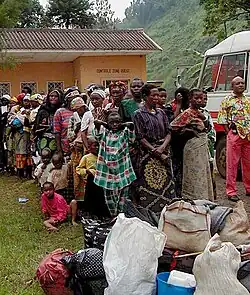 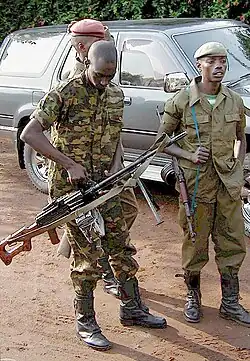 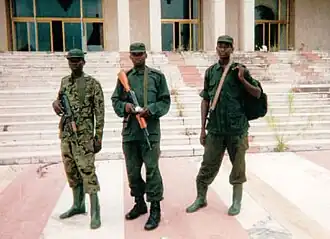 Refugees waiting to cross the Congo to Rwanda (2001) (top left) Congolese rebels (top right) Rebel soldiers in the northern town of Gobadolai (bottom) | |||||||
| |||||||
| Belligerents | |||||||
 Democratic Republic of the Congo  Namibia  Zimbabwe  Angola  Chad  Sudan (alleged) Militias:  Lord's Resistance Army  Allied Democratic Forces  Democratic Forces for the Liberation of Rwanda |
 UNITA  Uganda  Rwanda  Burundi | ||||||
| Commanders and leaders | |||||||
|
Laurent-Désiré Kabila Joseph Kabila Sam Nujoma Robert Mugabe Emmerson Mnangagwa Constantino Chiwenga José Eduardo dos Santos Idriss Déby |
Jean-Pierre Bemba (MLC) Laurent Nkunda (Tutsi rebel) Jonas Savimbi Paul Kagame Yoweri Museveni Pierre Buyoya | ||||||
| Strength | |||||||
|
Mai-Mai: 20,000-30,000 militia members participating in the joint offensive |
: More than 8,000 people[1] | ||||||
| Casualties and losses | |||||||
The Second Congo War was a civil war in the Democratic Republic of the Congo, the deadliest conflict since World War II.
In the civil war, more than four million people died due to massacres, gang rapes, torture, diseasesand over 25 million people became refugees.
The civil war in the DR Congo started like a power struggle between the regime of Mobutu Sese Seko, a dictatorship that led for 32 years since 1965, and Laurent-Désiré Kabila's rebel forces (First Congo War). After victory in May 1997, Kabila changed the country's name from Zaire back to the Democratic Republic of the Congo, which was the name before 1970, and inaugurated as president. The civil war officially broke out in 1998 when anti-Kabila forces tried to overthrow his regime. Eight African nations had fought in the DR Congo's territory for five years, Zimbabwe, Angola, Namibia, Sudan and Zambia sided with Kabila's government while Rwanda, Uganda and Burundi sided with the rebel forces. Because of this, the civil war is occassionally called as "Africa's version of World War I", "Great War of Africa" or the "African World War". The conflict, which was entangled with power struggles between ethnic groups, foreign powers' interests over resources such as gold and diamonds and the intervention of foreign companies were officially ended in 2003 through the United Nations' mediation.
References
- ↑ "Africa's great war". The Economist. 2002-07-04. ISSN 0013-0613. Archived from the original on 2022-07-07. Retrieved 2021-09-14.
- ↑ Coghlan B; Brennan RJ; Ngoy P; et al. (January 2006). "Mortality in the Democratic Republic of Congo: a nationwide survey" (PDF). Lancet. 367 (9504): 44–51. doi:10.1016/S0140-6736(06)67923-3. PMID 16399152. S2CID 2400082. Archived from the original (PDF) on 2012-04-26. Retrieved 2023-04-14.
- ↑ [Staff] (20100120) "DR Congo war deaths 'exaggerated'" Archived 2010-01-21 at the Wayback Machine BBC News
- ↑ International Rescue Committee Congo Crisis International Rescue Committee
- ↑ Les Roberts & others (2001) Mortality in eastern Democratic Republic of Congo: Results from Eleven Mortality Surveys (PDF)