Satoru Iwata
Satoru Iwata | |
|---|---|
岩田 聡 | |
 Iwata at Game Developers Conference in 2011 | |
| 4th President and CEO of Nintendo | |
| In office May 24, 2002 – July 11, 2015 | |
| Preceded by | Hiroshi Yamauchi |
| Succeeded by | Tatsumi Kimishima |
| Personal details | |
| Born | December 6, 1959 Sapporo, Japan |
| Died | July 11, 2015 (aged 55) Kyoto University Hospital, Kyoto, Japan |
| Cause of death | Complications from bile duct growth |
| Nationality | Japanese |
| Spouse(s) | Kayoko Iwata (m. ?–2015; his death)[1] |
| Alma mater | Tokyo Institute of Technology |
| Signature |  |
- In this Japanese name, the family name is Iwata.
Satoru Iwata (Japanese: 岩田 聡, Hepburn: Iwata Satoru; December 6, 1959 – July 11, 2015) was a Japanese businessman, video game programmer and gamer. He was the fourth president and CEO of Nintendo. He is widely regarded as someone who helped make video games liked by a wider audience by focusing on making entertaining games rather than advanced hardware.
On July 11, 2015, Iwata died of bile duct cancer at age 55. Iwata was posthumously awarded the Lifetime Achievement Award at the 2015 Golden Joystick Awards and the 2016 DICE Awards.
Early life
Iwata was born and raised in Sapporo, Japan on December 6, 1959. His father was a municipal mayor.[2]
Iwata got his first computer, a Commodore PET, in 1978.[3] He took the machine apart, and he studied the machine because he wanted to understand it. The computer had a central processing unit (MOS 6502) similar to the one used by Nintendo for the Nintendo Entertainment System (NES). The NES was a gaming console for which he would later make games.[4][5]
Iwata was interested in video games early on. The first time Iwata used computers was in middle school with a demo computer that used telephone lines. He often went to the Sapporo subway to play a simple numeric game called Game 31 on a pay-per-hour computer until he mastered it.[6]
Iwata began attending Sapporo Minami High School in April 1975, where he learned computer programming for the first time.[7] Iwata worked as a part-time dishwasher, saving up yen and some extra money from his father to buy an HP-65, the world's first programmable calculator. Iwata used the device to make several simple number games, such as Volleyball and Missile Attack,[3][8] and played them with his friends.
After high school, Iwata was admitted to the Tokyo Institute of Technology in April 1978, where he majored in computer science.[3][8][9]
Tomohiko Uematsu, an engineering professor, said Iwata was very good at software programming. He said that Iwata could write programs faster and better than any of his other students.[10]
While attending the school, Iwata did an unpaid internship at Commodore Japan. There, he helped head engineer Yash Terakura[5] with technical and software-development work.[11] One of the main reasons Iwata took the job was to spend more time around computers and learn how they worked.[5][12] Terakura would later be a mentor to Iwata and taught him about hardware engineering.[5] Iwata and some of his friends rented an apartment in Akihabara. They formed a club where they would create and code games.[13] Classmates living in nearby apartments called Iwata's room "Game Center Iwata".[nb 1][10]
After graduating, Iwata used the money he received as a graduation present to buy a Commodore PET 2001, the world's first all-in-one computer.[7] Iwata worked on it a lot to get better at computer programming.[14] Iwata stored the games he made on cassettes and often showed them to the Seibu department store's computer department.[7] Car Race ][ was Iwata's first commercially released game.[15]
HAL Laboratory
By 1980, a group of employees at the Seibu department store invited Iwata to join their company, HAL Laboratory, Inc.,[13][16][17] which was then a very small studio renting an apartment in Akihabara.[18] Iwata, still in university, accepted a part-time programming position at HAL Laboratory, where he was also an engineer, game marketer, and designer; he also did administrative tasks such as ordering food and cleaning the apartment.[19] One of the games Iwata made was Star Battle, a clone of Galaxian released for the Commodore VIC-20 in 1981 with a hidden progamming credit featuring his name.[20]
In 1982, after graduating from the Tokyo Institute of Technology, Iwata joined HAL Laboratory full-time;[7] he was its fifth employee and only programmer.[13][16][17][21] Around the same time, Iwata's father was elected mayor of Muroran.[17] Iwata's family was not happy that he took the job, and his father did not speak to him for six months after he joined HAL.[21]
Iwata became the company's coordinator of software production in 1983. With this role, Iwata helped HAL make a relationship with Nintendo so they could make games for the Family Computer (Famicom), an 8-bit game console later released in the anglosphere as the Nintendo Entertainment System. Iwata went to Kyoto asking for permission to work on games for the system, to which Nintendo said yes.[17] His first published game for the Family Computer was Joust, a port of the 1982 arcade game.[5] Other video games Iwata worked on around the time were Balloon Fight and Pinball.[4][22][23] Iwata programmed the "Balloon Trip" mode of Balloon Fight, which producer Gunpei Yokoi requested late in development, in just three days.[24]
After other developers declined to create NES Open Tournament Golf, believing the required data could not fit on a Famicom cartridge, Iwata decided to take on the project. Game development was exceptionally difficult, which led Iwata to create a custom data compression method to fit all 18 golf courses into the game. Similarly, Iwata and HAL had to implement a custom parallax scrolling technique for F-1 Race because the Famicom did not natively support the effect.[25]
Famicom Grand Prix II: 3D Hot Rally was the first game that Iwata and Shigeru Miyamoto worked on together. Miyamoto changed some things with the game, most notably adding Mario as a playable character.[26]
Because Iwata was good at his job, programmers and gamers started to respect him. Nintendo's then-president Hiroshi Yamauchi even invested in HAL Laboratory, turning it a second-party game developer for the company. Because of his commitment, Iwata often continued to work on weekends and holidays.[27]
At one point, HAL was about to be bankrupt, so Iwata was promoted to president of the company in 1993 at the request of Yamauchi.[13] With Nintendo's help, Iwata helped turn the company around from its ¥1.5 billion debt and manage its finances.[2][4][16][28] It took about six years to pay off the debt, with an annual repayment of roughly 250,000 yen.[29] Iwata had little experience with management, so he often read books about it and asked others for advice.[30]
Iwata rescued the role-playing game EarthBound from development hell after creator Shigesato Itoi and his team at Ape, Inc. had struggled with the project for four years. Upon reviewing the code, Iwata told the team that finishing the current version would take another two years, but if they were to start over from scratch, he could complete it in six months.[31] Iwata was nicknamed "superman" by Itoi for his efforts.[32]
Satoru Iwata played a vital role in bringing the Pokémon video game series (titled Pocket Monsters in Japan) to stores. During the development of Pokémon Red and Green, Iwata assisted Tsunekazu Ishihara in founding Creatures Inc., a company spun off from Ape Inc. made to help Game Freak finish the games. While he served as the president of HAL Laboratory, Iwata analyzed the source code of Red and Green, planning to localize the games in the Western world, where they were released as Pokémon Red and Blue,[33] two years after Pokémon began in Japan.
Iwata helped program Pokémon Stadium for the Nintendo 64, for which he ported the battle system of Pokémon Red and Green in just one week, a feat that surprised Game Freak developer Shigeki Morimoto.[13][34] Iwata also helped with developing Pokémon Gold and Silver by creating compression tools used for graphics in the games.[34]
Iwata helped Masahiro Sakurai develop Super Smash Bros. for the Nintendo 64.[13]
Nintendo
Early years (2000–02)
In 2000, Iwata became the head of Nintendo's corporate planning division. He was also put on the board of directors.[3] Over the next two years, he wanted to make game development cheaper and shorter while making sure they were still good.[35] During his first two years at Nintendo, the company saw profit increase 20 and 41 percent. Iwata's work helped do this.[21] When Yamauchi retired on May 24, 2002 from being the president of the company,[36][37] a position that he had since 1949, Iwata became Nintendo's fourth president.[38] He was the first Nintendo president that was not in the Yamauchi family through blood or marriage.[39] Yamauchi asked Iwata for one things: "that Nintendo have new ideas and create hardware that shows that ideal. And make software that has the same standard."[13] Nintendo was a company that wanted individualism, with a policy created by Yamauchi to create new development positions when needed. However, this did not make it easy for departments to work together.[40]
When Iwata was promoted, Nintendo was still a profitable company. However, they were not doing as well as other console makers. The GameCube was selling poorly compared to competitors, with Sony's PlayStation 2 and Microsoft's Xbox outselling it.[2] His presidency also happened when online gaming became popular. Nintendo had not started doing online gaming. He was careful about doing it, saying: "We're not against the idea of going online. We're just practical."[41] He also created a relationship between Nintendo and Capcom that helped the GameCube.[13] During an interview in 2002, Iwata said that he felt the gaming industry was becoming too exclusive. He wanted to make hardware and games that all people would want to play rather than focusing on good graphics.[41]
One of Iwata's first acts as president was to meet with the company's 40 department heads and 150 other employees. This was very different from the previous president, Yamauchi, who rarely met with employees and usually gave only one speech per year. Iwata knew that being president did not mean everyone would automatically agree with him. He decided to talk to employees on a personal level. If an employee disagreed with his view, Iwata would often suggest they follow their own idea. He believed that "creators only improve themselves if they take risks."[42]
Iwata also brought more data and science into the business. While Yamauchi made decisions using his own feelings and experience, Iwata used data to convince people.[43] Additionally, Iwata promoted Shigeru Miyamoto, Genyo Takeda, Yoshihiro Mori, and Shinji Hatano to the company's board of directors. Their new positions gave them the same amount of power as Iwata himself.[44][45]
Revitalization of the company (2003–09)
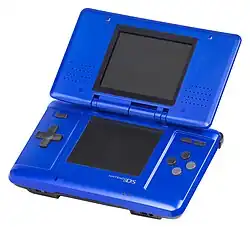
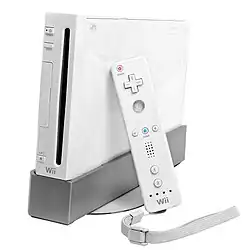
Following up on his 2002 interview,[41] Iwata said there was a problem in the gaming market in his keynote speech at the 2003 Tokyo Game Show. During this speech, he thought about the history of the industry and that there was less interest in video games.[46] Starting at the end of the 1990s, were fewer sales in the Japanese market. This continued into the early 2000s. Competition between Nintendo and Sony meant consoles were more focused on powerful hardware. However, the Nintendo 64 was too difficult for developers to make games. Because of this, software was not as good.[47] Iwata asked for an analysis to be done. Nintendo decided that focusing on hardware was not the best way to promote video games. They decided to focus on software.[46] In 2004, there was a big change within Nintendo. Iwata merged various departments created under Yamauchi. He wanted to have collaborative work throughout the company.[40] He later created a "User Expansion Project" in 2005. Employees normally not related to game development would give ideas for new games.[48]
In a March 2004 interview, Iwata said: "Games have come to a dead end."[49] He believed that developers spent too much time focusing only on "core gamers." He warned that the industry would not make a profit unless it made games for regular people as well. He also wanted to show that Nintendo, which was seen as a "conservative" company, could become a leader in new types of entertainment.[49] To do this, Iwata used a "blue ocean" strategy, which helped Nintendo compete against other companies in a new way; instead of trying to make the most powerful hardware, Iwata focused on making hardware and games that were interesting and fun for everyone.[1][4][9][13]
Financial downturn (2010–14)
The Nintendo 3DS and Wii U were not as successful as the DS and Wii. Nintendo's finances became worse starting in 2010.[56][59]
On April 25, 2013, Satoru Iwata succeeded Tatsumi Kimishima as the CEO of Nintendo of America to help Nintendo's global distribution strategy.[60]
Sickness and death

Public concern for Iwata's health began on June 5, 2014, when Nintendo announced that he would not be able to attend E3 2014 due to an unspecified health issue.[61] On June 24, Iwata told shareholders that he had undergone surgery the previous week. Doctors had discovered a tumor in his bile duct during a routine check-up.[62][63] The surgery was successful, and he returned to work in October after four months of recovery. Although he had lost a lot of weight, he stated that he was feeling healthier.[64] Iwata made his first public appearance in a Nintendo Direct broadcast on November 5, but he looked very thin and pale.[65] He seemed to accept these changes calmly. On June 12, 2015, Iwata even updated his Mii (a digital avatar used on Nintendo systems) to show his new, slimmer look.[66]
Iwata was unable to recover from his bile duct cancer in the long term. He died from the disease on July 11, 2015 in Kyoto University Hospital, at the age of 55.[67][68]
Buddhist funeral services for Iwata were held in Kyoto on July 16 and 17. Even though there was a storm caused by Typhoon Nangka, about 4,100 people came to pay their respects. Some of the people who attended were Reggie Fils-Aimé, Shigeru Miyamoto, Genyo Takeda, and Iwata's close friend Masahiro Sakurai.[69][70][71] After the wake, Iwata's body was cremated. His ashes were buried at an unknown place within Kyoto.[72]
For about two months after Iwata's death, Shigeru Miyamoto and Genyo Takeda jointly ran Nintendo. On September 14, 2015, Tatsumi Kimishima was named the new president and Iwata's official successor.[73][74]
Legacy
Throughout his life, Iwata was known for his unconventional ideas and his impact on the gaming industry.[13][75] Many people saw him as the face of Nintendo: playful, quirky, humorous, and fun.[76] His skill in programming led many people to call him a "genius," and some compared him to a Japanese Bill Gates.[10][77] His hands-on approach to running the company earned him respect from both developers and fans.[13] His "Heart of a Gamer" speech at GDC 2005 is often remembered as showing who he truly was: a humble businessman who deeply cared about video games.[78] He and others at Nintendo, such as Miyamoto, are credited with greatly expanding the gaming market.[13][79][80] By targeting new types of players instead of directly competing with Microsoft and Sony, Iwata helped Nintendo find a new path and reach his goals.[13][75] Because of this, Iwata was often called a "gentle revolutionary."[13] The simple and fun appeal of the Nintendo DS and Wii helped bring many new people into gaming.[13] Chris Kohler of Wired magazine wrote that "thanks to Nintendo's Satoru Iwata, we're all gamers now," referring to the big rise in gaming popularity after the Nintendo DS and Wii were released.[81] However, some people criticized him for being too slow to move Nintendo into the mobile gaming market.[82] After Iwata's death, Reggie Fils-Aimé said, "... it will be years before his impact on both Nintendo and the full video game industry will be fully appreciated."[83]
In October 2015, a fan made an amiibo using Iwata's Mii avatar and sold it on eBay for US$1,900. All the money was donated to the Child's Play charity in his memory.[84][85] Iwata was also given the Lifetime Achievement Award at the 2015 Golden Joystick Awards after his death, voted unanimously, for his influence on the gaming industry.[86] He also received the Lifetime Achievement Award at the 2016 DICE Awards.[87][88] At the 2016 Game Developers Choice Awards, David Hellman, the artist behind Braid, made a short animated film to honor Iwata.[89] In July 2019, Hobonichi published a book in Japan called 岩田さん (Iwata-san), written by Yasuda Nagata. The book includes parts of many "Iwata Asks" interviews and conversations with people close to Iwata, including Shigeru Miyamoto and Shigesato Itoi. Due to public interest, the Tuttle-Mori Agency planned to release the book in other languages.[90][91] Viz Media later published the book in North America as Ask Iwata on April 13, 2021.[92]
Video game appearances
During his life, Satoru Iwata appeared in a few WarioWare games. He first made a brief cameo in WarioWare, Inc.: Mega Microgames! during Wario's stage, where his likeness is on Wario's television screen thanking the player for playing the game.[93] He had a larger role in WarioWare: Smooth Moves as "Shop Manager Iwata"; in the 9-Volt and 18-Volt stage, Iwata sells 18-Volt a Game & Watch, which he bought for 9-Volt to replace the one he broke by accident. Following Iwata's death, a few video games in the mid-2010s had tributes to him.
A tribute to Iwata, reading "This game is dedicated to our wingman who fell in battle," was placed in the credits of Star Fox Zero.[94][95] Another possible tribute appears in The Legend of Zelda: Breath of the Wild, a Nintendo Switch launch game that was still being made at the time of his death.[96] In the game, a character who looks very much like Iwata asks the player to climb Satori Mountain to find a spirit called the Lord of the Mountain, who is also known as "Satori." Because "Satori" is very close to the name "Satoru," and because the Lord of the Mountain is seen as a guiding spirit, many people think this is a tribute to Iwata.[97] Both this character and the Lord of the Mountain also appear in The Legend of Zelda: Tears of the Kingdom.[98]
In September 2017, modders found that a hidden version of the NES game Golf was built into the Nintendo Switch system. It could be accessed by moving the Joy-Con controllers in the same way Iwata moved his hands during Nintendo Direct presentations, but only when the console's date was set to July 11, the day he died.[99] This feature was later removed by Nintendo in a system update later that year.[100] In Pokémon Ultra Sun and Ultra Moon, players who visit the Game Freak building with a Pokémon from Pokémon Gold and Silver will find a character who talks about how someone helped them fit all the game data onto the Game Boy Color cartridge. This is seen as a nod to Iwata's work on Gold and Silver, where he helped include the entire world from Pokémon Red and Blue without making the new game smaller.[101]
Notes
References
- 1 2 Boxer, Steve (July 14, 2015). "Satoru Iwata obituary". The Guardian. Archived from the original on July 15, 2015. Retrieved July 14, 2015.
- 1 2 3 Martens, Todd (July 12, 2015). "Nintendo's Satoru Iwata dies at 55; under him, Wii created hordes of new gamers". Los Angeles Times. Retrieved July 12, 2015.
- 1 2 3 4 Inoue 2009, p. 57.
- 1 2 3 4 Stanton, Rich; Stuart, Keith (July 13, 2015). "Satoru Iwata changed the whole games industry and now leaves it in mourning". The Guardian. Retrieved July 26, 2015.
- 1 2 3 4 5 Andersen, John (October 9, 2015). "A former mentor recalls the early career of Satoru Iwata". Gamasutra. UBM plc. Archived from the original on October 11, 2015. Retrieved October 11, 2015.
- ↑ Kasai 1994, chpt. 4.
- 1 2 3 4 Inoue, Osamu (May 13, 2010). "Iwata and Miyamoto: Business Ascetics - An Excerpt from Nintendo Magic". GameDeveloper. Retrieved June 14, 2026.
- 1 2 Takenaka, Kiyoshi (December 9, 2008). "Satoru Iwata – the man behind Nintendo's casual gaming boom". news.com.au. News Limited. Archived from the original on October 7, 2013. Retrieved March 27, 2012.
- 1 2 Wong, Tessa; Chen, Heather (July 13, 2015). "Satoru Iwata: Nintendo's gamer CEO". BBC. Retrieved July 31, 2015.
- 1 2 3 4 "岩田聡氏を悼んで" [Mourning Mr. Satoru Iwata] (in Japanese). Tokyo Institute of Technology. August 4, 2015. Retrieved October 8, 2015.
- ↑ Bagnall 2011, chpt. 15.
- ↑ Hasegawa 2010, p. 45.
- 1 2 3 4 5 6 7 8 9 10 11 12 13 14 15 Robinson, Martin (July 13, 2015). "Satoru Iwata: a gentle revolutionary". Eurogamer. Gamer Network. Retrieved July 17, 2015.
- ↑ "In memory of Satoru Iwata, Tokyo Tech alumnus and Nintendo president". Tokyo Institute of Technology. September 8, 2015. Retrieved June 14, 2026.
- ↑ "Car Race ][ (1980)". MobyGames. Retrieved June 14, 2026.
- 1 2 3 Szczepaniak, John. "Before They Were Famous". Retro Gamer. No. 35. Imagine Publishing. p. 76.
- 1 2 3 4 Inoue 2009, p. 58.
- ↑ ollie (September 19, 2015). "The HAL Laboratory games you've probably never played". Minus World. Retrieved June 14, 2026.
- ↑ Harding, Alex (January 11, 2018). "Satoru Iwata (Part 1): Before Working at Nintendo". Switchaboo. Retrieved June 14, 2026.
- ↑ rodneylives (March 4, 2026). "8-Bit Show And Tell Revives Satoru Iwata's VIC-20 Easter Egg". Set Side B. Retrieved June 14, 2026.
- 1 2 3 Burns, James (July 16, 2004). "Profile: Satoru Iwata". IGN. Ziff Davis. p. 1. Retrieved July 19, 2015.
- ↑ Nakago, Toshihiko; Tezuka, Takashi (November 13, 2009). "New Super Mario Bros.: Volume 2" (Interview). Iwata Asks. Interviewed by Satoru Iwata. Nintendo. Retrieved November 22, 2013.
- ↑ Iwata, Satoru (October 5, 2006). "Special Edition Interview: Turning the Tables: Asking Iwata" (Interview). Iwata Asks. Interviewed by Yasuhiro Nagata. Nintendo. Retrieved November 22, 2013.
- ↑ Booth, Richard (January 22, 2026). "This Day in Gaming History: A Cult Classic Launches in Japan". GamesRelated. Retrieved June 14, 2026.
- ↑ "Satoru Iwata – 1999 Developer Interview". Used Games. 1999. Retrieved July 13, 2016.
- ↑ "3. Satoru Iwata Talks Past Projects". Nintendo.com. Retrieved June 14, 2026.
- ↑ Hasegawa 2010, pp. 45–46.
- ↑ Inoue 2009, p. 61.
- ↑ Packwood, Lewis (December 28, 2024). "Feature: The Famicom Failure That Almost Bankrupted HAL, But Shaped Nintendo's Future". Nintendo Life. Retrieved June 14, 2026.
- ↑ Nakamura, Toshi (July 22, 2015). "Smash Bros. Creator Remembers Satoru Iwata". Kotaku. Gawker Media. Retrieved July 26, 2015.
- ↑ Krabbe, Esra (July 22, 2019). "How Satoru Iwata Saved Earthbound from Development Hell". IGN. Retrieved June 14, 2026.
- ↑ Matsuoka, Tomoko (September 15, 2021). "4 Lessons from Satoru Iwata: Nintendo's CEO". MailMate. Retrieved June 14, 2026.
- ↑ Wawro, Alex (December 30, 2015). "Pokemon chief: Iwata was the one who brought Pokemon to the West". Game Developer. Retrieved June 15, 2026.
- 1 2 Morimoto, Shigeki; Ishihara, Tsunekazu (September 4, 2009). "Pokémon HeartGold Version & SoulSilver Version: Just Being President Was A Waste!" (Interview). Iwata Asks. Interviewed by Satoru Iwata. Nintendo. Retrieved July 12, 2015.
- ↑ Burns, James (July 16, 2004). "Profile: Satoru Iwata". IGN. Ziff Davis. p. 2. Retrieved July 19, 2015.
- ↑ "Yamauchi Retires". IGN. Ziff Davis. May 24, 2002. Retrieved July 19, 2015.
- ↑ Thomas, Lucas M. (May 24, 2012). "Hiroshi Yamauchi: Nintendo's Legendary President". IGN. Ziff Davis. Retrieved July 19, 2015.
- ↑ Kageyama, Yuri (July 12, 2015). "Nintendo President Satoru Iwata Dies of Tumor". Associated Press. Archived from the original on August 1, 2015. Retrieved July 12, 2015.
- ↑ Stack, Liam (July 13, 2015). "Satoru Iwata, Nintendo Chief Executive, dies at 55". New York Times. Retrieved July 13, 2015.
- 1 2 Inoue 2009, p. 77.
- 1 2 3 Burns, James (July 16, 2004). "Profile: Satoru Iwata". IGN. Ziff Davis. p. 3. Retrieved July 19, 2015.
- ↑ Inoue 2009, pp. 83–85.
- ↑ Inoue 2009, pp. 87–88.
- ↑ 2003 Annual Report (PDF) (Report). Nintendo. 2003. p. 72. Retrieved September 14, 2015.
- 1 2 Annual Report 2014 for the fiscal year ended March 31, 2014 (PDF) (Report). Nintendo. 2014. p. 1. Retrieved September 3, 2015.
- 1 2 Inoue 2009, pp. 27–31.
- ↑ Inoue 2009, pp. 26–27.
- ↑ Inoue 2009, p. 81.
- 1 2 "Nintendo DS going wireless?". GameSpot. CBS Interactive. March 1, 2004. Archived from the original on July 27, 2015. Retrieved July 27, 2015.
- ↑ 2006 Annual Financial Report (PDF) (Report). Nintendo. 2006. p. 15. Retrieved September 3, 2015.
- ↑ 2007 Annual Financial Report: Consolidated Financial Statements (PDF) (Report). Nintendo. April 26, 2007. p. 1. Retrieved September 3, 2015.
- ↑ 2008 Annual Financial Report: Financial Section (PDF) (Report). Nintendo. 2008. p. 15. Retrieved September 3, 2015.
- ↑ 2009 Annual Financial Report: Financial Section (PDF) (Report). Nintendo. 2009. p. 17. Retrieved September 3, 2015.
- ↑ 2010 Annual Financial Report: Financial Section (PDF) (Report). Nintendo. 2010. p. 17. Retrieved September 2, 2015.
- ↑ 2011 Annual Financial Report: Financial Section (PDF) (Report). Nintendo. 2011. p. 17. Retrieved September 3, 2015.
- 1 2 Financial Results Briefing for the Nine-Month Period Ended December 2011 (PDF) (Report). Nintendo. January 27, 2012. p. 1. Retrieved September 2, 2015.
- ↑ 2013 Annual Financial Report (PDF) (Report). Nintendo. 2011. p. 21. Retrieved September 3, 2015.
- ↑ Annual Report 2015 for the fiscal year ended March 31, 2015 (PDF) (Report). Nintendo. 2015. p. 1. Retrieved September 2, 2015.
- ↑ Luckerson, Victor (May 7, 2015). "Why Nintendo is Suddenly Profitable Again". Time. Time Inc. Archived from the original on March 4, 2016. Retrieved July 21, 2015.
- ↑ Bishop, Todd (April 25, 2013). "Nintendo's Iwata steps in as Nintendo of America CEO". GeekWire. Retrieved June 14, 2026.
- ↑ Makuch, Eddie (June 5, 2014). "Nintendo President Not Coming to E3 on Doctor's Advice". GameSpot. CBS Interactive. Archived from the original on May 23, 2015. Retrieved June 14, 2026.
- ↑ Kreps, Daniel (July 13, 2015). "Satoru Iwata, President and CEO of Nintendo, Dead at 55". Rolling Stone. Wenner Media. Archived from the original on July 15, 2015. Retrieved July 13, 2015.
- ↑ Iwata, Satoru (June 24, 2014). To our shareholders. The 74th Annual General Meeting of Shareholders (Memo). Nintendo. Archived from the original on July 15, 2015. Retrieved July 18, 2015.
- ↑ Martin, Liam (October 29, 2014). "Nintendo President Satoru Iwata returns to work after surgery". Digital Spy. Hearst Corporation. Archived from the original on July 21, 2015. Retrieved July 18, 2015.
- ↑ Crossley, Rob (November 6, 2014). "Nintendo's Iwata Addresses Concerns Over Rapid Weight Loss". GameSpot. CBS Interactive. Archived from the original on July 6, 2015. Retrieved July 18, 2015.
- ↑ Iwata, Satoru [@Nintendo] (June 12, 2015). "[岩田]私は、昨年6月に病気で手術をした影響で少しスリムになりました.退院後、体重はほとんど変わっておらず、この体型が維持できそうですので、公式Miiを現状に合わせることにしました.よろしくお願いします.#Iwatter" (Tweet) (in Japanese). Retrieved July 18, 2015 – via Twitter.
- ↑ "Notification of Death and Personnel Change of a Representative Director (President)" (PDF). Nintendo. July 12, 2015. Archived (PDF) from the original on July 13, 2015. Retrieved July 13, 2015.
- ↑ Kageyama, Yuri (July 13, 2015). "Nintendo's Iwata who led through successes, woes dies at 55". AP News. Retrieved June 14, 2026.
- ↑ Mochizuki, Takashi (July 17, 2015). "Fans remember Nintendo President Iwata at funeral". Wall Street Journal. Dow Jones & Company. Archived from the original on July 24, 2015. Retrieved July 17, 2015.
- ↑ Schreier, Jason (July 17, 2015). "Thousands Attend Two-Day Funeral for Satoru Iwata". Kotaku. Gawker Media. Archived from the original on October 2, 2017. Retrieved July 17, 2015.
- ↑ Crecente, Brian (July 17, 2015). "Thousands attend Iwata's funeral in Kyoto". Polygon. Vox Media. Archived from the original on July 19, 2015. Retrieved July 17, 2015.
- ↑ Nakamura, Toshi (July 30, 2015). "Smash Bros. Creator Talks of Satoru Iwata's Funeral". Kotaku. Gawker Media. Archived from the original on July 31, 2015. Retrieved July 31, 2015.
- ↑ "Nintendo's New Leadership Pledges To Stick To Iwata's Plans". Scripps News. September 14, 2015. Retrieved June 14, 2026.
- ↑ "Notice Regarding Personnel Change of a Representative Director and Role Changes of Directors" (PDF). Nintendo.com. September 14, 2015.
- 1 2 Hiranand, Ravi (July 13, 2015). "Nintendo's CEO Satoru Iwata played by his own rules". CNN. Turner Broadcasting System. Archived from the original on February 15, 2016. Retrieved September 2, 2015.
- ↑ Rundle, Michael (July 13, 2015). "Nintendo President Satoru Iwata dies at 55". Wired. Condé Nast. Archived from the original on September 12, 2015. Retrieved September 2, 2015.
- ↑ Tane, Kiyoshi (August 8, 2015). 追悼・岩田聡氏.ゲームで辿る天才プログラマの軌跡 (1. 初期ファミコン編). Engadget Japan (in Japanese). AOL. Archived from the original on October 9, 2015. Retrieved October 8, 2015.
- ↑ Inoue 2009, p. 56.
- ↑ Jones & Thiruvathukal 2012, p. 53.
- ↑ Hasegawa 2010, p. 51.
- ↑ Kohler, Chris (July 16, 2015). "Thanks to Nintendo's Satoru Iwata, We're All Gamers Now". Wired. Condé Nast. Archived from the original on July 30, 2015. Retrieved July 31, 2015.
- ↑ Ozawa, Harumi (July 13, 2015). "Nintendo CEO Satoru Iwata dies of cancer at 55". Yahoo! Tech. Yahoo!. Agence France-Presse. Archived from the original on September 23, 2015. Retrieved September 2, 2015.
- ↑ Molina, Bret (July 13, 2015). "Nintendo CEO Satoru Iwata dies at 55". USA Today. Gannett Company. Archived from the original on September 1, 2015. Retrieved September 2, 2015.
- ↑ Hussein, Tamoor (October 5, 2015). "One-of-a-Kind Satoru Iwata Memorial Amiibo on Sale to Raise Money for Charity". GameSpot. CBS Interactive. Archived from the original on October 7, 2015. Retrieved October 8, 2015.
- ↑ Skipper, Ben (October 9, 2015). "Nintendo: Satoru Iwata Amiibo figure raises $1,900 for charity on eBay". International Business Times. IBT Media. Archived from the original on October 11, 2015. Retrieved October 9, 2015.
- ↑ Sheridan, Connor (October 30, 2015). "Satoru Iwata receives the Lifetime Achievement Award at the Golden Joysticks". GamesRadar. Future plc. Archived from the original on October 31, 2015. Retrieved October 30, 2015.
- ↑ Philips, Tom (January 13, 2016). "Satoru Iwata to be honoured with posthumous DICE Lifetime Achievement Award". Eurogamer. Archived from the original on January 15, 2016. Retrieved January 13, 2016.
- ↑ Campbell, Colin (February 18, 2016). "DICE honors Satoru Iwata with Lifetime Achievement Award". Polygon. Vox Media. Archived from the original on February 19, 2016. Retrieved February 19, 2016.
- ↑ McCormick, Rich (March 17, 2016). "Watch a touching tribute to deceased Nintendo CEO Satoru Iwata". The Verge. Archived from the original on March 17, 2016. Retrieved March 17, 2016.
- ↑ Ashcraft, Brian (August 2, 2019). "Publisher Of Satoru Iwata Book Says Unauthorized Translations Will Be Subject To Criminal Charges". Kotaku. Gawker Media. Archived from the original on August 3, 2019. Retrieved August 6, 2019.
- ↑ Baird, Scott (August 3, 2019). "Publisher Of The Iwata Book Issues Warning To Fan Translators, Says English Version In The Works". The Gamer. Archived from the original on August 6, 2019. Retrieved August 6, 2019.
- ↑ Petite, Steven (April 13, 2021). "Ask Iwata, New Book Compiling Satoru Iwata Interviews, Is Available Now". GameSpot. Archived from the original on January 1, 2022. Retrieved January 1, 2022.
- ↑ Iggy (September 3, 2018). "Satoru Iwata Appeared In A WarioWare Game". Nintendo Soup. Retrieved June 14, 2026.
- ↑ Rowen, Nic (April 11, 2016). "A touching Iwata tribute is in Star Fox Zero". Destructoid. Archived from the original on April 12, 2016. Retrieved April 11, 2016.
- ↑ Sheridan, Connor (April 11, 2016). "Watch Star Fox Zero's lovely tribute to Satoru Iwata". GamesRadar. Future plc. Archived from the original on April 13, 2016. Retrieved April 11, 2016.
- ↑ Kuchera, Ben (March 15, 2017). "Zelda: Breath of the Wild's alleged Iwata tribute is beautiful". Polygon. Vox Media. Archived from the original on March 17, 2017. Retrieved March 18, 2017.
- ↑ Dayus, Oscar (March 13, 2017). "Zelda: Breath Of The Wild Easter Egg May Pay Tribute To Late Nintendo President Satoru Iwata". GameSpot. CBS. Archived from the original on March 19, 2017. Retrieved March 18, 2017.
- ↑ Valentine, Rebekah (May 17, 2023). "Tears of the Kingdom Carries on a Breath of the Wild Tribute to Satoru Iwata". IGN. Ziff Davis. Archived from the original on May 16, 2023. Retrieved August 20, 2024.
- ↑ Saed, Sherif (September 20, 2017). "The Golf game on every Nintendo Switch is actually a tribute to late Satoru Iwata". VG247. Archived from the original on September 21, 2017. Retrieved September 20, 2017.
- ↑ Frank, Allegra (December 27, 2017). "Switch's hidden Iwata tribute removed in latest update". Polygon. Archived from the original on December 28, 2017. Retrieved December 27, 2017.
- ↑ Moyse, Chris (November 23, 2017). "Pokemon Ultra Sun & Moon features a nice salute to Satoru Iwata". Destructoid. Archived from the original on September 11, 2018. Retrieved November 23, 2017.
Other websites
- Satoru Iwata Archived 2017-11-08 at the Wayback Machine at Nintendo Miiverse
- Seattle Post Intelligence: Satoru Iwata Interview Archived 2008-12-15 at the Wayback Machine
- Satoru Iwata Kikizo Video Interview
- Gamespy: Nintendo's New Direction - A discussion with Nintendo President Satoru Iwata
- Heart of a Gamer speech at GDC '05 Archived 2008-07-24 at the Wayback Machine
- A+E Interactive E3 2007 Interview
- Level Up E3 2007 Interview