Sambhaji I
| Sambhaji | |
|---|---|
| Dharmaveer Maharajadhiraj Swarajya Rakshak Hindu king of India | |
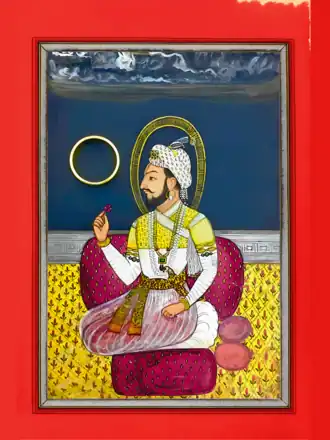 Sambhaji of Maratha Empire | |
| 2nd Chhatrapati of the Maratha Empire | |
| Reign | 1680-1689 |
| Coronation | 20 July 1680, Panhala (symbolic) or 16 January 1681, Raigad fort (official) |
| Predecessor | Shivaji |
| Successor | Rajaram I |
| Born | 14 May 1657 Purandar Pune Maharashtra |
| Died | 11 March 1689 (aged 31) Tulapur (present day Maharashtra, India) |
| Spouse | Yesubai |
| Issue | Shahu (Shivaji II) Bhavani Bai |
| House | House of Bhonsale |
| Father | Shivaji |
| Mother | Sai bai |
| Religion | Hinduism |
Sambhaji Bhonsle was the eldest son of Shivaji from his first wife Saibai. He was born in 1657 at Purandar and became the second Chhatrapati of Maratha Empire after the death of Shivaji. He was executed after being tortured by Aurangzeb in 1689 at Tulapur.[1][2]
Millitary Career
Sack of Bhuranpur
In 1681 Sambhaji sacked the city of Bhuranpur of Mughal Empire and looted it completely routing the enemies.[1][3]
Siege of Ramsej (1682)
Mughals laid siege to Fort of Ramsej, and the killedar put up a considerable defence while Sambhaji provided the necessary supplies. At last the Mughals captured the Fort through negotiation with the new killedar and was captured after a Siege of 6-7 years.[1][3]
Siege of Janjira(1681-82)
Sambhaji laid siege to Fort of Janjiram. Though initially successful he have to leave the siege in between to go fight with Mughals. He gave the command to dadaji Raghunath but he failed miserably.[1][2]
Battle of Kalyan Bhiwandi
In 1682 Mughals captured the Fort of Kalyan. Tukoji tired to repel him but failed and was killed. Sambhaji along with Hammbirrao Mohite, Manaji Moré and Rupaji Bhosale attacked the grassion and defeated them at Kalyan Bhiwandi on 1683 with heavy casualties on both sides.[1][3]
Mughal Invasion of Konkan
Mughal, under command of Shah Alam (the son of Aurangzeb) invaded Konkan with an army of one lakh (100,000 people) but were defeated by Sambhaji with their army of 60,000. The Mughals fled for their life.[1][3]
Maratha Invasion of Goa
Sambhaji Maharaja invaded Goa of the Portuguese empire in 1683. Various skirmishes were fought, Goa was almost captured but due to Mughal threat a peace treaty was signed between the two.[1]
Maratha Mysore war
In 1682 Sambhaji invaded Mysore, and though he was initially unsuccessful[4][5] he defeated Mysore ruler Chikka Dev Raya at Trichinopoly [5]and later in 1686.[6][1]
Death
In 1689 Sambhaji was captured by Mughal Subedar Muqqrab Khan (Shaikh Nizam) with the help of traitors Kanhoji Shirke and Ganoji Shirke (close relatives of Sambhaji). He was tortured and mutilated and eventually succumbed to his injuries (died). He was captured alongside his friend Kavi Kalash, who was also tortured to death. Some historians says that Sambhaji was cut into pieces and those parts scattered into the river.[1] Several accounts give reports that communities, which include the Kunbi Marathas, the Mahar, later gathered the mutilated body parts of Sambhaji and sewed them together to perform the last rites. He was succeeded by his brother Rajaram.[7]
Family
Sambhaji was born to Shivaji and Saibai. He was married to Yesubai from whom he had a son and a daughter called Shahu and Bhawani Bai. Bhawani Bai was married to the Son of Hiraji Mahadik and had 2 sons called Durgoji and Arjoji. She committed Sati after the death of her husband in 1727. Shahu became the 5th Chhatrapati of Maratha Empire. Massir e alamgiri mentions another wife of Sambhaji who was in Mughal camp during his desertion to Mughals. Another Wife with 3 issues is mentioned, named Madansingh, Madhosingh and a daughter who was married to a muslim gond. However this claim doesn't have any historical evidence and it can be concluded that the wives mentioned could have been concubines.[1]
See also
- Dharmarakshak Mahaveer Chhatrapati Sambhaji Maharaj: Chapter 1
References
- 1 2 3 4 5 6 7 8 9 10 Joshi, Pandit Shankar (1980). Chhatrapati Sambhaji, 1657-1689 A.D. S. Chand.
- 1 2 Sardesai Govind Sakharam (1946). New History Of Marathas.
- 1 2 3 4 Gordon, Stewart (1993-09-16). The Marathas 1600-1818. Cambridge University Press. ISBN 978-0-521-26883-7.
- ↑ B. Muddachari. Mysore-Maratha Relations Under Shahji, Shivaji, Sambhaji And Rajaram (As Revealed In Kannada Sources).
- 1 2 B. Muddhachari (1965-05-04). The Mysore-Maratha Relations in the 17th Century.
- ↑ Robert Orme (1805). Historical Fragments Of The Mogul Empire.
- ↑ Pāṭīla, Śālinī (1987). Maharani Tarabai of Kolhapur, C. 1675-1761 A.D. S. Chand & Company. ISBN 978-81-219-0269-4.