Roman Catholics and antisemitism in the 21st century
Some Roman Catholics hold antisemitic beliefs, and some Catholic organizations promote antisemitism.
Background
Classical antiquity
In 380 AD the Roman Empire made Christianity its state religion.[1][2] The Catholic Church also became its state church.[1][2] These antisemitic ideas became common in many European kingdoms during the first millennium:[1][2]
- All Jews are responsible for the Crucifixion of Jesus[1][3]
- Because the Jews killed Jesus, they aren't God's chosen people any more; Catholics are[1][3]
- When the Romans destroyed Jerusalem, God was punishing Jews for murdering Jesus and rejecting Christianity[1][3]
Some European kingdoms created government policies based on these ideas, according to many historians.[1][4] These policies caused over a thousand years of persecution towards Jews, according to these historians, including:[1][4]
- The Inquisition (c. 1229 – 1834)
- Genocides, including the Holocaust
- Deportations from regions across Europe
20 years after the Holocaust ended, the Catholic Church went through a reform to address this issue,[5] though antisemitism still exists among some Catholic communities.[5]
20th century
Second Vatican Council (Vatican II)
In 1965, Pope Paul VI wrote a document called the Nostra aetate. It rejected the Church's old antisemitic ideas. For example, it said that Jews were not to blame for Jesus' death:[3]
What happened in His passion cannot be charged against all the Jews, without distinction, then alive, nor against the Jews of today.
The Pope also said that Catholics should respect Jews,[6] and the Church should reconcile with them.[6] Vatican II caused division within the Roman Catholic Church.[7][8] Some conservative Catholics believed the Church's traditional ways should not be changed. Radical traditionalist Catholics were formed to oppose the Vatican II reforms.[7][8] Most of these groups are still active in the 21st century.[7][8]
2000 apology
On March 23, 2000, Pope John Paul II visited Yad Vashem, Israel's main Holocaust memorial. He said there were "no words strong enough to deplore the terrible tragedy" of the Holocaust, and that the Catholic Church was "deeply saddened by the hatred, acts of persecution and displays of anti-Semitism directed against the Jews by Christians at any time and in any place."[9]
Radical traditionalist Catholics
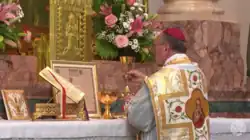
The American civil rights group Southern Poverty Law Center identified 13 radical traditionalist Catholic organizations active in the English-speaking world: The Fidelity Press, the Remnant, St. Joseph Forum, Tradition in Action, Legion of St. Louis, St. Michael's Parish, Society of St. Pius X, Catholic Counterpoint, Catholic Family Ministries, Omni Christian Book Club, Catholic Apologetics International, International Fatima Rosary Crusade and Slaves of the Immaculate Heart of Mary.[7]
Antisemitism is a key part of these organizations' belief systems, according to the SPLC.[10]
Some radical traditionalist Catholics are considered Holocaust deniers.[7][11]
According to the SPLC, Traditional Catholics believe that:[10]
- Catholics cannot trust Jews
- Jews are the "perpetual enemy" of Christ
- Jews have "infiltrated" the Catholic Church to make changes for themselves
- Jews are responsible for Jesus' death, and this broke their covenant with God
Influential radical traditionalist Catholic groups
Society of St. Pius X
Society of St. Pius X (SSPX) is one of the largest radical traditionalist Catholic organizations in the world. French archbishop Marcel-François Lefebvre founded it in Ecône, Switzerland in 1970 to resist the liberalized Roman Catholic Church.[7][8] Lefebvre was a supporter of the Nazi puppet state Vichy France.[7] He said that the liberation of France was the "victory of Freemasonry against the Catholic order of Petain."[7]
In 1992, E. Michael Jones wrote an article in his magazine Fidelity about an SSPX leader in Kansas City. He said the leader worshiped Adolf Hitler and promoted Nazism to his students.[12]
The Vatican tried to mediate with the SSPX over their different beliefs, but the SSPX refused. The Catholic Church excommunicated them in 1988, but reversed their excommunication in 2009.[13]
The SSPX has become the biggest Catholic publisher of Holocaust-denying materials.[7][8] Some countries, including Canada, ban SSPX publications.[7][8]
Scholars estimated that in 2016, the SSPX had 103 chapels, 25 private schools, and up to 30,000 followers.[12] As of October 2024, the organization had 700 priests worldwide. Of these priests, 180 were based in France; they operated 250 places of worship and hosted at least 35,000 attendees.[14]
Richard Williamson
Richard Williamson (March 8, 1940 – January 25, 2025) is an SSPX bishop who publicly denied the Holocaust several times. He said there were no gas chambers in the Auschwitz concentration camp.[11][12] He also claimed that The Protocols of the Elders of Zion were true and insisted that fewer than 300,000 Jews had died in the Holocaust[11] in a Swedish TV interview.[15] As a result, he was fined €10,000 in Germany for Holocaust denial.[11][15]
At first, the Catholic Church excommunicated Williamson.[11] However, they later cancelled the excommunication and made Williamson a bishop again.[11] This created controversy over the influence of radical traditionalist Catholics within the Church hierarchy.[11]
Influence on U.S. politics
In 2022 – 57 years after Pope Paul VI's Nostra aetate) – 11% of American Catholics still blamed Jews for the Crucifixion of Jesus, according to a poll by the Institute for Jewish-Catholic Relations.[16] The poll also found that 13.3% of these Catholics thought Jews are "cursed by God". Additionally, 15.8% believed that God's covenant with Jews had ended.[16]
FBI memo incident
In April 2024, the FBI was forced to withdraw an internal memo on antisemitic violence committed by radical traditionalist Catholics. This happened because some conservative Republican Congress members publicly opposed the memo[17] and misrepresented the FBI's moves as "persecution of Catholics".[17]
In one case the FBI had handled, a young SSPX member was arrested for the illegal possession of 6 smoke bombs; 8 molotov cocktails; parts of a Glock 19 pistol; a lower parts kit for the pistol; a 3D-printed Glock 19 frame; a magazine; and 9mm ammunition.[17] This individual claimed to be "anti-Zionist" and "anti-progressive".[17]
Later, a 120-day congressional review found no evidence that the FBI was biased against Catholics.[18]
Expansion
A rising number of American Catholic churches have drifted towards radical traditionalist Catholicism,[19] rejecting the Vatican II that renounced antisemitism.[19] Radical traditionalist Catholic organizations, like the FOCUS and Newman Centers, have also seen a massive spike in youth membership[19] and viewership of their allied cable TV networks (like EWTN).[19]
Inquisition denial
Background
In 1229, Dominicans in Rome set up the permanent Inquisition to persecute heretics and non-Christians,[20] especially Jews. Meanwhile, the Spanish Inquisition was founded in 1478 and run until 1834, during which the Catholic Spanish Empire unleashed a systematic campaign of persecution of Jews,[4][21] due to its racist belief that Jews who converted to Catholicism (conversos) were mostly faking as Christians,[4][21] including those forcibly converted following the Alhambra Decree, or the Edict of Expulsion.[4][21] As many as 300,000 Jews under Catholic Spanish rule were given false charges of "crypto-Judaism,"[4][21] a charge slapped on Jews who were forcibly converted.[4][21]
The Vatican
In 2004, the Roman Catholic Church claimed that the judges of the Inquisition were "not as brutal as previously believed" and that most trials "were not carried out by Catholic courts".[22] They also added that the victims on trial were often "tortured for only 15 minutes in the presence of doctors".[22]
Responses
United States Conference of Catholic Bishops (USCCB)
On December 11, 2024, the United States Conference of Catholic Bishop (USCCB) announced the adoption of the Translate Hate: The Catholic Edition[23] drafted together with the American Jewish Committee (AJC) in response to worsening antisemitism in America since 7 October 2023.[24]
As of December 30, 2024, the 1985 revision of the USCCB Guidelines for Catholic-Jewish Relations is still in place.[25] The General Principles of the Guidelines include but not limited to[25]
- Prayer in common with Jews should be encouraged when mutually acceptable
- Proselytism, which does not respect human freedom, is carefully to be avoided
- Catholic–Jewish meetings are dedicated to fostering mutual respect and eliminating misunderstandings
- A commission or secretariat is recommended to be assigned to Catholic–Jewish relations in each diocese
Meanwhile, the Recommended Programs under the Guidelines encourage the[25]
- Advancement of Catholic–Jewish relations on all levels
- Removal of content from catechesis and homilies that blames all Jews for the Crucifixion of Jesus
- Rejection of the historically inaccurate notion that Judaism was a "decadent formalism and hypocrisy"
- Further analysis of such phrases as "the Jews" by St. John in modern context to erase negative undertones about Jews
See also
References
- 1 2 3 4 5 6 7 8
- "Antisemitism in History: From the Early Church to 1400". Holocaust Encyclopedia. Retrieved December 28, 2024.
- "Christian Persecution of Jews over the Centuries". United States Holocaust Memorial Museum (USHMM). Retrieved December 28, 2024.
- "The Early Church and the Beginnings of Anti-Semitism". Jewish Virtual Library (JVL). Retrieved December 29, 2024.
- 1 2 3
- "Matthew 27:24". Bible Hub. Retrieved December 23, 2024.
The Christian Bible
- James Parkes, Prelude to Dialogue (London: 1969) p. 153; cited in Wilken, p. xv.
- Ritter, Adolf M. (1998). "John Chrysostom and the Jews — A Reconsideration". In Mgaloblishvili, Tamila (ed.). Ancient Christianity in the Caucasus. Routledge. doi:10.4324/9781315026954-11. ISBN 9781315026954.
- Levine, Amy-Jill; Brettler, Marc Zvi, eds. (2011). The Jewish Annotated New Testament. Oxford University Press.
- "Matthew 27:24". Bible Hub. Retrieved December 23, 2024.
- 1 2 3 4
- Ritter, Adolf M. (1998). "John Chrysostom and the Jews — A Reconsideration". In Mgaloblishvili, Tamila (ed.). Ancient Christianity in the Caucasus. Routledge. doi:10.4324/9781315026954-11. ISBN 9781315026954.
- Brustein, Willian I. (2003). Roots of Hate: Anti-Semitism in Europe before the Holocaust. Cambridge University Press. p. 52. ISBN 0-521-77308-3.
- Levine, Amy-Jill; Brettler, Marc Zvi, eds. (2011). The Jewish Annotated New Testament. Oxford University Press.
- 1 2 3 4 5 6 7
- Jacobs, Janet Liebman (2002). "Introduction: Crypto-Jewish Descent: An Ethnographic Study in Historical Perspective". Hidden Heritage: The Legacy of the Crypto-Jews (1 ed.). University of California Press. pp. 1–20. doi:10.1525/california/9780520233461.003.0001. ISBN 978-0-520-23346-1. Retrieved December 6, 2024.
- Egmond, Florike; Zwijnenberg, Robert (2003). "Physicians' and Inquisitors' Stories? Circumcision and Crypto-Judaism in Sixteenth–Eighteenth-Century Spain". Bodily Extremities (1 ed.). Routledge. doi:10.4324/9781315261447-14. ISBN 9781315261447. Retrieved December 6, 2024.
- Ward, Seth (2004). "Crypto-Judaism and the Spanish Inquisition (review)". Shofar: An Interdisciplinary Journal of Jewish Studies. 22 (4). University of Nebraska Press: 167–169. doi:10.1353/sho.2004.0117. Retrieved December 6, 2024.
- Bodian, Miriam (2007). Dying in the Law of Moses: Crypto-Jewish Martyrdom in the Iberian World. Indiana University Press. ISBN 9780253348616. Retrieved December 6, 2024.
- Kamen, Henry (May 27, 2014). The Spanish Inquisition: A Historical Revision. Yale University Press. ISBN 9780300180510. Retrieved December 6, 2024.
- 1 2 Tausch, Arno; Obirek, Stanislaw (2020). Global Catholicism, Tolerance and the Open Society: An Empirical Study of the Value Systems of Roman Catholics. doi:10.1007/978-3-030-23239-9. ISBN 978-3-030-23241-2. Retrieved December 29, 2024.
- 1 2 Fumagalli, Pier Francesco. "The Roots of Anti-Judaism in the Christian Environment". The Vatican. Retrieved December 12, 2018.
Finally, two points are repudiated which in the past were the roots of persecution: the accusation that the Jewish people were collectively and forever responsible for the death of Christ (the so-called deicide) and anti-Semitism.
- 1 2 3 4 5 6 7 8 9 10
- "12 Anti-Semitic Radical Traditionalist Catholic Groups". Southern Poverty Law Center (SPLC). January 16, 2007. Retrieved December 29, 2024.
- Ehret, Ulrike (2011). "4: The Catholic right, political Catholicism and radicalism". Church, Nation and Race: Catholics and Antisemitism in Germany and England, 1918-45. doi:10.7228/manchester/9780719079436.003.0004. Retrieved December 30, 2024.
- "Radical Traditional Catholicism". Southern Poverty Law Center (SPLC). 2016. Retrieved December 29, 2024.
For "radical traditionalist" Catholics, antisemitism is an inextricable part of their theology. They subscribe to an ideology that is rejected by the Vatican and some 70 million mainstream American Catholics.
- "Traditionalist Catholicism". Anti-Defamation League (ADL). Retrieved December 29, 2024.
Traditionalist Catholics [...] continued to incorporate explicit antisemitism into their theology [...] a paranoid belief in Jewish conspiracies to undermine the church and Western civilization [...] preach that contemporary Jews are responsible for deicide, endorsed The Protocols of the Elders of Zion, and claimed that there was a factual basis for the medieval blood libel. One of its bishops, Richard Williamson, is a well known Holocaust denier.
- 1 2 3 4 5 6
- Weitzman, Mark. "Jews and Judaism in the Political Theology of Radical Catholic Traditionalists" (PDF). Vidal Sassoon International Center for the Study of Antisemitism (SICSA).
- Joyce, Kathryn (October 30, 2020). "How QAnon and Trumpism Have Revealed a Deep Church Schism Among Catholics". Vanity Fair. Retrieved December 29, 2024.
- Strong, Franklin (July 29, 2019). "The Webs Connecting 'Traditionalist' Catholics and White Nationalists". Sojourners. Retrieved December 29, 2024.
- Sales, Ben (July 19, 2021). "Pope Francis restricts Latin Mass that calls for the conversion of the Jews". The Times of Israel. Retrieved December 29, 2024.
- ↑ "Address of Pope John Paul II at Yad Vashem". Yad Vashem. March 23, 2000. Retrieved April 8, 2026.
- 1 2 "Radical Traditional Catholicism". Southern Poverty Law Center. Retrieved 2025-03-21.
- 1 2 3 4 5 6 7
- "Pope to cancel excommunication of rebel bishops | The Pope is expected to cancel the excommunication of four breakaway bishops including a Briton who has said the Nazis did not use gas chambers". The Telegraph. London, United Kingdom. January 22, 2009. Archived from the original on 20 November 2018. Retrieved 9 February 2019.
- "Catholic Bishop Williamson Unrepentant in Holocaust Denial". ABC News. February 1, 2020. Retrieved October 23, 2024.
- "Seminary sacks 'Holocaust bishop' | An ultra-traditionalist British bishop who denies the Holocaust has been removed from his post as the head of a Roman Catholic seminary in Argentina". BBC News. February 9, 2009. Archived from the original on 3 October 2018. Retrieved 9 February 2019.
- Willan, Philip (January 25, 2009). "Pope readmits Holocaust-denying priest to the church | Vatican lifts excommunication on renegade British bishop who declared: 'There were no gas chambers'". The Independent. London, United Kingdom. Archived from the original on 24 November 2018. Retrieved February 9, 2019.
- "Bishop Richard Williamson". Anti-Defamation League (ADL). Retrieved December 5, 2024.
- 1 2 3 "Radical Powerhouse". Southern Poverty Law Center (SPLC). 2015. Retrieved December 29, 2024.
The Society of St. Pius X, which has chapels and schools across the United States, remains a font of anti-Semitic propaganda.
- ↑ "Decree remitting the excommunication "latae sententiae" of the Bishops of the Society of St Pius X". www.vatican.va. Retrieved 2025-03-21.
- ↑ Lasserre, Matthieu (October 10, 2024). "36 years after the schism, what does the Society of Saint Pius X represent?". La Croix International. Archived from the original on December 29, 2024. Retrieved December 29, 2024.
- 1 2 Meikle, James (April 16, 2010). "German court fines British bishop for Holocaust denial". The Guardian. Retrieved December 29, 2024.
- 1 2 Gfeller, Kevin (April 20, 2023). "First-of-its-kind Survey Reveals American Catholics' Attitudes Toward Jews Have Improved in Last Century". Saint Joseph's University. Retrieved December 30, 2024.
- 1 2 3 4 Pattison, Mark (April 24, 2024). "FBI memo examined activities of far-right radical Catholics ahead of 2024 election". La Croix International.
- ↑ "No Bias Found in F.B.I. Report on Catholic Extremists". The New York Times. April 18, 2024. Retrieved December 29, 2024.
- 1 2 3 4 Sullivan, Tim (May 1, 2024). "'A step back in time': America's Catholic Church sees an immense shift toward the old ways". Associated Press (AP). Retrieved December 29, 2024.
- ↑ Lea, Henry Charles (1888). "VII". A History of the Inquisition of the Middle Ages: Volume 1. ISBN 1-152-29621-3. Retrieved December 29, 2024.
{{cite book}}: ISBN / Date incompatibility (help) - 1 2 3 4 5
- O’Connor, Thomas (2016). Irish Voices from the Spanish Inquisition: Migrants, Converts and Brokers in Early Modern Iberia. doi:10.1057/9781137465900. ISBN 978-1-349-69094-7. Retrieved December 6, 2024.
- "Role of Irish people in the Spanish Inquisition explored". Maynooth University Department of History. May 6, 2016. Retrieved December 6, 2024.
- "The Irish-Spanish Inquisition Alliance". Denis Casey. Retrieved December 6, 2024.
- 1 2
- Murphy, Verity (June 15, 2004). "Vatican 'dispels Inquisition myths'". BBC News. Retrieved December 24, 2024.
- Arie, Sophie (June 16, 2004). "Historians say Inquisition wasn't that bad". The Guardian. Retrieved December 24, 2024.
- Aderet, Ofer (May 6, 2018). "'We Weren't the Only Ones Deporting Jews': In Spain, the Inquisition Is Getting a Facelift". Haaretz. Retrieved December 24, 2024.
- ↑ "Translate Hate: The Catholic Edition" (PDF). American Jewish Committee (AJC). Retrieved December 30, 2024.
- ↑ "New Glossary Breaks Ground in Tackling Antisemitism Through a Catholic Lens". United States Conference of Catholic Bishops (USCCB). December 11, 2024. Retrieved December 30, 2024.
- 1 2 3 "Guidelines for Catholic-Jewish Relations". United States Conference of Catholic Bishops (USCCB). Retrieved December 30, 2024.