Robert Moses
Robert Moses | |
|---|---|
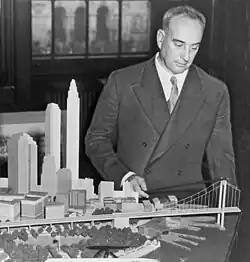 Moses in 1939 with a model of his proposed Battery Bridge | |
| 49th Secretary of State of New York | |
| In office January 17, 1927 – January 1, 1929 | |
| Governor | Al Smith |
| Preceded by | Florence E. S. Knapp |
| Succeeded by | Edward J. Flynn |
| 1st Chairman of the New York State Council of Parks | |
| In office 1924–1963 | |
| Preceded by | Position established |
| Succeeded by | Laurance Rockefeller |
| 1st Commissioner of the New York City Department of Parks and Recreation | |
| In office January 18, 1934 – May 23, 1960 | |
| Appointed by |
|
| Preceded by | Position established |
| Succeeded by | Newbold Morris |
| Personal details | |
| Born | December 18, 1888 New Haven, Connecticut, U.S. |
| Died | July 29, 1981 (aged 92) West Islip, New York, U.S. |
| Resting place | Woodlawn Cemetery, Bronx, New York City, U.S. |
| Political party | Republican[1] |
| Spouse(s) |
|
| Children | 2 |
| Education | |
Robert Moses (December 18, 1888 – July 29, 1981) was very powerful American official American near New York. He built many bridges, dams, highways, and parks. He did this through holding many titles at the same time, like Park Commissioner. He was very good at writing laws and started many public authorities. With these, he was able to build many projects without permission from the mayor or the public.
In the 1960s, many people started to dislike his work. They said he focused too much on cars and not enough on public transportation, like subways or buses. They said that his projects hurt poor people and were based on racism or classism.
References
- ↑ Robert Caro, The Power Broker, 1975.