Robert Knox
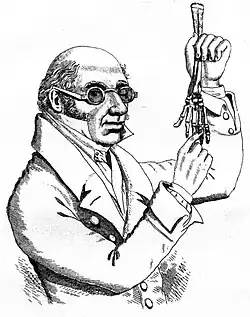
Robert Knox (4 September 1791 – 20 December 1862) was a Scottish anatomist, zoologist, ethnologist and doctor. He is best known for the Burke and Hare murders. Some of his work had controversy because he tried to prove that Anglo-Saxons were superior to other people.
Life
Robert Knox was born in Edinburgh's North Richmond Street to Mary and Robert Knox. His father was a teacher of mathematics and philosophy. He had smallpox as an infant, which blinded his left eye and changed his face.[1] He was educated at the Royal High School,[2] where he bullied his friends.[3]
In 1810, he joined medical classes in Edinburgh. He became interested in transcendentalism.[4]
Knox graduated from Edinburgh University in 1814.[5]
Knox married his wife Susan in 1824.[6]
References
- ↑ Bates, A.W. (2010). The Anatomy of Robert Knox: Murder, Mad Science and Medical Regulation in Nineteenth-Century Edinburgh. Eastbourne: Sussex Academic Press. p. 16. ISBN 978-1-84519-381-2.
- ↑ Waterston, Charles D; Macmillan Shearer, A (July 2006). Former Fellows of the Royal Society of Edinburgh 1783–2002: Biographical Index (PDF). Vol. II. Edinburgh: The Royal Society of Edinburgh. ISBN 978-0-902198-84-5. Archived from the original (PDF) on 4 October 2006. Retrieved 8 February 2011.
- ↑ Lonsdale, Henry (1870). A Sketch of the Life and Writings of Robert Knox, the Anatomist. London: Macmillan and Co. p. 5.
- ↑ Knox, Robert (1855). "Contributions to the philosophy of zoology, with spethat time. Redoubling his efforts, Knox passed very competently the second time around.cial reference to the natural history of man". Lancet. 2: 24-6, 45-6, 68-71, 162-4, 186-8, 216-18.
- ↑ Knox, Robert (1815). "On the relations subsisting between the time of the day, and various functions of the human body; and on the manner in which the pulsations of the heart and arteries are affected by muscular exertion". Edinburgh Medical and Surgical Journal. 11: 52-65.
- ↑ Wilsone, W. Syme (1863). "The late Dr Robert Knox". Lancet. 1: 49.
Other websites
- Robert Knox MD, FRCSEd, FRSEd 1791–1862: The first Conservator of the College Museum Archived 2007-03-10 at the Wayback Machine
The Royal College of Surgeons of Edinburgh, Historical Review, 2000. Accessed 23 February 2007. - Collection of prints related to the Burke and Hare murders Archived 2008-05-09 at the Wayback Machine