Richard II, Duke of Normandy
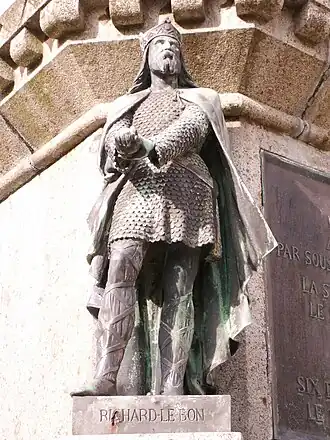
Richard II (23 August 963[1] - 28 August 1026), called the Good (French: Le Bon), was the Duke of Normandy from 996 to 1026. He was the first to assume the title of duke and built up his court to resemble that of a king. He commissioned Dudo of Saint-Quentin to write a detailed history of the Norman Dukes showing their nobility and Christian patronage.
Early career
Richard II was the oldest son of Richard I the Fearless and Gunnora. He succeeded his father as Duke of Normandy in 996.[2] During his minority, which was the first five years of his reign, his regent was his uncle Count Ralph of Ivrea. Ralph put down a peasant revolt at the start of Richard's reign.[3]
Richard was very religious like his overlord king Robert II of France. Richard used his army to support the king against the duchy of Burgundy.[3] He formed a marriage alliance with Brittany by marrying his sister Hawise of Normandy to Geoffrey I, Duke of Brittany. It became a double alliance when he married Geoffrey's sister, Judith of Brittany.[3]
Vikings and England
In the 980s the Vikings had been raiding England again.[4] They would then cross the English Channel to Normandy to sell their plunder.[5] Norman and Viking relations were good. Richard's father had hired Viking mercenaries in the 960s.[5] He also allowed them safe haven in Normandy.[5] This caused problems in England and with the Pope in Rome. In 990 representatives of the Pope negotiated a treaty between England and Normandy. Richard I agreed not to aid enemies of England (including Vikings).[5] From 997 to 1000 a great Viking army attacked Wessex a number of times. In 1000 they came to Normandy and were allowed to land by Richard II.[a] This broke the treaty between his father and the English king.[5] In 1000-1001 the English attacked Normandy on the Cotentin Peninsula. The raid was led by king Ethelred the Unready of England.[6] Ethelred had given orders that Richard be captured, shackled and brought to England.[7] But the English were not prepared for the rapid response of the Norman cavalry and were quickly defeated.[8]
Richard wanted to make peace with the English king. He gave his sister Emma of Normandy in marriage to King Ethelred.[6] Ethelred gave Emma the city of Exeter as a dowry.[5] This turned out to be an important marriage as it later gave Richard's grandson, William the Conqueror, a claim to the throne of England.[9] In 1013 when Sweyn Forkbeard invaded England, Emma with her two sons Edward and Alfred fled to Normandy. After losing his throne King Ethelred followed shortly.[9] Soon after the death of Ethelred, Cnut, King of England forced Emma to marry him. Duke Richard was forced to recognize the new regime as his sister was again Queen.[6]
Norman prestige
Richard II commissioned Dudo of Saint-Quentin, his clerk and priest, to write about his ancestors. He was to tell the story of the Norman dukes in a way that showed their Christian morals. He wanted them shown to be good and upright leaders who built Normandy despite the bad behavior of their Frankish neighbors.[4] It has been called by some historians a work of propaganda.[10] While it contains a number of stories and legends, nowhere did Dudo claim the stories to be facts.[11] When he wrote his work on the Customs and Deeds of the First Dukes of the Normans,[b] Dudo seems to have met his goal "to tell in the noblest style the story of a noble destiny."
In 1025 and 1026 Richard confirmed gifts of his ancestor Rollo to Saint-Ouen at Rouen.[13] He gave many other gifts to Monasteries. Their names show the areas over which Richard had ducal control: Caen, the Éverecin, the Cotentin, the Pays de Caux and Rouen.[14]
Richard II died 28 Aug 1026.[2]
Marriages
He married firstly, c. 1000, Judith (992–1017), daughter of Conan I of Brittany,[15] by whom he had the following issue:
- Richard III Succeeded his father as duke.[2]
- Alice of Normandy, married Renaud I, Count of Burgundy.[2]
- Robert (c. 1005/7), duke of Normandy after his brother.[2]
- William, a monk at Fécamp.[2]
- Eleanor, married to Baldwin IV, Count of Flanders
- Matilda, a nun at Fecamp, d. 1033
Secondly he married Poppa of Envermeu. They had the following children:
Illegitimate children
- Papia, wife of the Gulbert, Advocate of Saint Valery-en-Caux[16]
Notes
References
- ↑ "Richard II "the Good" of Normandy (963-1026) -". Find a Grave.
- 1 2 3 4 5 6 7 8 Detlev Schwennicke, Europäische Stammtafeln: Stammtafeln zur Geschichte der Europäischen Staaten, Neue Folge, Band II (Marburg, Germany: J. A. Stargardt, 1984), Tafel 79
- 1 2 3 François Neveux, A Brief History of The Normans (Constable and Robinson, 2008) p. 74
- 1 2 David Crouch, The Normans: The History of a Dynasty (London; New York: Hambledon Continuum, 2007), p. 32
- 1 2 3 4 5 6 7 David Crouch, The Normans: The History of a Dynasty (London; New York: Hambledon Continuum, 2007), p. 33
- 1 2 3 François Neveux, A Brief History of The Normans (Constable and Robinson, 2008) pp. 94-5
- ↑ Eleanor Searle, Predatory Kinship and the Creation of Norman Power, 840-1066 (University of California Press, Berkeley, 1988), p. 132
- ↑ David Crouch, The Normans: The History of a Dynasty (Hambledon Continuum, 2007), p. 34
- 1 2 David C. Douglas, William the Conqueror (University of California Press,1964), p. 160
- ↑ The Gesta Normannorum Ducum of William of Jumièges, Orderic Vitalis, and Robert of Torigni, Ed. & Trans. Elizabeth M.C. Van Houts, Vol. I (Clarendon Press, Oxford, 1992), p. xx
- ↑ Victoria B. Jordan, 'The Role of Kingship in Tenth-Century Normandy: Hagiography of Dudo of Saint-Quentin', Studies in medieval history, ed. Robert B Patterson (London: Hambledon Press, 1992), p. 53
- ↑ Encyclopædia Britannica Online s. v. "De moribus et actis primorum Normanniae ducum", accessed July 28, 2013
- ↑ The Gesta Normannorum Ducum of William of Jumièges, Orderic Vitalis, and Robert of Torigni, Ed. & Trans. Elizabeth M.C. Van Houts, Vol. I (Clarendon Press, Oxford, 1992), p. 67 n. 5
- ↑ Eleanor Searle, Predatory Kinship and the Creation of Norman Power, 840-1066 (University of California Press, Berkeley, 1988), p. 128
- ↑ David C. Douglas, William The Conqueror (University of California Press, Berkeley & Los Angeles, 1964), p. 15, n. 5
- ↑ Orderic Vitalis, The Ecclesiastical History of Oderic Vitalis, Vol. II, Books III And IV, Ed. Marjorie Chibnall (Oxford: Clarendon Press, 1993), p. 266