Raorchestes sanctisilvaticus
| Raorchestes sanctisilvaticus | |
|---|---|
Scientific classification  | |
| Kingdom: | Animalia |
| Phylum: | Chordata |
| Class: | Amphibia |
| Order: | Anura |
| Family: | Rhacophoridae |
| Genus: | Raorchestes |
| Species: | R. sanctisilvaticus |
| Binomial name | |
| Raorchestes sanctisilvaticus (Das and Chanda, 1997) | |
| Synonyms[2] | |
| |
The sacred grove bush frog, Similipal bush frog, or boring bush frog (Raorchestes sanctisilvaticus) is a frog. It lives in India.[2][3][1]
This frog hides during the day and moves around at night. It lives in forests that have never been cut down. Scientists think it hatches out of its egg as a small frog, like other frogs in Raorchestes do.[1]
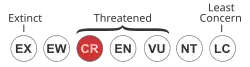
Scientists believe this frog is in big danger of dying out because it lives in a small place. Human beings have cut down the trees in the forests to get wood and to build things for visitors. Fires have also burned the forest.[1]
References
- 1 2 3 4 Indraneil Das; Sushil Dutta; Karthikeyan Vasudevan; S.P. Vijayakumar (2004). "Sacred Grove Bushfrog: Raorchestes sanctisilvaticus". The IUCN Red List of Threatened Species. 3.1. p. e.T58897A11846368. doi:10.2305/IUCN.UK.2004.RLTS.T58897A11846368.en. 58897. Retrieved August 18, 2023.
- 1 2 Frost, Darrel R. "Raorchestes sanctisilvaticus (Das and Chanda, 1997)". Amphibian Species of the World, an Online Reference. Version 6.0. American Museum of Natural History, New York. Retrieved August 18, 2023.
- ↑ "Raorchestes sanctisilvaticus (Das and Chanda, 1997)". AmphibiaWeb. University of California, Berkeley. Retrieved August 18, 2023.