Ranidae
| Ranidae | |
|---|---|
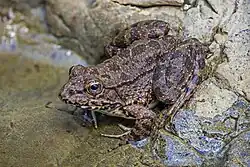 | |
| Cyprus water frog (Pelophylax cypriensis) | |
Scientific classification  | |
| Kingdom: | Animalia |
| Phylum: | Chordata |
| Class: | Amphibia |
| Order: | Anura |
| Suborder: | Neobatrachia |
| Clade: | Ranoidea |
| Family: | Ranidae Rafinesque, 1814 |
| Synonyms | |
|
See text | |
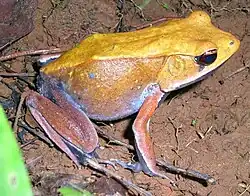
The Ranidae or true frogs can be found in most countries except Antarctica. The true frogs can be found in North America, northern South America, Europe, Asia, Madagascar, Africa, East Indies, New Guinea, and Australia. The bullfrog is the largest true frog in North America. Usually, true frogs are smooth, moist-skinned frogs, with large, powerful legs and have webbed feet. The smallest true frogs are the Wood frog (Rana sylvatica). The largest is the Goliath frog (Conraua goliath). True frogs are semi-aquatic frogs. They live near water.
Systematics
The Ranidae are not fully organized. There are some arguments about organization. Most organizations are agreed with.Some subfamilies are now seen as families (Petropedetidae, Cacosterninae, Mantellidae, and Dicroglossidae). The genus Rana is now split up.[1][2][3][4]
This phylogeny was made by Che et al., 2007 using mitochondrial genes.[5]
Genera
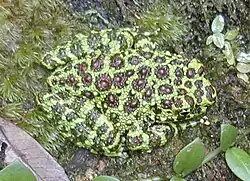
Most of the subfamilies in Ranidae are separate families. Raninae is the only subfamily. These genera are part of the family Ranidae:[6]
- Abavorana Oliver, Prendini, Kraus, and Raxworthy, 2015 (three species)
- Amnirana Dubois, 1992 (11 species)
- Amolops Cope, 1865 (80 species)
- Babina Thompson, 1912 (two species)
- Chalcorana Dubois, 1992 (nine species)
- Clinotarsus Mivart 1869 (three species)
- Glandirana Fei, Ye, and Huang, 1990 (six species)
- Huia Yang, 1991 (monotypic)
- Humerana Dubois, 1992 (four species)
- Hydrophylax Fitzinger, 1843 (four species)
- Hylarana Tschudi 1838 (four species)
- Indosylvirana Oliver, Prendini, Kraus, and Raxworthy, 2015 (13 species)
- Lithobates Fitzinger, 1843 (55 species)
- Meristogenys Yang, 1991 (13 species)
- Nidirana Dubois, 1992 (19 species)
- Odorrana Fei, Ye, and Huang, 1990 (64 species)
- Papurana Dubois, 1992 (19 species)
- Pelophylax Fitzinger 1843 (19 species)
- Pseudorana Fei, Ye, and Huang, 1990 (monotypic)
- Pterorana Kiyasetuo and Khare, 1986 (monotypic)
- Pulchrana Dubois, 1992 (18 species)
- Rana Linnaeus, 1758 (58 species)
- Sanguirana Dubois, 1992 (six species)
- Staurois Cope, 1865 (six species)
- Sumaterana Arifin, Smart, Hertwig, Smith, Iskandar, and Haas, 2018 (three species)
- Sylvirana Dubois, 1992 (12 species)
- Wijayarana Arifin, Chan, Smart, Hertwig, Smith, Iskandar, and Haas, 2021 (five species)
Incertae sedis
Some taxa are part of Ranidae incertae sedis. This means that their taxonomic status is too uncertain to allow more specific placement.
- "Hylarana" chitwanensis (Das, 1998)
- "Hylarana" garoensis (Boulenger, 1920)
- "Hylarana" latouchii (Boulenger, 1899)
- "Hylarana" margariana Anderson, 1879
- "Hylarana" montivaga (Smith, 1921)
- "Hylarana" persimilis (Van Kampen, 1923)
References

- ↑ Cai, Hong-xia; Che, Jing; Pang, Jun-feng; Zhao, Er-mi; Zhang, Ya-ping (2007): Paraphyly of Chinese Amolops (Anura, Ranidae) and phylogenetic position of the rare Chinese frog, Amolops tormotus. Zootaxa 1531: 49–55. PDF fulltext
- ↑ Kotaki, Manabu; Kurabayashi, Atsushi; Matsui, Masafumi; Khonsue, Wichase; Djong, Tjong Hon; Tandon, Manuj; Sumida, Masayuki (2008): Genetic Divergences and Phylogenetic Relationships Among the Fejervarya limnocharis Complex in Thailand and Neighboring Countries Revealed by Mitochondrial and Nuclear Genes. Zool. Sci. 25 (4): 381–390. doi:10.2108/zsj.25.381 (HTML abstract)
- ↑ Stuart, Bryan L. (2008): The phylogenetic problem of Huia (Amphibia: Ranidae). Mol. Phylogenet. Evol. 46 (1): 49–60. doi:10.1016/j.ympev.2007.09.016 PDF fulltext
- ↑ Amphibian Species of the World 5.5, an Online Reference. "Hylarana Tschudi, 1838". American Museum of Natural History.
{{cite web}}: CS1 maint: numeric names: authors list (link) - ↑ Che, Jing; Pang, Junfeng; Zhao, Hui; Wu, Guan-fu; Zhao, Er-mi; Zhang, Ya-Ping (2007-04-01). "Phylogeny of Raninae (Anura: Ranidae) inferred from mitochondrial and nuclear sequences". Molecular Phylogenetics and Evolution. 43 (1): 1–13. doi:10.1016/j.ympev.2006.11.032. ISSN 1055-7903. PMID 17300963.
- ↑ "Ranidae Batsch, 1796 | Amphibian Species of the World". 2023-05-28. Archived from the original on 2023-05-28. Retrieved 2023-08-07.
- Cogger, H.G.; Zweifel, R.G.; Kirschner, D. (2004): Encyclopedia of Reptiles & Amphibians (2nd ed.). Fog City Press. ISBN 1-877019-69-0
- Frost, Darrel R. (2006): Amphibian Species of the World Version 3 - Petropedetidae Noble, 1931. American Museum of Natural History, New York, USA. Retrieved 2006-AUG-05.
- Frost, Darrel R. et al. (2006): The amphibian tree of life. Bulletin of the American Museum of Natural History. Number 297. New York.
- Hillis, D.M. (2007) Constraints in naming parts of the Tree of Life. Mol. Phylogenet. Evol. 42 (2): 331–338. doi:10.1016/j.ympev.2006.08.001 PDF fulltext Archived 2011-09-27 at the Wayback Machine
- Hillis, D.M.; Wilcox, T.P. (2005): Phylogeny of the New World true frogs (Rana). Mol. Phylogenet. Evol. 34 (2): 299–314. doi:10.1016/j.ympev.2004.10.007 PDF fulltext Archived 2008-05-28 at the Wayback Machine
- Pauly, Greg B.; Hillis, David M.; Cannatella, David C. (2009): Taxonomic freedom and the role of official lists of species names. Herpetologica 65: 115–128.
- Rafinesque, C.S. (2007): "Fine del prodromo d'erpetologia siciliana ". Specchio delle Scienze, o, Giornale Enciclopedico di Sicilia 2: 102–104. (Ranidae, new family). (in Italian).