Rampur State
Royal State of Rampur Dar-Ul-Insha | |||||||||
|---|---|---|---|---|---|---|---|---|---|
| 1774–1947 | |||||||||
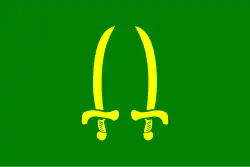 Flag
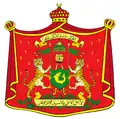 Coat of arms
| |||||||||
| Motto: "Al Hukumu Lilah Wāl Mulk Lilah" (Rulership And Sovereignty Belongs To God) Lā Fata ʾIllā ʿAlī; Lā Sayf ʾIllā Ḏū l-Fiqār. ' (There Is No Conqueror Like Ali And No Sword Like The Zulfiqar) | |||||||||
 Rampur State in yellow | |||||||||
| Capital | Rampur | ||||||||
| Official languages | Persian (1774–1887) Urdu (1889–1947)[1] | ||||||||
| Common languages | Urdu, English | ||||||||
| Religion | Shi'ism | ||||||||
| Government | Absolute Monarchy | ||||||||
| Nawab of Rampur | |||||||||
• 1754–1794 | Faizullah Khan (First) | ||||||||
• 1794 | Muhammad Ali Khan | ||||||||
• 1794 | Ghulam Muhammad Khan | ||||||||
• 1794–1840 | Ahmad Ali Khan | ||||||||
• 1930–1966 | Raza Ali Khan (Last) | ||||||||
| History | |||||||||
• First Rohilla War | 7 October 1774 | ||||||||
| 15 August 1947 | |||||||||
| |||||||||
Rampur State was a 15 gun-salute Princely state of British India. It is now a state of India. Rampur came into existence on 7 October 1774. It was created by a treaty with Oudh, The state gained independence in 1949.[2] It was the first Princely state to accede in India.[2]
The state was founded by Nawab Faizullah Khan of the Rohilla dynasty. Faizullah was the son of Ali Mohammed Khan, originally named Prem Singh Nain, a Jat convert who was adopted by the Rohilla chief Daud Khan.[3][4]
References
- ↑ Rahman, Tariq (2011). From Hindi to Urdu : a social and political history. Orient Blackswan Private Ltd. p. 209. ISBN 978-81-250-4248-8. OCLC 757810159.
- 1 2 NH Web Desk (12 October 2020). "Rampur's 47-year-old property dispute gets a twist, five new claimants demand share in property". National Herald. Retrieved 22 March 2022.
- ↑ Journal of the Pakistan Historical Society Volume 42. Pakistan Historical Society. 1994. p. 24.
Among the captives was one handsome Jat boy by the name of Prem Singh Nano. Da'ud Khan was so attracted towards him that he adopted him as his son, initiated him into the Islamic belief, and named him Ali Muhammad Nano. Later, when the boy reached adulthood, Daud Khan declared him as his successor. Thus began the pedigree of the Nawwabs of Rampur.
- ↑ Khan, Iqbal Ghani (2002). "Technology and the Question of Elite Intervention in Eighteenth-Century North India". In Barnett, Richard B. (ed.). Rethinking Early Modern India. Manohar Publishers & Distributors. p. 271. ISBN 978-81-7304-308-6. "Thus we witness the Ruhelas accepting an exceptionally talented non-Afghan, an adopted Jat boy, as their nawab, purely on the basis of his military leadership..."