Ptah-Patek (Ancient Egyptian deity)
| Egyptian Deity | |
|---|---|
god of goldsmiths and artisans | |
| Member of Egyptian Deity | |
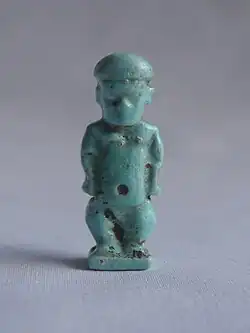 Amulet of Ptah-Patèque, faience siliceous, Private collection, France, Origin Egypt, 26th dynasty—30th dynasty | |
| Other names | Patek; pataikos |
| Major cult centre | Memphis, Egypt |
Pateco (gr. Παταϊκός (pataikos)), or also Ptah-pateco, is an Egyptian deity represented in the form of a dwarf and mainly on amulets. Many of these have been found in Phoenician and Punic centers throughout the Mediterranean, but also in Etruria and to a lesser extent in Greece.
Origins, Attributes, and Representation
The name "Pateque" comes from Herodotus who, in his Histories, refers by this name to the figureheads of Phoenician ships in the form of a protective dwarf.[1] Her connection with Ptah comes from the dwarves who, in Egyptian Antiquity, were generally associated with experts in metallurgy[2][3]
Ptah-Patek is generally represented as a deformed, completely naked, green dwarf with a pot-bellied belly and a head disproportionate to his body. There are, however, rare cases where he is adorned with a necklace and a crown that surmounts his skullcap. Unlike Ptah, he possesses neither the Djed pillar, nor the Was scepter, nor the ankh, nor the false beard symbol of royalty. Their only similarity lies in the wearing of the skullcap atop their heads.[4] He was represented exclusively in the form of a faience amulet that protected its wearer from evil forces and chaos.
Cult
The Late Period is the period when its popularity grew among the Egyptian people, who, associating it with the god Bes from the 22nd Dynasty of Egypt onwards,[5] exports it throughout the Eastern Mediterranean in the Hellenistic period.
Related pages
Notes
- ↑ Herodotus, Egypt: Histories, 2002, chap. 3, p. 37
- ↑ Michel Valloggia, Archived 2016-03-03 at the Wayback Machine, line 8-10.
- ↑ Let us remember that Ptah is the patron saint of artisans.
- ↑ Comparison between a bronze statuette of Ptah (E 3305) inlaid with gold and electrum from the Louvre Museum in Paris and a faience amulet of Ptah-Patek (number: BAAM 1114) from the Museum of Antiquities in Alexandria.
- ↑ Fourrier, Sabine; Grivaud, Gilles (2006). Intersecting Identities in a Mediterranean Environment: The Case of Cyprus (Antiquity-Middle Ages) (in French). Publications of the Universities of Rouen and Le Havre. p. 75-76. ISBN 9782877754071.
Bibliography
- Philippe Germond, "The Symbolic World of Egyptian Amulets: From the Jacques-Édouard Berger Collection," Éditions 5 Continents, 2005;
- Alain-Pierre Zivie, Memphis and its Necropolises in the New Kingdom, Éditions du CNRS, 1988.
Other websites
- "Amulet of Ptah-Patèque". barbier-mueller.ch via Internet Archive. Archived from the original on 2018-01-26. Retrieved 2025-05-29.