Proceratophrys itamari
| Proceratophrys itamari | |
|---|---|
Scientific classification  | |
| Kingdom: | Animalia |
| Phylum: | Chordata |
| Class: | Amphibia |
| Order: | Anura |
| Family: | Odontophrynidae |
| Genus: | Proceratophrys |
| Species: | P. itamari |
| Binomial name | |
| Proceratophrys itamari Mângia, Santana, Cruz, and Feio, 2014 | |
Proceratophrys itamari is a frog. It lives in Brazil.[2][3][1]
Body
The adult male frog is 31.1-42.5 mm long from nose to rear end, and the adult female frog 39.5-52.3 mm long.[4]
Name
Scientists named this frog for Professor Itamar Martins from the Universidade de Taubaté.[4]
Home
This frog lives in forests where the tree branches come together like a roof. Scientists saw it on the dead leaves on the ground near streams. Scientists saw the frog between 1200 and 2000 meters above sea level.[1]
Scientists found the frog in a protected park, Parque Estadual de Campos de Jordão.[1]
Young
The tadpoles swim in streams, both streams that are streams all year and in streams that dry up.[1]
Danger
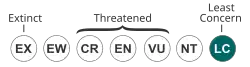
Scientists from the IUCN say this frog is not in danger if of dying out. Human beings used to cut down trees to get wood and make farms, tree farms, and places for cows to eat grass, but this only happens in some places now.[1]
References
- 1 2 3 4 5 6 IUCN SSC Amphibian Specialist Group; Instituto Boitatá de Etnobiologia e Conservação da Fauna (2023). "Proceratophrys itamari". IUCN Red List of Threatened Species. 2023: e.T79116149A86255378. doi:10.2305/IUCN.UK.2023-1.RLTS.T79116149A86255378.en. Retrieved October 1, 2025.
- ↑ Frost, Darrel R. "Proceratophrys itamari Mângia, Santana, Cruz, and Feio, 2014". Amphibian Species of the World, an Online Reference. Version 6.0. American Museum of Natural History, New York. Retrieved October 1, 2025.
- ↑ "Proceratophrys itamari Mângia, Santana, Cruz, & Feio, 2014". AmphibiaWeb. University of California, Berkeley. Retrieved October 1, 2025.
- 1 2 Mângia S; Santana DJ; Cruz CAG; Feio RN (2014). "Taxonomic review of Proceratophrys melanopogon (Miranda Ribeiro, 1926) with description of four new species (Amphibia, Anura, Odontophrynidae)". Boletim do Museu Nacional. Nova Serie, Zoologia. (Full text). 531. Rio de Janeiro: 1–33. Retrieved September 29, 2025.