Proceratophrys dibernardoi
| Proceratophrys dibernardoi | |
|---|---|
Scientific classification  | |
| Kingdom: | Animalia |
| Phylum: | Chordata |
| Class: | Amphibia |
| Order: | Anura |
| Family: | Odontophrynidae |
| Genus: | Proceratophrys |
| Species: | P. dibernardoi |
| Binomial name | |
| Proceratophrys dibernardoi Brandão, Caramaschi, Vaz-Silva, and Campos, 2013 | |
Proceratophrys dibernardoi is a frog. It lives in Brazil.[2][3][1]
Home
This frog lives on the ground in near streams. Scientists saw it in open areas and in forests growing next to streams. They saw it on the dead leaves on the ground. They also saw it in places where animals eat grass and soybean farms. Scientists saw the frog between 520 and 855 meters above sea level.[1]
Scientists have seen the frog in some protected places: Área de Proteção Ambiental Rio Araguaia, Córrego Rico, Couto Magalhães and Rio Araguainha, Parque Estadual Matas do Segredo, and Parque Estadual Serra Azul.[1]
Danger
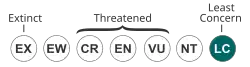
Scientists from the IUCN say this frog is not in danger of dying out. Human beings change the places where the frog lives to make farms and places for animals to eat grass. Humans also use fire to change the forest to fields.[1]
First paper
- Brandao RA; Caramaschi U; Vaz-Silva W; Campos LA (2013). "Three new species of Proceratophrys Miranda-Ribeiro 1920 from Brzilian Cerrado (Anura, Odontophrynidae)". Zootaxa. 3750: 321–347.
References
- 1 2 3 4 5 IUCN SSC Amphibian Specialist Group; Instituto Boitatá de Etnobiologia e Conservação da Fauna (2023). "Proceratophrys dibernardoi". IUCN Red List of Threatened Species. 2023: e.T78575607A86256029. doi:10.2305/IUCN.UK.2023-1.RLTS.T78575607A86256029.en. Retrieved September 28, 2025.
- ↑ Frost, Darrel R. "Proceratophrys dibernardoi Brandão, Caramaschi, Vaz-Silva, and Campos, 2013". Amphibian Species of the World, an Online Reference. Version 6.0. American Museum of Natural History, New York. Retrieved September 28, 2025.
- ↑ "Proceratophrys dibernardoi Brandão, Caramaschi, Vaz-Silva, and Campos, 2013". AmphibiaWeb. University of California, Berkeley. Retrieved September 28, 2025.