Proceratophrys carranca
| Proceratophrys carranca | |
|---|---|
Scientific classification  | |
| Kingdom: | Animalia |
| Phylum: | Chordata |
| Class: | Amphibia |
| Order: | Anura |
| Family: | Odontophrynidae |
| Genus: | Proceratophrys |
| Species: | P. carranca |
| Binomial name | |
| Proceratophrys carranca Godinho, Moura, Lacerda, and Feio, 2013 | |
Proceratophrys carranca is a frog. It lives in Brazil.[2][3][1]
Body
The adult male frog is 31.6-39.9 mm long from nose to rear end. It has black color near the front of its neck. Its belly is cream-white in color with light brown marks.[4]
Name
Scientists named this frog carranca after statues that people say keep travelers safe on the São Francisco River. The statues also mean the people who work and live on rivers.[4]
Home
This frog lives on the ground near streams with small woody plants nearby. Scientists saw the frog 654 meters above sea level.[1]
Scientists have seen the frog in one protected place, Parque Nacional Grande Sertão Veredas.[1]
Danger
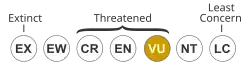
Scientists from the IUCN say this frog is in some danger of dying out. Human beings change the places where the frog lives to make farms, towns, and places for animals to eat grass. Humans also use fire to change the forest to fields.[1]
References
- 1 2 3 4 5 IUCN SSC Amphibian Specialist Group; Instituto Boitatá de Etnobiologia e Conservação da Fauna (2022). "Proceratophrys carranca". IUCN Red List of Threatened Species. 2022: e.T78575596A86255974. doi:10.2305/IUCN.UK.2022-2.RLTS.T78575596A86255974.en. Retrieved September 26, 2025.
- ↑ Frost, Darrel R. "Proceratophrys carranca Godinho, Moura, Lacerda, & Feio, 2013". Amphibian Species of the World, an Online Reference. Version 6.0. American Museum of Natural History, New York. Retrieved September 26, 2025.
- ↑ "Proceratophrys carranca Godinho, Moura, Lacerda, & Feio, 2013". AmphibiaWeb. University of California, Berkeley. Retrieved September 26, 2025.
- 1 2 Godinho LB; Moura MR; Lacerda JVA; Feio RN (2013). "A new species of Proceratophrys (Anura: Odontophrynidae) from the middle Sao Franciso River, southeastern Brazil". Salamandra (Full text). 49 (2): 63–73. Retrieved September 26, 2025.