Potassium gold cyanide
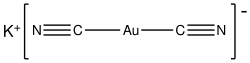 | |
| Names | |
|---|---|
| IUPAC name
Potassium dicyanoaurate(I) | |
| Other names | |
| Identifiers | |
3D model (JSmol) |
|
| Beilstein Reference | 6235525 |
| ChEBI | |
| ChemSpider | |
| ECHA InfoCard | 100.034.303 |
| EC Number |
|
| Gmelin Reference | 37363 |
PubChem CID |
|
| UNII | |
| UN number | 1588 |
CompTox Dashboard (EPA) |
|
SMILES
| |
| Properties | |
| KAu(CN)2 | |
| Molar mass | 288.101 g/mol |
| Appearance | white crystal[1] |
| Density | 3.45 g/cm3[1] |
| Boiling point | decomposes |
| 140 g/L[1] | |
| Structure | |
| Rhombohedral, hR54, No. 148 | |
Space group |
R3 |
Lattice constant |
a = 0.728 nm
, b = 0.728 nm , c = 2.636 nm
|
Lattice volume (V) |
1.2099 nm3 |
Formula units (Z) |
9 |
| Hazards | |
| Occupational safety and health (OHS/OSH): | |
Main hazards |
toxic |
| GHS labelling: | |
Pictograms |
   |
Signal word |
Warning |
Hazard statements |
H290, H300, H310, H315, H317, H318, H330, H410 |
Precautionary statements |
P260, P264, P273, P280, P284, P301+P310 |
| Related compounds | |
Other anions |
Potassium silver cyanide |
Other cations |
|
Except where otherwise noted, data are given for materials in their standard state (at 25 °C [77 °F], 100 kPa). | |
| Infobox references | |
Potassium gold cyanide, also called potassium dicyanoaurate, is a chemical compound. It has the chemical formula KAu(CN)2.
Along with sodium gold cyanide and calcium gold cyanide, it part of the gold cyanidation process that separates gold from ores. It is also used in electroplating.[3]
History
It was discovered by Carl Wilhelm Scheele, not long after he discovered cyanide. Scheele made a solution of potassium cyanide that could dissolve gold.[3]
References
- 1 2 3 4 Haynes, William M., ed. (2011). CRC Handbook of Chemistry and Physics (92nd ed.). CRC Press. p. 4.82. ISBN 978-1439855119.
- Greenwood, N. N.; & Earnshaw, A. (1997). Chemistry of the Elements (2nd Edn.), Oxford:Butterworth-Heinemann. ISBN 0-7506-3365-4.
- 1 2 Williams, Graham (1978). "The cyanides of gold". Gold Bulletin. 11 (2): 56–59. doi:10.1007/BF03215451.