Politics of Nigeria
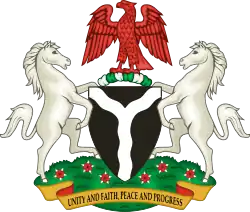 Coat of arms of Nigeria | |
| Formation | 1 October 1963 |
|---|---|
| Jurisdiction | Nigeria |
| Legislative branch | |
| Legislature | National Assembly |
| Executive branch | |
| Leader | President of Nigeria |
| Headquarters | Aso Rock Presidential Villa |
| Judicial branch | |
| Court | Supreme Court |
| Seat | Abuja |
The federal government of Nigeria is made up of three parts: the executive, the legislative, and the judicial. These three parts are given their powers by the Constitution of Nigeria.[1]The three parts are kept separate so that no one part becomes too powerful. The constitution also divides power between the federal government and Nigeria's 36 states, and it protects the rights of Nigerian citizens.[2]Nigeria became independent from Britain on 1 October 1960 and joined the British Commonwealth.[3]
Law
The law of Nigeria is based on three main types:
English law: Because Nigeria was once ruled by Britain, many Nigerian laws came from English law. When Nigeria became independent in 1960, many English laws were kept.[4]
Common law: This is made up of old court decisions that help guide how new cases are decided, especially when there is no written law to cover a situation.[5]
Customary law: This is law based on the traditions and customs of different Nigerian groups. It is divided into two types: ethnic customary law, which applies to members of a specific group, and Islamic law (Sharia), which applies to Muslims.[6]
Sharia law: This is used in some states in the northern part of Nigeria. It covers both legal and religious matters for Muslims.[7]
Executive branch
The president is the head of the Nigerian government. The president is chosen by a public vote and can serve no more than two four-year terms. The president is also in charge of the armed forces.[8]The current president is Bola Tinubu, who was elected in 2023. The current vice president is Kashim Shettima.[9]The executive branch is divided into 24 Federal Ministries. Each ministry is headed by a minister chosen by the president. The president must include at least one person from each of Nigeria's 36 states in his cabinet.[10]
Legislative branch
The legislature is the part of government that makes laws. In Nigeria, it is called the National Assembly.[11]
The National Assembly has two parts:
The House of Representatives: This has 360 members. Each member represents one area of the country and is elected for four years.[12]
The Senate: This has 109 members. Each of Nigeria's 36 states has three senators. One extra senator comes from the Federal Capital Territory. Senators are also elected for four years.
The current president of the Senate is Godswill Akpabio. The current Speaker of the House is Tajudeen Abbas, who was elected Speaker in 2023.[13]
A law must be passed by both chambers before it can go to the president, who must agree to it before it becomes law.
Judicial branch
The judicial branch is made up of courts. The highest court in Nigeria is the Supreme Court of Nigeria. Below it are the Court of Appeal, high courts, and lower courts.[14]The Supreme Court has a chief justice and up to 21 judges in total. These judges are chosen by the president but must be approved by the Senate.[15]
Unlike the other two branches, judges are not elected by the public. They are appointed.
The current chief justice is Kudirat Kekere-Ekun.
Democracy
Nigeria became independent in 1960 and became a republic in 1963. In 1966, the military took over the government. There was also a civil war that lasted until 1970.
Democracy returned briefly from 1979 to 1983, but the military took power again. After the death of military leader Sani Abacha in 1998, a new constitution was put in place in 1999. Olusegun Obasanjo was elected president in 1999, ending the cycle of military rule.[16]Since 1999, Nigeria has held regular elections. However, problems such as vote buying, violence, and cheating in elections have been reported.[17]
Freedom House has rated Nigeria as "partly free".[17]
Political parties
There are 18 recognised political parties in Nigeria. The two most important ones are the Peoples Democratic Party and the All Progressives Congress. Both of these parties have held the presidency at different times.[18]
Elections
Nigerian citizens who are at least 18 years old can vote. The Independent National Electoral Commission (INEC) is in charge of running elections and checking that they are fair.[19]
Religion
Nigeria has both a large Christian population and a large Muslim population. Christians are mostly in the south, while Muslims are mostly in the north. Twelve northern states use Sharia law. There have been conflicts between the two groups over the years.[20]
Military
The military has played a major role in Nigerian history, taking control of the government several times. The last period of military rule ended in 1999.[21]
Nigeria's armed forces have about 76,000 soldiers in total, divided between the army, navy, and air force.
States
Nigeria is made up of 36 states and 1 federal capital territory (Abuja). Each state is divided into smaller areas called local government areas (LGAs). There are 774 LGAs in total. They handle local matters such as schools, health care, roads, and rubbish collection.[22]
References
- ↑ "Federal Republic of Nigeria". Forum of Federations. Retrieved 21 December 2022.
- ↑ "Functions of the Constitution". Nigerian Scholars. Retrieved 21 December 2022.
- ↑ "Nigeria". The Commonwealth. 15 August 2013. Retrieved 18 November 2020.
- ↑ Edeh Samuel, Chukwuemeka (24 June 2020). "Meaning & Characteristics of Nigerian Legal System". Bscholarly. Retrieved 21 December 2022.
- ↑ "Common Law – Definition, Understanding, and Why Common Law is Important?". cleartax.in. Retrieved 21 December 2022.
- ↑ Enabulele, Amos O.; Bazuaye, Bright (February 2019). "Validity and Enforceability of Customary Law in Nigeria". Journal of African Law. 63 (1): 79–104. doi:10.1017/S002185531800030X.
- ↑ "Sharia". Britannica. Retrieved 22 December 2022.
- ↑ "Section 130 of the Constitution of the Federal Republic of Nigeria". jurist.ng. Retrieved 22 December 2022.
- ↑ Alabi, Tope (19 May 2023). "FULL LIST: FG releases timetable for Tinubu, Shettima swearing-in". The Punch.
- ↑ "Government Ministries in Nigeria". Commonwealth of Nations. Retrieved 21 December 2009.
- ↑ "National Assembly". nass.gov.ng. Retrieved 21 December 2022.
- ↑ "National Assembly". nass.gov.ng. Retrieved 22 December 2022.
- ↑ Premium Times https://www.premiumtimesng.com/news/headlines/604187-breaking-tajudeen-abbas-elected-speaker-house-of-representatives.html. Retrieved 6 May 2025.
{{cite news}}: Missing or empty|title=(help) - ↑ "Court System in Nigeria". The Beehive. Retrieved 17 July 2012.
- ↑ "Structure of the Nigerian Judiciary". Nigerian Scholars. Retrieved 22 December 2022.
- ↑ Enang, Wisdom (24 July 2022). "History of Democracy in Nigeria till date". ProGuide. Retrieved 22 December 2022.
- 1 2 "Nigeria". Freedom House. Retrieved 17 November 2020.
- ↑ "The Role of Political Parties in Nigeria's Fledgling Democracy" (PDF). International Republic Institute. 2020.
- ↑ Goitom, Hanibal (May 2015). "Nigeria: Election Laws". Law Library of Congress.
- ↑ Akinade, Akintunde E. (2002). "The Precarious Agenda: Christian-Muslim Relations in Contemporary Nigeria" (PDF). Hartford Seminary.
- ↑ "Nigeria – Military regimes, 1983–99". Encyclopedia Britannica. Retrieved 31 May 2021.
- ↑ "THE LOCAL GOVERNMENT SYSTEM IN NIGERIA" (PDF). Commonwealth Local Government Forum.