Pleurodema thaul
| Pleurodema thaul | |
|---|---|
 | |
Scientific classification  | |
| Kingdom: | Animalia |
| Phylum: | Chordata |
| Class: | Amphibia |
| Order: | Anura |
| Family: | Leptodactylidae |
| Genus: | Pleurodema |
| Species: | P. thaul |
| Binomial name | |
| Pleurodema thaul (Schneider, 1799) | |
| Synonyms[2] | |
| |
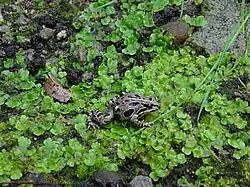
The Chile four-eyed frog (Pleurodema thaul) is a frog. It lives in Chile and Argentina.[2][3][1]
Body
The adult male frog is 50 mm long from nose to rear end and the female frogs are larger. The skin of the frog's back can be yellow, green, or dark green in color. The frogs have brown spots that match on each side. The belly is white in color.[3]
Food
This frog eats animals with jointed legs, for example spiders and similar animals and flies and similar animals. They also eat some plants.[3]
Home
This frog lives in Nothofagus forest placess. It can also live in grassy places and towns. People find adult frogs near plants and under logs and rocks. Scientists have seen it between 0 and 3,000 m (0 and 9,843 ft) above sea level.[1]
Scientists have seen the frog in protected places.[1]
Young
This frog can have young in almost any body of water.[1] The tadpoles are gray in color with spots on the back.[3]
Danger
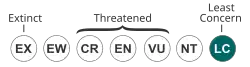
Scientists from the IUCN say this frog is not in danger of dying out. In some places, some of the frogs are in some danger because of fire, bad chemicals in water from farms and other human things, people changing the places where it lives, and drought.[1]
References
- 1 2 3 4 5 6 IUCN SSC Amphibian Specialist Group (2015). "Chile Four-eyed Frog: Pleurodema thaul". IUCN Red List of Threatened Species. 2015: e.T57291A79813410. doi:10.2305/IUCN.UK.2015-4.RLTS.T57291A79813410.en. Retrieved March 25, 2026.
- 1 2 Frost, Darrel R. "Pleurodema thaul (Schneider, 1799)". Amphibian Species of the World, an Online Reference. Version 6.0. American Museum of Natural History, New York. Retrieved March 25, 2026.
- 1 2 3 4 Kellie Whittaker (January 1, 2005). Kellie Whittaker (ed.). "Pleurodema thaul (Schneider, 1799)". AmphibiaWeb. University of California, Berkeley. Retrieved March 25, 2026.