Pleurodema marmoratum
| Pleurodema marmoratum | |
|---|---|
 | |
Scientific classification  | |
| Kingdom: | Animalia |
| Phylum: | Chordata |
| Class: | Amphibia |
| Order: | Anura |
| Family: | Leptodactylidae |
| Genus: | Pleurodema |
| Species: | P. marmoratum |
| Binomial name | |
| Pleurodema marmoratum (Duméril and Bibron, 1840) | |
| Synonyms[2] | |
| |
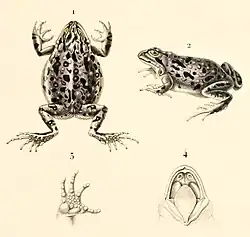
The marbled four-eyed frog (Pleurodema marmoratum) is a frog. It lives in Bolivia, Peru, Chile, and Argentina.[2][3][1]
Body
The adult male frog is 27.9 mm long from nose to rear end and adult female frog is 31.8 mm. The skin of the frog's back is tan and can have darker brown marks. The male frog's male organs are very large for its size and can be one third of the inside of its body.[3]
Name
Scientists used to call this frog Phrynopus spectabilis. Spectabilis is Latin for "remarkable."[3]
Home
This frog lives on the ground on mountains. People see it under rocks near bogs, water from melting ice walls, and bodies of water that are not there all year. Scientists have seen it between 3,000 and 5,200 m (9,800 and 17,100 ft) above sea level.[1]
Scientists have seen the frog in protected places: Área Natural de Manejo Integrado Apolobamba, Reserva Nacional de Fauna Andina Eduardo Avaroa, Parque Nacional y Área Natural de Manejo Integrado Cotapata, Parque Nacionale Carrasco, Parque Nacionale Sajama, Reserva Nacional Salinas y Aguada Blanca, Reserva Nacional Pampa Galeras, Área de Conservación Regional Bosque de Puya Raimondi Titankayocc, Santuario Histórico de la Pampa de Ayacucho, Reserva de la Biósfera Laguna de Pozuelos, Parque Nacional Lauca, and Parque Nacional Isluga.[1]
Young
This frog has many young at the same time. The female frog puts eggs in ponds and streams with slow water. People have also seen it in farmland with water on it.[1]
Danger
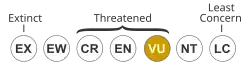
Scientists from the IUCN say this frog is in some danger of dying out. Climate change can hurt this frog. People set fires so they can change the frog's home into a good place for animals to eat grass. Scientists have found the dangerous fungus Batrachochytrium dendrobatidis on some of the frogs, but they do not know if chytridiomycosis kills the frog.[1]
References
- 1 2 3 4 5 6 IUCN SSC Amphibian Specialist Group (2020). "Marbled Four-eyed Frog: Pleurodema marmoratum". IUCN Red List of Threatened Species. 2020: e.T57289A114559758. doi:10.2305/IUCN.UK.2020-3.RLTS.T57289A114559758.en. Retrieved March 27, 2026.
- 1 2 Frost, Darrel R. "Pleurodema marmoratum (Duméril and Bibron, 1840)". Amphibian Species of the World, an Online Reference. Version 6.0. American Museum of Natural History, New York. Retrieved March 27, 2026.
- 1 2 3 Raul E. Diaz; Alessandro Catenazzi; Sierra Raby (August 27, 2004). Kellie Whittaker (ed.). "Pleurodema marmoratum (Duméril and Bibron, 1840)". AmphibiaWeb. University of California, Berkeley. Retrieved March 27, 2026.