Pleurodema guayapae
| Pleurodema guayapae | |
|---|---|
Scientific classification  | |
| Kingdom: | Animalia |
| Phylum: | Chordata |
| Class: | Amphibia |
| Order: | Anura |
| Family: | Leptodactylidae |
| Genus: | Pleurodema |
| Species: | P. guayapae |
| Binomial name | |
| Pleurodema guayapae Barrio, 1964 | |
Guayapa's four-eyed frog (Pleurodema guayapae) is a frog. It lives in Argentina and Bolivia. Scientists think it could also live in Paraguay.[2][3][1]
Body
This frog is about 40 - 45 mm long from nose to rear end. The skin of the frog's back is gray in color, with spots. The belly is white in color.[3]
Home
This frog lives on the ground. It lives in places without too many trees, for example, dry parts of the Chaco. Scientists have seen it between 80 and 520 m (260 and 1,710 ft) above sea level.[1]
Scientists have seen the frog in protected places: Parque Nacional Sierra de las Quijadas and Reserva Provincial Chancaní.[1]
Young
This frog has many young at the same time.[1] The male and female frog make a nest out of bubbles for the eggs. This stops the eggs from drying and stops animals that want to eat the eggs. For example Ceratophrys cranwelli tadpoles would eat these eggs. The nests are 6 - 9 cm across and 1 - 3 cm tall. Each egg is about 1.44 mm across. In laboratories, the eggs take 26-30 hours to hatch into tadpoles. The tadpoles are light in color.[3]
Danger
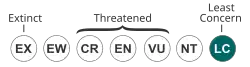
Scientists from the IUCN say this frog is not in danger of dying out.[1]
References
- 1 2 3 4 5 6 IUCN SSC Amphibian Specialist Group (2020). "Guayapa's Four-eyed Frog: Pleurodema guayapae". IUCN Red List of Threatened Species. 2020: e.T57287A61414407. doi:10.2305/IUCN.UK.2020-1.RLTS.T57287A61414407.en. Retrieved March 30, 2026.
- ↑ Frost, Darrel R. "Pleurodema guayapae Bell, 1843". Amphibian Species of the World, an Online Reference. Version 6.0. American Museum of Natural History, New York. Retrieved March 30, 2026.
- 1 2 3 Madeline Ahn; Ann T. Chang (October 12, 2023). Ann T. Chang (ed.). "Pleurodema guayapae Bell, 1843". AmphibiaWeb. University of California, Berkeley. Retrieved March 30, 2026.