Pleurodema bibroni
| Pleurodema bibroni | |
|---|---|
 | |
Scientific classification  | |
| Kingdom: | Animalia |
| Phylum: | Chordata |
| Class: | Amphibia |
| Order: | Anura |
| Family: | Leptodactylidae |
| Genus: | Pleurodema |
| Species: | P. bibroni |
| Binomial name | |
| Pleurodema bibroni Tschudi, 1838 | |
| Synonyms[2] | |
| |
The four-eyed frog (Pleurodema bibroni) is a frog. It lives in Brazil, Paraguay, and Uruguay. Scientists think it might also live in Argentina.[2][3][1]
Body
The adult male frog is 50 mm long from nose to rear end and the female frogs are larger. The skin of the frog's back can be yellow, green, or dark green in color. The frogs have brown spots that match on each side. The belly is white in color.[3]
Food
This frog eats animals with jointed legs, for example spiders and similar animals and flies and similar animals. They also eat some plants.[3]
Home
This frog lives in Nothofagus forest placess. It can also live in grassy places, sand plains, rocky places, and mountain places. People find adult frogs near places where animals eat grass. Scientists have seen it between 0 and 1,100 m (0 and 3,609 ft) above sea level.[1]
Scientists have seen the frog in protected places: Floresta Nacional de São Francisco de Paula, Área de Recursos Manejados Humedales de Santa Lucía, Área de Manejo de Hábitats y/o Especies de Cerro Verde e Islas de la Coronilla, Paisaje Protegido Laguna de Rocha, and Parque Nacional Cabo Polonio.[1]
Young
This frog has young in pools of water that dry up for part of the year.[1]
Danger
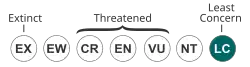
Scientists from the IUCN say this frog is not in danger of dying out. The governments of Brazil and Paraguay say there is not enough information to say. The main danger to the frog is humans changing the places where the frogs live to make farms, tree farms, and places for humans to live. Scientists have found the dangerous fungus Batrachochytrium dendrobatidis near where the frogs used to live, but they do not know if chytridiomycosis kills the frog.[1]
References
- 1 2 3 4 5 6 IUCN SSC Amphibian Specialist Group (2023). "Four-eyed Frog: Pleurodema bibroni". IUCN Red List of Threatened Species. 2023: e.T57281A168937658. doi:10.2305/IUCN.UK.2023-1.RLTS.T57281A168937658.en. Retrieved March 26, 2026.
- 1 2 Frost, Darrel R. "Pleurodema bibroni Tschudi, 1838". Amphibian Species of the World, an Online Reference. Version 6.0. American Museum of Natural History, New York. Retrieved March 26, 2026.
- 1 2 3 "Pleurodema bibroni Tschudi, 1838". AmphibiaWeb. University of California, Berkeley. Retrieved March 26, 2026.