Pleurodema alium
| Pleurodema alium | |
|---|---|
Scientific classification  | |
| Kingdom: | Animalia |
| Phylum: | Chordata |
| Class: | Amphibia |
| Order: | Anura |
| Family: | Leptodactylidae |
| Genus: | Pleurodema |
| Species: | P. alium |
| Binomial name | |
| Pleurodema alium Maciel and Nunes, 2010 | |
Home
Scientists saw this frog in rocky meadows high in the hills. These frogs spend time underground or under sand. Sometimes people see it in farm fields or places where animals eat grass. Scientists have seen it between 500 and 970 m (1,640 and 3,180 ft) above sea level.[1]
Scientists saw the frog in a protected place, Parque Nacional de Grão Mogol.[1]
Young
This frog puts its eggs in water. The tadpoles swim in the water.[1]
Danger
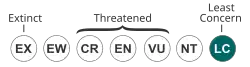
Scientists from the IUCN Red List say this frog is not in danger of dying out. In some places, it may be in some danger from people digging in the ground, farms, cows eating grass, and when people use fire to change forests into farms and places for animals to eat grass.[1]
First paper
- Maciel DB; Nunes I (2010). "A new species of four-eyed frog genus Pleurodema Tschudi, 1838 (Anura: Leiuperidae) from the rock meadows of Espinhaco range, Brazil". Zootaxa. 2640: 53–61.
References
- 1 2 3 4 5 6 IUCN SSC Amphibian Specialist Group (2023). "Pleurodema alium". IUCN Red List of Threatened Species. 2023: e.T45499600A45499603. doi:10.2305/IUCN.UK.2023-1.RLTS.T45499600A45499603.en. Retrieved April 8, 2026.
- ↑ Frost, Darrel R. "Pleurodema alium Maciel and Nunes, 2010". Amphibian Species of the World, an Online Reference. Version 6.0. American Museum of Natural History, New York. Retrieved April 8, 2026.
- ↑ "Pleurodema alium Maciel & Nunes, 2010". AmphibiaWeb. University of California, Berkeley. Retrieved April 8, 2026.