Pitcairn Island Massacre
| Massacre Day | |
|---|---|
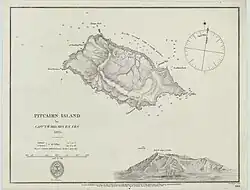 The map of the island where it took place | |
| Native name | Massacre dieh (in Pitkern) |
| Location | Pitcairn Islands |
| Coordinates | 25°4′S 130°6′W |
| Date | 20 September 1793 |
| Target | Englishmen |
Attack type | Massacre |
| Weapons | Muskets |
| Deaths | 5 |
Injured | 1 (John Adams)[1] |
| Victims | John Mills, John Williams, Isaac Martin, William Brown, Fletcher Christian |
| Perpetrators | Polynesian men |
| Motive | Slave-like Conditions |
Pitcairn Island Massacre or to the Pitcairn Islanders "Massacre day"[2] took place on the Pitcairn Islands on 20 September 1793.
Background
After leaving Tahiti on 22 September 1789, Christian sailed Bounty west in search of a safe haven. He then formed the idea of settling on Pitcairn Island, far to the east of Tahiti; the island had been reported in 1767, but its exact location was never verified. After months of searching, Christian rediscovered the island on 15 January 1790, 188 nautical miles (348 km; 216 mi) east of its recorded position.[3] This longitudinal error contributed to the mutineers' decision to settle on Pitcairn.[4]
On arrival, the ship was unloaded and stripped of most of its masts and spars, for use on the island.[5] On 23 January, five days after their arrival, as the seamen discussed whether to burn the ship, Quintal set the ship ablaze and destroyed it, either as an agreed-upon precaution against discovery or as an unauthorised act. There was now no means of escape.[6]
The island proved an ideal haven for the mutineers—uninhabited and virtually inaccessible, with plenty of food, water, and fertile land.[3] For a while, the mutineers and Tahitians existed peaceably. Christian settled down with Isabella; a son, Thursday October Christian, was the first child born on the island, and others followed.[7] Christian's authority as leader gradually diminished, and he became prone to long periods of brooding and introspection.[8]
Gradually, tensions and rivalries arose over the increasing extent to which the Europeans regarded the Tahitians as their property, in particular the women who, according to Alexander, were "passed around from one 'husband' to the other".[6] The lower-caste Tahitian man, Hu, was often a victim of the white men's beatings and abuse. Martin treated the islanders including his wife with disdain, causing increasing discord. McCoy figured out how to distill brandy from ti-root and built a still. He, Quintal, and some of the women were continually drunk. In 1791, after working side-by-side with the islanders to perform the daily tasks that sustained the colony, some of the seamen decided to loaf in the shade all day while they coerced the Polynesian men to complete the tasks too hard for the women to perform.[9]: 653
Massacre
On 20 September 1793, Mills and McCoy were leaning against a fence discussing their crop of corn when they heard shots and the distant sound of groaning.[10] Neither are alarmed by the sounds of firearms as they were used to persons shooting at birds or wild pigs.[11] A little uneasily McCoy shrugged and accepted the explanation and they resumed their conversation. Neither had any idea they were the next Europeans marked down for killing. The Polynesian men's plan, made in much secrecy the night before, was to separate Mills and McCoy. Meanwhile Teimua and Niau had carefully hidden themselves along the trail McCoy would take.[12] The ambush was effected when McKoy came running towards them. They both stood and shot at him and both missed. McCoy turned and ran the way he had come only to find Manarii, who was waiting for just such an eventuality, blocking his escape. They grappled, McCoy's brawny arms circled Manarii's waist and, with a strength born of realisation and desperation, he lifted the smallest of the Polynesians into the air and threw him over a fence into a pigsty. He backed away and looked for more attacks, but before the others could close in he doubled back and ran along the path towards Mill's plantation. His legs pumped and he breathed hard thinking his pursuers were gaining. His intention on reaching Mill's plantation was to warn him and raise the alarm among the rest of the settlers. Make some defence. But Mills, forever the trusting soul unbelievably still doubted his loyal servant Manarii would do anything to harm him. McCoy became agitated to the extreme. Meanwhile the Polynesians made their way confidently to the American, Isaac Martin's house who observed their approach and noticed the blood on them. Appearing unconcerned Manarii called out to him, "Do you know what we are doing?" "No," replied Martin backing away. "We are killing pigs."[13] They closed on him. Mananii lifted his musket and shot Martin dead Next they took the path to William Brown's plantation. 'Bounty's' assistant botanist, lived near the edge of the cliff. Teinua liked Brown and ran ahead of the others. He explained the situation and shot the botanist with powder but no lead. He told him to lie very still in the long grass and display the powder burns on his black. The others arrived but were not duped by this simple and hopeful ruse. The prone Brown was clubbed to death.[14] His face was buried in the earth as his head was split wide open by the first powerful blow.[15] He died instantly. [2]The four remaining Polynesian men stole muskets and set out to kill all of the Englishmen.[16]Within hours they beheaded Martin and Mills, shot Williams and Brown dead, and fatally wounded Christian in a carefully executed series of murders.[9]: 656 Christian was set upon while working in his fields, first shot and then butchered with an axe; his last words, supposedly, were: "Oh, dear!"[17][n 1] Three of the Englishmen's wives took revenge, killing Te Moa and Niuha. Teraura, the wife of Ned Young, beheaded Tetahiti while he slept. Quintal killed Minarii in a violent fight.[9]: 656 [19][20][21]
Aftermath
Four mutineers survived the initial attack: John Adams (then known as Alexander Smith), Ned Young, Matthew Quintal, and William McCoy.[22]
Young and Adams assumed leadership and secured a tenuous calm disrupted by the drunken behaviour of McCoy and Quintal.[3] The two men and some of the women spent their days in an alcoholic stupor. Some of the women attempted to leave the island in a makeshift boat but could not launch it successfully[23].[24]
On 20 April 1798, McCoy attached a rock to his neck with a rope and leapt over a cliff to his death. Quintal became increasingly erratic. He demanded to take Isabella, Fletcher Christian's widow, as his wife, and threatened to kill Christian's children if his demands were not granted. Ned Young and John Adams invited him to Young's home. There they overpowered him, and killed him with an axe.[25][26]
Young and Adams became interested in Christianity, and Young taught Adams to read using the Bounty's Bible. Young died of an asthma attack in 1800. By 1800, only John Adams, several Polynesian women, and their children remained, with Adams transitioning into a patriarchal, religious leader. Adams lived until 1829.[27][28]
The day became known as Massacre Day due to the bloody and retributive nature of the events that transpired, which also involved violent revenge by the mutineers' Tahitian wives.[29]
Notes
References
- ↑ https://puc.libguides.com/PISC-pitcairn-encyclopedia#:~:text=MANARII%20(Manalii%2C%20sometimes%20Menalee%20or,the%20island%2C%20left%20no%20children.
- 1 2 whalesite.org https://whalesite.org/pitcairn/bountychronicles/chronicle_massacre.htm. Retrieved 2025-05-28.
{{cite web}}: Missing or empty|title=(help) - 1 2 3 Government of Pitcairn 2000.
- ↑ Stanley 2004, pp. 288–296.
- ↑ Hough 1972, p. 286.
- 1 2 Alexander 2003, p. 369.
- ↑ Hough 1972, pp. 243, 246.
- ↑ Hough 1972, pp. 245–246.
- 1 2 3 Coenen, Dan T. (1997). "Of Pitcairn 's Island and American Constitutional Theory". William & Mary Law Review. 38 (2). Retrieved 5 March 2019.
- ↑ Meyer, Kristyn (2024-08-11). "The World's Most Remote Island Has A Dark History". TheTravel. Retrieved 2026-02-09.
- ↑ "The Company of the Bounty and Their Various Fates". law2.umkc.edu. Archived from the original on 2025-02-16. Retrieved 2026-02-09.
- ↑ Alvarez, Emily Pena. "LibGuides: Pitcairn Island Encyclopedia: Home". puc.libguides.com. Retrieved 2026-02-09.
- ↑ "Mutiny on the Bounty, Chronicles – the Pitcairn Massacre part 2". whalesite.org. Retrieved 2026-02-09.
- ↑ "Reclaiming the Bounty - Archaeology Magazine Archive". archive.archaeology.org. Retrieved 2026-02-09.
- ↑ "Harrison Christian: the infamous mutiny on the Bounty". RNZ. 2021-07-17. Retrieved 2026-02-09.
- ↑ Alvarez, Emily Pena. "LibGuides: Pitcairn Island Encyclopedia: Home". puc.libguides.com. Retrieved 2025-05-28.
- ↑ Hough 1972, pp. 254–259.
- ↑ Alexander 2003, pp. 371–372.
- ↑ "Teraura". Archived from the original on July 24, 2008. Retrieved 5 March 2019.
- ↑ Guttridge 2006, p. 86.
- ↑ "The True Story Of The Mutiny In The Bounty". December 5, 1936 – via Internet Archive.
- ↑ "Mutiny of the Bounty and story of Pitcairn Island, by Rosalind Amelia Young—A Project Gutenberg eBook". www.gutenberg.org. Retrieved 2026-02-17.
- ↑ "Pitcairn Islands Study Center". library.puc.edu. Retrieved 2026-02-09.
- ↑ Hough 1972, pp. 266–267.
- ↑ "Bounty's Crew Encyclopedia". library.puc.edu. Retrieved 5 March 2019.
- ↑ "Matthew Quintal". May 18, 2008. Archived from the original on 2008-05-18.
- ↑ Marks, Kathy (2009). Lost Paradise: From Mutiny on the Bounty to a Modern-Day Legacy of Sexual Mayhem, the Dark Secrets of Pitcairn Island Revealed. Simon and Schuster. p. 16. ISBN 9781416597841. Retrieved 5 March 2019.
- ↑ Editors, HISTORY com (2010-02-09). "Mutiny on the HMS Bounty | April 28, 1789". HISTORY. Retrieved 2026-02-09.
{{cite web}}:|last=has generic name (help) - ↑ "History of the Pitcairn Islands - History Matters". 2017-04-07. Retrieved 2025-11-20.