Physalaemus orophilus
| Physalaemus orophilus | |
|---|---|
Scientific classification  | |
| Kingdom: | Animalia |
| Phylum: | Chordata |
| Class: | Amphibia |
| Order: | Anura |
| Family: | Leptodactylidae |
| Genus: | Physalaemus |
| Species: | P. orophilus |
| Binomial name | |
| Physalaemus orophilus Cassini, Cruz, and Caramaschi, 2010 | |
Physalaemus orophilus is a frog. It lives in Brazil.[2][3][1]
Body
The adult male frog is about 21.1–24.8 mm long from nose to rear end and the adult female frog is 25.5–28.1 mm. The adult frog has a black stripe from each eye to the place where the back leg meets the body. There is a white line from the eye to where the front leg meets the body.[4]
Home
This frog lives in forests that were never cut down and forests that are growing back. Scientists have seen this frog between 800 and 1,300 m (2,600 and 4,300 ft) above sea level.[1]
There are some protected places near where scientists saw the frog lives: Reserva Particular do Patrimônio Natural da Serra do Caraça, APA Nova Era, and APA Pedra Gaforina.[1]
Young
The tadpoles swim on the bottoms of shallow ponds that dry up for part of the year. These ponds have plants in them and are near mountain streams.[1]
Danger
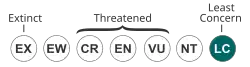
Scientists from the IUCN say this frog is not in danger of dying out. In some places, some of the frogs may be in danger when humanbeings change the places where it lives to make farms, tree farms, and places for animals to eat grass. Human beings light fires to change the forest to farmland. In some places, people collect wood to use.[1]
References
- 1 2 3 4 5 6 IUCN SSC Amphibian Specialist Group; Instituto Boitatá de Etnobiologia e Conservação da Fauna (2023). "Physalaemus orophilus". IUCN Red List of Threatened Species. 2023: e.T79101850A86255743. doi:10.2305/IUCN.UK.2023-1.RLTS.T79101850A86255743.en. Retrieved May 25, 2026.
- ↑ Frost, Darrel R. "Physalaemus orophilus Cassini, Cruz, and Caramaschi, 2010". Amphibian Species of the World, an Online Reference. Version 6.0. American Museum of Natural History, New York. Retrieved May 25, 2026.
- ↑ "Physalaemus orophilus Cassini, Cruz, & Caramaschi, 2010". AmphibiaWeb. University of California, Berkeley. Retrieved May 25, 2026.
- ↑ Cassini CS; Cruz CAG; Caramaschi U (2010). "Taxonomic review of Physalaemus olfersii (Lichtenstein & Martens, 1856) with revalidation of Physalaemus lateristriga (Steindachner, 1864) and description of two new related species (Anura: Leiuperidae)". Zootaxa (Full text). 2491: 1–33. doi:10.5281/zenodo.195620. Retrieved May 25, 2026.