Physalaemus nattereri
| Physalaemus nattereri | |
|---|---|
 | |
Scientific classification  | |
| Kingdom: | Animalia |
| Phylum: | Chordata |
| Class: | Amphibia |
| Order: | Anura |
| Family: | Leptodactylidae |
| Genus: | Physalaemus |
| Species: | P. nattereri |
| Binomial name | |
| Physalaemus nattereri (Steindachner, 1863) | |
 | |
| Synonyms[2] | |
| |
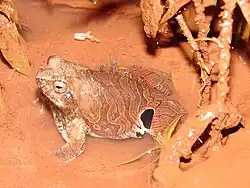
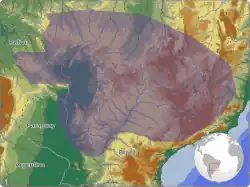
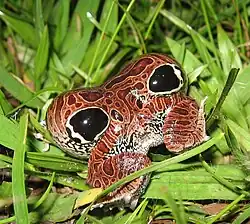
The Cuyaba dwarf frog (Physalaemus nattereri) is a frog. It lives in Brazil, Bolivia, and Paraguay.[2][3][1]
Home
This frog lives underground. It lives in places that are dry but not too dry. It lives in Atlantic forest, Pantanal, and grassy places in the Cerrado places. People see it on the ground near water. Scientists have seen it between 0 and 1,500 m (0 and 4,921 ft) above sea level. [1]
Scientists have seen the frog in protected places and its home is in or near others: PA Corumbatai, Botucatu e Tejupa Perimetro Corumbatai, APA da Chapada dos Guimaraes, APA da Escarpa Devoniana (Campos Gerais), APA da Sub-Bacia do Rio Apore, APA das Nascentes do Rio Vermelho, APA Rio Batalha, ESEC dos Caetetus, ESEC Serra Geral do Tocantins, PARES do Morro do Diabo, PARNA dos Campos Gerais, RPPN Estancia Santa Ines, RPPN Fazenda Boqueirao, RPPN Fazenda Sao Jose, and RPPN Olavo Egydio Setubal.[1]
Young
Uses
Human beings study the chemicals in the frogs' skin to see if they can kill small living things and stop pain.[1]
Danger
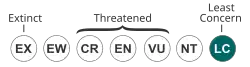
Scientists from the IUCN say this frog is not in danger of dying out. In some places, human beings change the Cerrado where the frog lives to make farms, for example soybean-only farms and places for cows to eat grass. Scientists think this could hurt the frogs.[1]
Papers
- Steindachner F. (1863). "Über einige neue Batrachier aus den Sammlungen des Wiener Museums". Sitzungsberichte der Kaiserlichen Akademie der Wissenschaften, Mathematisch-Naturwissenschaftliche Classe. 48: 186–192.
- Recognized by Nascimento LB; Caramaschi U; Cruz CAG (2005). "Taxonomic review of the species group of the genus Physalameus Fitzinger, 1826 with revalidation of the genera Engystomops Jimenez- de-la-Espada, 1872 and Eupemphix Steindachner, 1836 (Amphibia, Anura, Leptodactylidae)". Arquivos do Museu Nacional. Rio de Janeiro. 63: 297–320.
References
- 1 2 3 4 5 6 7 IUCN SSC Amphibian Specialist Group; Instituto Boitatá de Etnobiologia e Conservação da Fauna (2023). "Cuyaba Dwarf Frog: Physalaemus nattereri". IUCN Red List of Threatened Species. 2023: e.T57267A148971050. doi:10.2305/IUCN.UK.2023-1.RLTS.T57267A148971050.en. Retrieved April 18, 2026.
- 1 2 Frost, Darrel R. "Physalaemus nattereri (Steindachner, 1863)". Amphibian Species of the World, an Online Reference. Version 6.0. American Museum of Natural History, New York. Retrieved April 18, 2026.
- ↑ "Physalaemus nattereri (Steindachner, 1863)". AmphibiaWeb. University of California, Berkeley. Retrieved April 18, 2026.