Physalaemus maculiventris
| Physalaemus maculiventris | |
|---|---|
 | |
Scientific classification  | |
| Kingdom: | Animalia |
| Phylum: | Chordata |
| Class: | Amphibia |
| Order: | Anura |
| Family: | Leptodactylidae |
| Genus: | Physalaemus |
| Species: | P. maculiventris |
| Binomial name | |
| Physalaemus maculiventris (Lutz, 1925) | |
| Synonyms[2] | |
| |
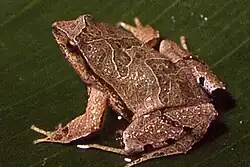
The Mantagnes dwarf frog (Physalaemus maculiventris) is a frog. It lives in Brazil.[2][3][1]
Home
This frog lives in forests that were never cut down and forests that are growing back but cannot live anywhere that is not a forest. People see it on dead leaves on the ground near water that dries up for part of the year. Scientists have seen this frog between 800 and 1,200 m (2,600 and 3,900 ft) above sea level. Scientists have seen the frog in protected places.[1]
Young
The two adult frogs make a nest out of bubbles for the eggs in a body of water that is not there all year. The eggs hatch into tadpoles, not small froglets.[1]
Danger
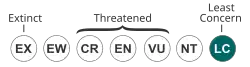
Scientists from the IUCN say this frog is not in danger of dying out. The frogs may be in some danger from people cutting down too many trees to make towns, big and small farms, tree farms, and places for cows to eat grass.[1]
References
- 1 2 3 4 5 IUCN SSC Amphibian Specialist Group; Instituto Boitatá de Etnobiologia e Conservação da Fauna (2023). "Mantagnes Dwarf Frog: Physalaemus maculiventris". IUCN Red List of Threatened Species. 2023: e.T57263A172228674. doi:10.2305/IUCN.UK.2023-1.RLTS.T57263A172228674.en. Retrieved April 28, 2026.
- 1 2 Frost, Darrel R. "Physalaemus maculiventris (Lutz, 1925)". Amphibian Species of the World, an Online Reference. Version 6.0. American Museum of Natural History, New York. Retrieved April 28, 2026.
- ↑ "Physalaemus maculiventris (Lutz, 1925)". AmphibiaWeb. University of California, Berkeley. Retrieved April 28, 2026.