Physalaemus lateristriga
| Physalaemus lateristriga | |
|---|---|
Scientific classification  | |
| Kingdom: | Animalia |
| Phylum: | Chordata |
| Class: | Amphibia |
| Order: | Anura |
| Family: | Leptodactylidae |
| Genus: | Physalaemus |
| Species: | P. lateristriga |
| Binomial name | |
| Physalaemus lateristriga (Steindachner, 1864) | |
| Synonyms[2] | |
| |
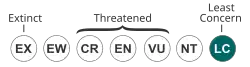
Physalaemus lateristriga is a frog. It lives in Brazil.[2][3][1]
Body
The adult male frog is 30.3–37.8 mm long from nose to rear end and the adult female frog is 32.6–40.3 mm. The skin of the frog's back is gray or light brown in color. There is a line down the middle of the back. There is a black stripe on each side of the body. The upper eyelid has a white line on it. There is a dark brown rectangle on the top of each front leg and brown stripes on the tops of the back legs. There is a brown mark further down on each back leg near the heel. There are white spots on the belly. The bottoms of all four feet are red in color.[4]
Home
This frog lives in grassy places, rainforests, and the edges of forests. People see them near ponds, rivers, and streams with plants nearby. People have also seen them in places where animals eat grass and forests that were cut down and are growing back. Scientists have seen it between 45 and 980 m (148 and 3,215 ft) above sea level.[1]
Scientists have seen the frog in protected places, for example Curitiba City Parks and Campos Gerais National Park.[1]
Young
The young hatch out of eggs as tadpoles, not small froglets.[1]
Danger
Scientists from the IUCN say this frog is not in danger of dying out. The frog's home has a lot of Atlantic forest in it. In some parts of the frog's home, human beings cut down many trees to make towns, big and small farms, tree farms, and places for cows to eat grass. People used to cut down trees to get wood to use but now people only take a little wood.[1]
References
- 1 2 3 4 5 6 IUCN SSC Amphibian Specialist Group; Instituto Boitatá de Etnobiologia e Conservação da Fauna (2023). "Steindachner's Dwarf Frog: Physalaemus lateristriga". IUCN Red List of Threatened Species. 2023: e.T89158413A136879314. doi:10.2305/IUCN.UK.2023-1.RLTS.T89158413A136879314.en. Retrieved April 20, 2026.
- 1 2 Frost, Darrel R. "Physalaemus lateristriga (Steindachner, 1864)". Amphibian Species of the World, an Online Reference. Version 6.0. American Museum of Natural History, New York. Retrieved April 20, 2026.
- ↑ "Physalaemus lateristriga (Steindachner, 1864)". AmphibiaWeb. University of California, Berkeley. Retrieved April 20, 2026.
- ↑ Cassini CS; Cruz CAG; Caramaschi U (2010). "Taxonomic review of Physalaemus olfersii (Lichtenstein & Martens, 1856) with revalidation of Physalaemus lateristriga (Steindachner, 1864) and description of two new related species (Anura: Leiuperidae)". Zootaxa (Full text). 2491: 1–33. doi:10.5281/zenodo.195620. Retrieved April 20, 2026.