Physalaemus insperatus
| Physalaemus insperatus | |
|---|---|
Scientific classification  | |
| Kingdom: | Animalia |
| Phylum: | Chordata |
| Class: | Amphibia |
| Order: | Anura |
| Family: | Leptodactylidae |
| Genus: | Physalaemus |
| Species: | P. insperatus |
| Binomial name | |
| Physalaemus insperatus Cruz, Cassini, and Caramaschi, 2008 | |
Physalaemus insperatus is a frog. It lives in Brazil.[2][3][1]
Home
Scientists found the frog in exactly one place, a steep place with forest that has never been cut down. They found it in 1951 and have not gone back to look for it since then. Later, other scientists looked at dead frogs that had been put in a museum. So they did not see the frog looking for food or laying its eggs, but they think it lives on the dead leaves on the ground and puts its eggs in pools of water because that is what other frogs in Physalaemus do.[1]
Scientists found the frog in a protected place, APA Guaratuba.[1]
Danger
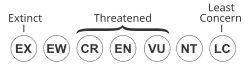
Scientists from the IUCN say they do not know if the frog is in danger of dying out. Scientists found the frog on steep hills with forests on them. These forests are not in danger. But if the frogs also live somewhere else, they might be in danger in those places.[1]
First paper
- Cruz CAG; Cassini CS; Caramaschi U (2008). "A new species of the genus Physalaemus Fitzinger, 1826 (Anura, Leiuperidae) from southern Brazil". South American Journal of Herpetology (Abstract). 3 (3): 239–243. doi:10.2994/1808-9798-3.3.239. Retrieved May 24, 2026.
References
- 1 2 3 4 5 IUCN SSC Amphibian Specialist Group; Instituto Boitatá de Etnobiologia e Conservação da Fauna (2023). "Physalaemus insperatus". IUCN Red List of Threatened Species. 2023: e.T158537A172240450. doi:10.2305/IUCN.UK.2023-1.RLTS.T158537A172240450.en. Retrieved May 24, 2026.
- ↑ Frost, Darrel R. "Physalaemus insperatus Cruz, Cassini, and Caramaschi, 2008". Amphibian Species of the World, an Online Reference. Version 6.0. American Museum of Natural History, New York. Retrieved May 24, 2026.
- ↑ "Physalaemus insperatus Cruz, Cassini, & Caramaschi, 2008". AmphibiaWeb. University of California, Berkeley. Retrieved May 24, 2026.