Physalaemus ephippifer
| Physalaemus ephippifer | |
|---|---|
 | |
Scientific classification  | |
| Kingdom: | Animalia |
| Phylum: | Chordata |
| Class: | Amphibia |
| Order: | Anura |
| Family: | Leptodactylidae |
| Genus: | Physalaemus |
| Species: | P. ephippifer |
| Binomial name | |
| Physalaemus ephippifer (Steindachner, 1864) | |
| Synonyms[2] | |
| |
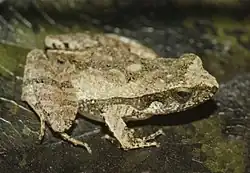
Steindachner's dwarf frog (Physalaemus ephippifer) is a frog. It lives in Brazil. Scientists think it could also live in Guyana, French Guiana, Suriname, and Venezuela.[2][3][1]
Body
This frog is 21.0- 39.6 mm long from nose to rear end.[3]
Home
This frog is awake at night and buries itself in sand during the day.[3] It lives in rainforests. People have also seen it in places that human beings have changed. Scientists have seen it between 0 and 350 m (0 and 1,148 ft) above sea level. [1]
Scientists have seen the frog in protected places.[1]
Young
The adult frog makes a nest out of bubbles for the eggs. The foam nest lasts for four days and then melts into the water. The eggs hatch on the third day. After that, the tadpoles swim in the water.[3]
Danger
Scientists from the IUCN say this frog is not in danger of dying out.[1]
References
- 1 2 3 4 5 IUCN SSC Amphibian Specialist Group; Instituto Boitatá de Etnobiologia e Conservação da Fauna (2023). "Steindachner's Dwarf Frog: Physalaemus ephippifer". IUCN Red List of Threatened Species. 2023: e.T57252A109540867. doi:10.2305/IUCN.UK.2023-1.RLTS.T57252A109540867.en. Retrieved April 19, 2026.
- 1 2 Frost, Darrel R. "Physalaemus ephippifer (Steindachner, 1864)". Amphibian Species of the World, an Online Reference. Version 6.0. American Museum of Natural History, New York. Retrieved April 19, 2026.
- 1 2 3 4 Keith Lui; Kellie Whittaker (July 13, 2009). Kellie Whittaker (ed.). "Physalaemus ephippifer (Steindachner, 1864)". AmphibiaWeb. University of California, Berkeley. Retrieved April 19, 2026.