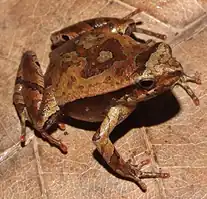
Physalaemus camacan
| Physalaemus camacan | |
|---|---|
 | |
Scientific classification  | |
| Kingdom: | Animalia |
| Phylum: | Chordata |
| Class: | Amphibia |
| Order: | Anura |
| Family: | Leptodactylidae |
| Genus: | Physalaemus |
| Species: | P. camacan |
| Binomial name | |
| Physalaemus camacan Pimenta, Cruz, and Silvano, 2005 | |
Home
This frog lives on the dead leaves on the ground in forests that were never cut down, forests that are growing back, places where people cut down some trees but not all of them, and some cacao farms and rubber tree farms. Scientists have seen this frog between 35 and 200 m (115 and 656 ft) above sea level.[1][4]
Scientists have seen the frog in protected places: APA Costa de Itacare/Serra Grande, APA Lagoa Encantada, PARES Ponta da Tulha, and REBIO de Una.[1]
Young
The male frogs sit near or on the water and call to the female frogs. This frog lays eggs in nests made out of bubbles.[1]
Danger
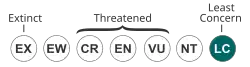
Scientists from the IUCN say this frog is not in danger of dying out. There are large pieces of forest in the frog's home, and when human beings do change the forest, they often change it to farms that need shade, so they need trees. For example, many cacao farms do this. In other places, the frogs may be in some danger when people cut down forests to make farms, places for animals to eat grass, and other tree farms.[1]
References
- 1 2 3 4 5 6 IUCN SSC Amphibian Specialist Group; Instituto Boitatá de Etnobiologia e Conservação da Fauna (2023). "Physalaemus camacan". IUCN Red List of Threatened Species. 2023: e.T135997A172237591. doi:10.2305/IUCN.UK.2023-1.RLTS.T135997A172237591.en. Retrieved May 21, 2026.
- ↑ Frost, Darrel R. "Physalaemus camacan Pimenta, Cruz, and Silvano, 2005". Amphibian Species of the World, an Online Reference. Version 6.0. American Museum of Natural History, New York. Retrieved May 21, 2026.
- ↑ "Physalaemus camacan Pimenta, Cruz, & Silvano, 2005". AmphibiaWeb. University of California, Berkeley. Retrieved May 21, 2026.
- ↑ Pimenta B; Goncalves Cruz CA; Silvano DL (2005). "A new species of the genus Physalaemus Fitzinger, 1826 (Anura: Leptodactylidae) from the Atlantic rain forest of southern Bahia, Brazil". Amphibia-Reptilia (Abstract). 26: 201–210. doi:10.1163/1568538054253483. Retrieved May 21, 2026.