Physalaemus biligonigerus
| Physalaemus biligonigerus | |
|---|---|
 | |
Scientific classification  | |
| Kingdom: | Animalia |
| Phylum: | Chordata |
| Class: | Amphibia |
| Order: | Anura |
| Family: | Leptodactylidae |
| Genus: | Physalaemus |
| Species: | P. biligonigerus |
| Binomial name | |
| Physalaemus biligonigerus (Cope, 1861) | |
| Synonyms[2] | |
| |
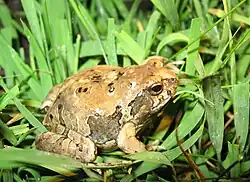
The weeping frog (Physalaemus biligonigerus) is a frog. It lives in Brazil, Argentina, Bolivia, Paraguay, and Uruguay.[2][3][1]
Home
This frog lives in grassy places not far from water. In Brazil, this frog lives in Cerrado and Pampa places. It does not live in forests. This frog is good at living in places that people have changed. Scientists have seen it between 0 and 1,400 m (0 and 4,593 ft) above sea level.[1]
Scientists have seen the frog in protected places: Parque Estadual Itapeva, Parque Nacional da Lagoa do Peixe, and Reserva Biológica Lami Jose Lutzenberger.[1]
Young
The male frog sits near or in the water and calls to the female frogs. The female frog puts her eggs in a round nest made out of bubbles on top of the water. The female frogs have many eggs each year.[1]
Danger
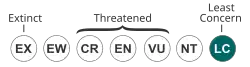
Scientists from the IUCN, Uruguay, and Paraguay say this frog is not in danger of dying out. In some places, it is in some danger. For example, in Argentina, people change the Chaco to make farms and get wood to use. Chemicals from farms can make the water bad, which can hurt the frog.[1]
Sometimes people catch this frog to sell as a pet.[1]
References
- 1 2 3 4 5 6 7 IUCN SSC Amphibian Specialist Group; Instituto Boitatá de Etnobiologia e Conservação da Fauna (2023). "Weeping Frog: Physalaemus biligonigerus". IUCN Red List of Threatened Species. 2023: e.T88427645A101431121. doi:10.2305/IUCN.UK.2023-1.RLTS.T88427645A101431121.en. Retrieved April 14, 2026.
- 1 2 Frost, Darrel R. "Physalaemus biligonigerus (Cope, 1861)". Amphibian Species of the World, an Online Reference. Version 6.0. American Museum of Natural History, New York. Retrieved April 14, 2026.
- ↑ "Physalaemus biligonigerus (Cope, 1861)". AmphibiaWeb. University of California, Berkeley. Retrieved April 14, 2026.