Physalaemus barrioi
| Physalaemus barrioi | |
|---|---|
 | |
Scientific classification  | |
| Kingdom: | Animalia |
| Phylum: | Chordata |
| Class: | Amphibia |
| Order: | Anura |
| Family: | Leptodactylidae |
| Genus: | Physalaemus |
| Species: | P. barrioi |
| Binomial name | |
| Physalaemus barrioi Bokermann, 1967 | |
The Bocaina dwarf frog (Physalaemus barrioi) is a frog. It lives in Brazil.[2][3][1]
Body
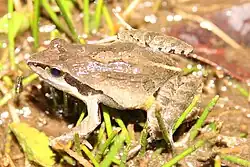
The adult frog is 26.2 mm long from nose to rear end. It has short front legs and no webbed skin on any of its four feet. The iris of the eye is gold in color on top and brown in color on the bottom and sides. There is red, yellow, and black color near where the back legs meet the body.[3]
Home
The frog lives on the ground in grassy places in the Serra do Bocaina in Brazil's Atlantic forest place. People find it near water. Scientists have seen this frog between 1,550 and 1,600 m (5,090 and 5,250 ft) above sea level.[1]
Scientists have seen the frog in a protected place: Parque Nacional da Serra da Bocaina.[1]
Young
This from has young in wetlands without trees that stay wet all year. The adult frog makes a nest out of bubbles for the eggs. The nest floats on the water. After the eggs hatch, the tadpoles swim in shallow water with clay on the bottom and water plants in the water.[1] The tadpoles stay near the bottom.[3]
Danger
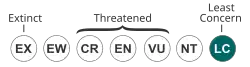
Scientists from the IUCN say this frog is not in big danger of dying out.[1]
References
- 1 2 3 4 5 6 IUCN SSC Amphibian Specialist Group; Instituto Boitatá de Etnobiologia e Conservação da Fauna (2023). "Bocaina Dwarf Frog: Physalaemus barrioi". IUCN Red List of Threatened Species. 2023: e.T57241A172227626. doi:10.2305/IUCN.UK.2023-1.RLTS.T57241A172227626.en. Retrieved May 10, 2026.
- ↑ Frost, Darrel R. "Physalaemus barrioi Bokermann, 1967". Amphibian Species of the World, an Online Reference. Version 6.0. American Museum of Natural History, New York. Retrieved May 10, 2026.
- 1 2 3 Diogo B. Provete (July 9, 2012). Michelle S. Koo (ed.). "Physalaemus barrioi Bokermann, 1967". AmphibiaWeb. University of California, Berkeley. Retrieved May 10, 2026.