Physalaemus atlanticus
| Physalaemus atlanticus | |
|---|---|
 | |
Scientific classification  | |
| Kingdom: | Animalia |
| Phylum: | Chordata |
| Class: | Amphibia |
| Order: | Anura |
| Family: | Leptodactylidae |
| Genus: | Physalaemus |
| Species: | P. atlanticus |
| Binomial name | |
| Physalaemus atlanticus Haddad and Sazima, 2004 | |
| Synonyms[2] | |
| |
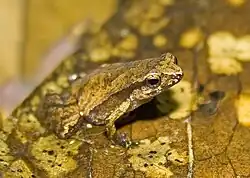
Physalaemus atlanticus is a frog. It lives in Brazil.[2][3][1]
Body
The adult male frog is 20.1 22.1 mm long from nose to rear end and the adult female frog is 21.0-23.9 mm long. Its belly is orange in color.[4]
Home
People see the frog on the dead leaves on the ground in rainforests that are not too far from the ocean. Scientists have seen this frog between 0 and 50 m (0 and 164 ft) above sea level.[1][2]
Most of the frog's home is inside a protected place: Parque Estadual da Serra do Mar.[1]
Young
This frog lays eggs in nests made out of bubbles in ponds. The nests float on the water or is on wet dead leaves.[1]
Danger
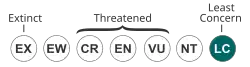
Scientists from the IUCN say this frog is not in danger of dying out. The frog lives in Serra do Mar, and there are large forests there. Only a few of the frogs are in danger. Human beings change the forests to make towns, farms, tree farms, and places for animals to eat grass.[1]
References
- 1 2 3 4 5 6 IUCN SSC Amphibian Specialist Group; Instituto Boitatá de Etnobiologia e Conservação da Fauna (2023). "Physalaemus atlanticus". IUCN Red List of Threatened Species. 2023: e.T57240A172227542. doi:10.2305/IUCN.UK.2023-1.RLTS.T57240A172227542.en. Retrieved May 16, 2026.
- 1 2 3 Frost, Darrel R. "Physalaemus atlanticus Haddad and Sazima, 2004". Amphibian Species of the World, an Online Reference. Version 6.0. American Museum of Natural History, New York. Retrieved May 16, 2026.
- ↑ "Physalaemus atlanticus Haddad & Sazima, 2004". AmphibiaWeb. University of California, Berkeley. Retrieved May 16, 2026.
- ↑ C.F.B. HADDAD; I. SAZIMA (2004). "A new species of Physalaemus (Amphibia; Leptodactylidae) from the Atlantic forest in southeastern Brazil". Zootaxa (Abstract and references). 479 (1): 1–12. doi:10.11646/zootaxa.479.1.1. Retrieved May 16, 2026.