Philippine–American War
| Philippine–American War | |||||||||
|---|---|---|---|---|---|---|---|---|---|
| |||||||||
| Belligerents | |||||||||
|
1899–1902:
|
1899–1902:[a]
| ||||||||
|
1902–1913:
|
1902–1913: Tagalog Republic (until 1906)  Maguindanao Sultanate (until 1905)  Sulu Sultanate | ||||||||
| Commanders and leaders | |||||||||
|
| ||||||||
| Units involved | |||||||||
|
1899–1902:
1902–1913:
|
1899–1902:
1902–1913  Irreconcilables  Babaylanes Pulajanes Moro people | ||||||||
| Strength | |||||||||
|
≈80,000–100,000 regular and irregular[3] | |||||||||
| Casualties and losses | |||||||||
|
1,020 killed 3,176 died of disease 2,930 wounded[4] |
About 10,000 killed[5] (Emilio Aguinaldo estimate), 16,000–20,000 killed[6] (American estimate) | ||||||||
| 200,000–250,000 civilian deaths[lower-roman 2] | |||||||||
| |||||||||
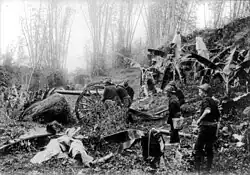
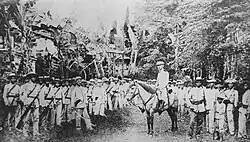
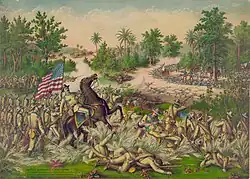
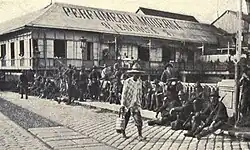
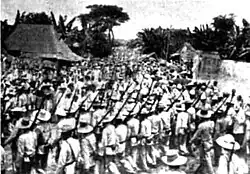
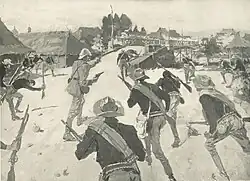
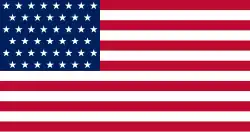


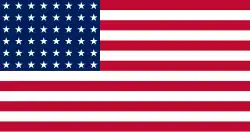



The Philippine–American War, also known as the Philippine War, the Philippine Insurrection and the Tagalog Insurgency[8][9] (Tagalog: Digmaang Pilipino-Amerikano, Spanish: Guerra Filipino-Estadounidense) was an armed conflict between the First Philippine Republic (Spanish: República Filipina, Tagalog: Republikang Pilipino) and the United States from 4 February 1899 to 2 July 1902.[10] This war was an another Filippino continuous fight beginning in 1896 with the successful Philippine Revolution. The cause of the war was because the Philippines opposed many provisions stated in the Treaty of Paris which the United States brought the Philippines from the Spanish Empire, ending the Spanish–American War.[11]
The fight began on 4 February 1898 between the United States and the First Philippine Republic, in the second battle of Manila. On 2 June 1899, the First Philippine Republic officially declared war on the United States.[12][13] The war ended on 2 July 1902, with a decisive United States victory. However, Filipino revolutionary groups like the Katipunan continued to fight against the U.S. for several years, one of the leaders were General Macario Sakay, a former veteran of the Katipunan, who was the leader of the Tagalog Republic which was established in 1902 after the arrest of Filipino President Emilio Aguinaldo. Other groups like the Moro people continued to fight in other places until their defeat at the Battle of Bud Bud Bagsak on 15 June 1913.
The war and the United States occupation changed the culture of many islands, because Filipino deaths were around 200–250.000 deaths,[14][15][16][17][18][19][20][21] and establishing English in Filipino islands as the official language of the government, education, business, infrastructure continued in many decades. The occupation of the Philippines faced severe opposition from the natives which forced the United States to slowly giving the nation independent.
In 1902, the United States Congress passed the Philippine Organic Act to create the Philippine Assembly which members of the Assembly will be elected by the Filipino people.[22] This will be replaced by the 1916 Jones Act which stated the United States' commitment to give the Philippines independence.[23] The Philippine Independence Act of 1934 established the Commonwealth of the Philippines the same year. This was a limited self-governance state, but increasing independence following years (it was set to be 1944. However, it was delayed because of World War II, particularly the Japanese invasion and occupation, combined with the Philippines campaign at the time). The United States gave the Philippines independence in 1946 by withdrawing and recognizing the state's sovereignty following the Treaty of Manila.
Notes
- ↑ The Philippine Republic was de jure dissolved in 1901 when Emilio Aguinaldo surrendered himself to the Americans and announce the Philippine people to lay down their weapons. However, his unofficial successor Miguel Malvar continued the fight without formal recognition of the people until his surrender in 1902.
References
- ↑ "Diplomatic relations between the Philippines and Japan". Diplomatic relations. Manila: Official Gazette of the Republic of the Philippines. 2016. Archived from the original on 2017-02-02. Retrieved 25 December 2016.
On 4 February 1899, the Philippine-American War broke out. A handful of Japanese shishi, or ultranationalists, fought alongside President Aguinaldo's army. They landed in Manila, led by Captain Hara Tei and joined Aguinaldo's forces in Bataan.
- ↑ Deady 2005, p. 62 (p.10 of the pdf)
- 1 2 Deady 2005, p. 55 (p.3 of the pdf)
- ↑ John W. Chambers, II, ed. in chief, "The Oxford Companion to American Military History." (Oxford University Press, 1999, ISBN 0-19-507198-0), 849.
- ↑ Aguinaldo, E. (2016). A Second Look at America (Classic Reprint). Fb&c Limited. p. 131. ISBN 978-1-333-84114-0. Retrieved 2022-11-17.
- ↑ Burdeos 2008, p. 14
- ↑ Ramsey 2007, p. 103.
- ↑ Battjes 2011, p. 74.
- ↑ Silbey 2008, p. 15.
- ↑ Worcester 1914, p. 293. sfn error: multiple targets (2×): CITEREFWorcester1914 (help)
- ↑ Randolph 2009.
- ↑ Kalaw 1927, pp. 199–200.
- ↑ Paterno, Pedro Alejandro (2 June 1899). "Pedro Paterno's Proclamation of War". The Philippine-American War Documents. San Pablo City, Philippines: MSC Institute of Technology, Inc. Retrieved 25 December 2016.
- ↑ Clodfelter, Michael, Warfare and Armed Conflict: A Statistical Reference to Casualty and Other Figures, 1618-1991
- ↑ Leon Wolff, Little Brown Brother (1961) p.360
- ↑ Benjamin A. Valentino, Final solutions: mass killing and genocide in the twentieth century (2005) p.27
- ↑ FAS 2000: Federation of American Scientists, The World at War (2000)
- ↑ Philip Sheldon Foner, The Spanish-Cuban-American War and the Birth of American Imperialism (1972) p.626
- ↑ George C. Herring, From colony to superpower: The United States' foreign relations since 1776 (2008) p.329
- ↑ Graff, American Imperialism and the Philippine Insurrection (1969)
- ↑ Irving Werstein, 1898: The Spanish American War: told with pictures (1966) p.124
- ↑ http://www.thecorpusjuris.com/constitutions/philippine-bill-of-1902.php
- ↑ In the "Instructions of the President to the Philippine Commission Archived 27 February 2009 at the Wayback Machine" dated 7 April 1900, President William McKinley reiterated the intentions of the United States Government to establish and organize governments, essentially popular in their form, in the municipal and provincial administrative divisions of the Philippine Islands. However, there was no official mention of any declaration of Philippine Independence.
- Template:Cite publisher
- Template:Cite publisher
<ref> tag with name "JHUG20060410" defined in <references> is not used in prior text. ().Cite error: Cite error: <ref> tag with name "Smallman1998" defined in <references> is not used in prior text. ().Sources
- Agoncillo, Teodoro A. (1990) [1960]. History of the Filipino People (Eighth ed.). Quezon City: Garotech Publishing. ISBN 978-9718711064.
- Agoncillo, Teodoro A. (1997). Malolos: The crisis of the republic. Philippine studies reprint series. Quezon City: University of the Philippines Press. ISBN 978-9715420969.
- Aguinaldo, Don Emilio (1899). True version of the Philippine revolution. Tarlac, Philippines: self-published.
- Anderson, Gerald R. (2009). Subic Bay from Magellan to Pinatubo: The History of the United States Naval Station, Subic Bay. Gerald Anderson. ISBN 978-1-4414-4452-3.
- Arnold, James R. (2011). The Moro War: How America Battled a Muslim Insurgency in the Philippine Jungle, 1902-1913. New York City: Bloomsbury Publishing. ISBN 978-1-60819-365-3.
- Battjes, Mark E. (2011). Protecting, Isolating, and Controlling Behavior: Population and Resource Control Measures in Counterinsurgency Campaigns (PDF). United States Army Combined Arms Center, Fort Leavenworth, Kansas: Combat Studies Institute Press. ISBN 978-0-9837226-6-3. Archived from the original (PDF) on 10 April 2020. Retrieved 12 May 2017.
- Bayor, Ronald H. (2004). The Columbia Documentary History of Race and Ethnicity in America. Columbia University Press. ISBN 0-231-11994-1.
- Birtle, Andrew J. (1998). U.S. Army counterinsurgency and contingency operations doctrine 1860–1941. Washington, D.C.: United States Government Publishing Office. ISBN 978-0-16-061324-1.
- Blitz, Amy (2000). The Contested State: American Foreign Policy and Regime Change in the Philippines. Rowman & Littlefield. ISBN 0-8476-9935-8.
- Boot, Max (2014). The Savage Wars Of Peace: Small Wars And The Rise Of American Power (Revised ed.). New York City: Basic Books. ISBN 978-0-465-03866-4.
- Brands, Henry William (1992). Bound to Empire: The United States and the Philippines. Oxford: Oxford University Press. ISBN 0-19-507104-2.
- Brody, David (2010). Visualizing American Empire: Orientalism and Imperialism in the Philippines. Chicago: University of Chicago Press. ISBN 978-0226075341.
- Brooks, Van Wyck (1920). Ordeal of Mark Twain. E.P. Dutton & Company.
- Chambers, John W.; Anderson, Fred (1999). The Oxford Companion to American Military History. Oxford: Oxford University Press. ISBN 0-19-507198-0.
- Chapman, William (1988). Inside the Philippine revolution. I.B.Tauris. ISBN 978-1-85043-114-5.
- Coker, Kathy R. (1989). The Signal Corps and the United States Army Regimental System. United States Army Signal Center.
- Coker, Kathy R.; Stokes, Carol E. (1991). A Concise History of the United States Army Signal Corps. United States Army Signal Center.
- Constantino, Renato (1975). The Philippines: A Past Revisited. Renato Constantino. ISBN 978-971-8958-00-1. (note: page number info in short footnotes citing this work may be incorrect—work is underway to correct this)
- Halstead, Murat (1898). The Story of the Philippines and Our New Possessions, Including the Ladrones, Hawaii, Cuba and Porto Rico. Chicago: Our Possessions Publishing Company.
- Deady, Timothy K. (2005). "Lessons from a Successful Counterinsurgency: The Philippines, 1899–1902" (PDF). Parameters. 35 (1). Carlisle, Pennsylvania: United States Army War College: 53–68. Archived from the original (PDF) on 10 December 2016. Retrieved 12 May 2017.
- Dolan, Ronald E., ed. (1991). "United States Rule". Philippines: A Country Study. Washington, D.C.: United States Library of Congress.
- Escalante, Rene R. (2007). The Bearer of Pax Americana: The Philippine Career of William H. Taft 1900-1903. Quezon City: New Day Publishers. ISBN 978-971-10-1166-6.
- Feuer, A. B. (2002). America at War: The Philippines, 1898–1913. Santa Barbara, California: Greenwood Publishing Group. ISBN 0-275-96821-9.
- Francisco, Luzviminda; Jenkins, Shirley; Taruc, Luis; Constantino, Renato; et al. (1999). Schirmer, Daniel B.; Shalom, Stephen Rosskamm (eds.). The Philippines Reader: A History of Colonialism, Neocolonialism, Dictatorship, and Resistance. Brooklyn, New York: South End Press. ISBN 978-0896082755.
- Gates, John M. (1973). Schoolbooks and Krags: The United States Army in the Philippines, 1898–1902. Santa Barbara, California: Greenwood Publishing Group. ISBN 0-8371-5818-4.
- Gates, John M. (1983). War-Related Deaths in the Philippines, 1898–1902. Vol. 53.
- Gates, John M. (2002). The United States Army and Irregular Warfare (PDF). Wooster, Ohio: The College of Wooster.
- Giddings, Howard A. (1900). Exploits of the Signal Corps In the War With Spain. Hudson-Kimberly Publishing Co. pp. 15–16, 83.
- Golay, Frank Hindman (2004). Face of Empire: United States-Philippine Relations, 1898-1946. Quezon City: Ateneo de Manila University Press. ISBN 978-1881261179.
- Guevara, Sulpico, ed. (1972). The laws of the first Philippine Republic (the laws of Malolos) 1898–1899. Ann Arbor, Michigan: University of Michigan Library.
- Hack, Karl; Rettig, Tobias (2006). Colonial Armies in Southeast Asia (Routledge Studies in the Modern History of Asia). Abingdon-on-Thames, United Kingdom: Routledge. ISBN 978-0-415-33413-6.
- Halstead, Murat (1898). The Story of the Philippines and Our New Possessions, Including the Ladrones, Hawaii, Cuba and Porto Rico. Chicago: Our Possessions Publishing Company.
- Hamilton, Richard F. (2007). President McKinley and America's "New Empire". Transaction Publishers. ISBN 978-0-7658-0383-2.
- Ileto, Reynaldo Clemeña (1997). Pasyon and revolution: popular movements in the Philippines, 1840–1910. Quezon City: Ateneo de Manila University Press. ISBN 978-9715502320.
- Jaycox, Faith (2005). The Progressive Era: Eyewitness History (Eyewitness History Series). New York City: Infobase Publishing. ISBN 978-0-8160-5159-5.
- Joaquin, Nicomedes (1977). A Question of Heroes. ISBN 971-27-1545-0.
- Kalaw, Maximo Manguiat (1927). The development of Philippine politics (1872-1920). Manila: Oriental Commercial Company, Inc.
- Karnow, Stanley (1989). In Our Image: America's Empire in the Philippines. New York City: Random House. ISBN 978-030777543-6.
- Keenan, Jerry (2001). Encyclopedia of the Spanish–American & Philippine–American wars. Santa Barbara, California: ABC-CLIO. ISBN 978-1-57607-093-2.
- Kumar, Amitava (1999). Poetics/Politics: Radical Aesthetics for the Classroom. Palgrave. ISBN 0-312-21866-4.
- Lacsamana, Leodivico Cruz (1990). Philippine History and Government (2 ed.). Phoenix Publishing House, Inc. ISBN 971-06-1894-6.
- Linn, Brian McAllister (2000). The U.S. Army and counterinsurgency in the Philippine war, 1899–1902. Chapel Hill: University of North Carolina Press. ISBN 978-0807849484.
- Lone, Stewart (2007). Daily Lives of Civilians in Wartime Asia: From the Taiping Rebellion to the Vietnam War. Santa Barbara, California: Greenwood Publishing Group. ISBN 978-0313336843.
- May, Glenn Anthony (1991). Battle for Batangas: A Philippine Province at War. New Haven, Connecticut: Yale University Press. ISBN 0-300-04850-5.
- Miller, Stuart Creighton (1982). Benevolent assimilation: the American conquest of the Philippines, 1899—1903. New Haven, Connecticut: Yale University Press. ISBN 0-300-03081-9.
- Minahan, James (2002). Encyclopedia of the Stateless Nations: L-R. Santa Barbara, California: Greenwood Publishing Group. ISBN 978-0-313-32111-5.
- Paine, Albert Bigelow (1912). Mark Twain: A Biography: The Personal and Literary Life of Samuel Langhorne Clemens. Harper & Brothers.
- Painter, Nell Irvin (1989). Standing at Armageddon: The United States, 1877–1919. W. W. Norton & Company. ISBN 0-393-30588-0.
- "Race-Making and Colonial Violence in the American Empire: The Philippine–American War as Race War," Diplomatic History, Vol. 30, No. 2 (April 2006), 169–210. (version at Japanfocus.org).
- Ramsey, Robert D. III (2007). Savage Wars of Peace: Case Studies of Pacification in the Philippines, 1900–1902 (PDF). United States Army Combined Arms Center, Fort Leavenworth, Kansas: Combat Studies Institute Press. ISBN 978-0-16-078950-2. Archived from the original (PDF) on 16 January 2019. Retrieved 12 May 2017.
- Randolph, Carman Fitz (2009). "Chapter I, The Annexation of the Philippines". The Law and Policy of Annexation. Charleston, South Carolina: BiblioBazaar, LLC. ISBN 978-1-103-32481-1.
- Schirmer, Daniel B. (1972). Republic or Empire: American Resistance to the Philippine War. Schenkman. ISBN 0-87073-105-X.
- Schurman, Jacob Gould; Dewey, George; Denby, Charles Harvey; Worcester, Dean Conant (1900). Report of the Philippine Commission to the President. Vol. I. Washington, D.C.: United States Government Publishing Office.
- Sexton, William Thaddeus (1939). Soldiers in the Sun. Charleston, South Carolina: Nabu Press. ISBN 978-1179372662.
{{cite book}}: ISBN / Date incompatibility (help) - Shaw, Angel Velasco (2002). Vestiges of War: The Philippine–American War and the Aftermath of an Imperial Dream, 1899–1999. New York University Press. ISBN 0-8147-9791-1.
- Silbey, David J. (2008). A War of Frontier and Empire: The Philippine–American War, 1899–1902. Farrar, Straus and Giroux. ISBN 978-0-8090-9661-9.
- Simmons, Edwin Howard (2003). The United States Marines: a history (4 ed.). Annapolis, Maryland: Naval Institute Press. ISBN 978-1557508683.
- Storey, Moorfield; Codman, Julian (1902). Secretary Root's record. "Marked severities" in Philippine warfare. An analysis of the law and facts bearing on the action and utterances of President Roosevelt and Secretary Root. Boston: George H. Ellis Company. See also Moorfield Storey và Julian Codman (1902). Secretary Root's Record:"Marked Severities" in Philippine Warfare – Wikisource.
- Tucker, Spencer C., ed. (2009). The encyclopedia of the Spanish–American and Philippine–American wars: a political, social, and military history. Vol. I–III. Santa Barbara, California: ABC-CLIO. ISBN 978-1-85109-951-1.
- Wildman, Edwin (1901). Aguinaldo: A Narrative of Filipino Ambitions (PDF). Norwood, Massachusetts: Norwood Press.
- Wolff, Leon (1960). Little Brown Brother: How the United States Purchased and Pacified the Philippine Islands at the Century's Turn. Doubleday & Company, Inc. Library of Congress Catalog Card Number 61-6528.
- Wolters, Willem G. (2004). Gin, Ooi Keat (ed.). Southeast Asia: A historical encyclopedia, from Angkor Wat to East Timor. Vol. II. Santa Barbara, California: ABC-CLIO. ISBN 1-57607-770-5.
- Worcester, Dean Conant (1914). The Philippines: Past and Present. Vol. I. New York: Macmillan Publishers.
- Worcester, Dean Conant (1914). The Philippines: Past and Present. Vol. II. New York: Macmillan Publishers.
- Young, Kenneth Ray (1994). The General's General: The Life and Times of Arthur Macarthur. Boulder, Colorado: Westview Press.
- Zwick, Jim (1992). Mark Twain's Weapons of Satire: Anti-Imperialist Writings on the Philippine–American War. Syracuse University Press. ISBN 0-8156-0268-5.
- Zwick, Jim. Friends of the Filipino People Bulletin.
- Zwick, Jim (1982). Militarism and Repression in the Philippines. Centre for Developing-Area Studies, McGill University. ISBN 0-88819-054-9.
- Zwick, Jim (1992). Prodigally Endowed with Sympathy for the Cause: Mark Twain's Involvement with the Anti-Imperialist League. Ephemera Society of America. ASIN B0006R8RJ8.
- Zinn, Howard (2003). A People's History of the United States. New York City: The New Press. ISBN 978-1-56584-826-9.
Read more
- Delmendo, Sharon (2004). The star-entangled banner: one hundred years of America in the Philippines. New Brunswick, New Jersey: Rutgers University Press. ISBN 0-8135-3411-9.
- Jacobson, Matthew Frye (2000). Barbarian virtues: the United States encounters foreign peoples at home and abroad, 1876–1917. New York City: Hill & Wang. ISBN 978-0-8090-1628-0.
- Legarda, Benito J. Jr. (2001). The Hills of Sampaloc: the Opening Actions of the Philippine–American War, February 4–5, 1899. Makati: Bookmark. ISBN 978-971-569-418-6.
- Stewart, Richard W. General Editor, Ch. 16, Transition, Change, and the Road to war, 1902–1917" Archived 2012-01-12 at the Wayback Machine, in "American Military History, Volume I: The United States Army and the Forging of a Nation, 1775–1917" Archived 2011-12-27 at the Wayback Machine, Center of Military History, United States Army, ISBN 0-16-072362-0.
- Edward Stratemeyer. (1898). Under Dewey at Manila – Wikisource.
- Ralph Bonehill. (1899). A Sailor Boy with Dewey – Wikisource.
- Edward Stratemeyer. (1900). The Campaign of the Jungle – Wikisource.
- Edward Stratemeyer. (1901). Under MacArthur in Luzon – Wikisource.
- The "Lodge Committee" (a.k.a. Philippine Investigating Committee) hearings and a great deal of documentation were published in three volumes (3000 pages) as S. Doc. 331, 57th Cong., 1st Session An abridged version of the oral testimony can be found in: American Imperialism and the Philippine Insurrection: Testimony Taken from Hearings on Affairs in the Philippine Islands before the Senate Committee on the Philippines—1902; edited by Henry F Graff; Publisher: Little, Brown; 1969.
- Wilcox, Marrion. Harper's History of the War. Harper, New York and London 1900, reprinted 1979. [Alternate title: Harper's History of the War in the Philippines]. Also reprinted in the Philippines by Vera-Reyes.
| Library resources about Philippine–American War |
Other websites
- The American Peril - An Examination of the Spanish–American War and the Philippine Insurrection by Dan Carlin Archived 4 June 2011 at Archive.today
- War Archived 10 May 2017 at the Wayback Machine Arnaldo Dumindin
- Images from the Philippine-United States War historicaltextarchive.com
- Philippine Centennial Celebration MSC Computer Training Center.
- The Matter of the Philippines, from Birth of an American Empire Archived 2011-11-12 at the Wayback Machine,
- "El Primer Genocido". Retrieved 2 January 2017.(Spanish) (archived from the original Archived 26 November 2002 at the Wayback Machine on 2006-10-15)
- A brief description of the war between the United States and the Philippines, which began in 1899.
- "13 August 1898 and RP's short-lived republic" at the Wayback Machine (archived 13 February 2008) by Mariano "Anong" Santos, Pinoy Newsmagazine, August 2006 (archived on 2008-02-13)
- "Imperial Amnesia" by John B. Judis, Foreign Policy, July/August 2004
- The Philippine Revolutionary RecordsArchived 24 May 2012 at the Wayback Machine at Filipiniana.net (archived on 2009-05-25).
- "Battle of Paceo", 1899 painting by Kurz and Allison at the Wayback Machine (archived 11 May 2011)(archived on 2011-05-11)
- "Battle Of Quingua", 1899 painting by Kurz and Allison at the Wayback Machine (archived 11 May 2011)(archived on 2011-05-11)
- Images of Philippine–American War Archived 2 May 2017 at the Wayback Machine
- Booknotes interview with Stanley Karnow on In Our Image: America's Empire in the Philippines, 28 May 1989.
- No. 15 Spanish 12-pounder Archived 2012-09-21 at the Wayback Machine Photo of a bronze cannon captured by the Americans in Manila.
- Philippine–American War - 1899-1902 (videos)
- Reenactment of Spanish–American War (video) on YouTube
- Spanish–American War Reenactment Groups

