Peritonitis
Peritonitis is inflammation of the peritoneum, the lining of the inner wall of the abdomen and cover of the abdominal organs.[1] The lining of the stomach (the peritoneum) covers internal organs like the kidneys, liver and bowel. If left untreated, peritonitis can be life-threatening.
| Peritonitis | |
|---|---|
| Other names | Surgical abdomen, acute abdomen[2] |
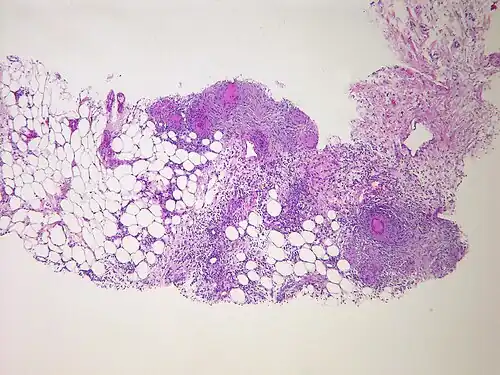 | |
| Peritonitis from tuberculosis | |
| Pronunciation |
|
| Medical specialty | Emergency medicine, general surgery |
| Symptoms | Severe pain, swelling of the abdomen, fever[1][3] |
| Complications | Sepsis (sepsis is likely if not quickly treated), shock, acute respiratory distress syndrome[4][5] |
| Usual onset | Sudden[2] |
| Types | Primary, secondary, tertiary, generalized, localized[2] |
| Causes | Perforation of the intestinal tract, pancreatitis, pelvic inflammatory disease, cirrhosis, ruptured appendix[3] |
| Risk factors | Ascites, peritoneal dialysis[4] |
| Diagnostic method | Examination, blood tests, medical imaging[6] |
| Treatment | Antibiotics, intravenous fluids, pain medication, surgery[3][4] |
| Frequency | Relatively common[2] |
Symptoms
Signs and symptoms may include:
- severe pain in the stomach[3]
- fever, or feeling hot and shivering[3]
- tachycardia (fast heart rate)[3]
- trouble urinating or urinating less than usual[3]
- weight loss.[5]
There may also be swelling in the abdomen, feeling or being sick, and a loss of appetite.[3]
If peritonitis happens while kidney dialysis treatment is being used, the fluid in the collection bag might look cloudier than usual or contain white flecks.[3] These are white blood cells, and if blood samples were taken and tested then the test might show an increased white blood cell count (WBC) of >100 million cells/L, with half of the cells in the sample being neutrophils.[7]
Causes
Peritonitis causes include:[3]
- perforation of the intestinal tract
- pancreatitis
- pelvic inflammatory disease
- burst stomach ulcer
- cirrhosis
- ruptured appendix.
- digestive problems (example Crohn's disease or diverticulitis)
- surgery
If the lining becomes infected in someone with peritonitis, the internal organs it covers can also be damaged.
Treatment
After a peritonitis diagnosis, treatment in hospital is needed to cure the infection.Treatment usually involves being given antibiotics into a vein (intravenously).[3]
If regular kidney dialysis is ongoing, a doctor might discuss a different way of doing it until the peritonitis has been treated.[3]
Related pages
- appendix
- gallbladder
- acid reflux
References
- 1 2 "Peritonitis - National Library of Medicine". PubMed Health. Retrieved 22 December 2017.
- 1 2 3 4 Ferri, Fred F. (2017). Ferri's Clinical Advisor 2018 E-Book: 5 Books in 1. Elsevier Health Sciences. pp. 979–980. ISBN 9780323529570. Archived from the original on 2020-10-08. Retrieved 2020-08-24.
- 1 2 3 4 5 6 7 8 9 10 11 12 "Peritonitis". NHS. 28 September 2017. Retrieved 31 December 2017.
- 1 2 3 "Acute Abdominal Pain". Merck Manuals Professional Edition. Archived from the original on 13 July 2018. Retrieved 31 December 2017.
- 1 2 "Acute Abdominal Pain". Merck Manuals Consumer Version. Retrieved 31 December 2017.
- ↑ "Encyclopaedia : Peritonitis". NHS Direct Wales. 25 April 2015. Archived from the original on 31 December 2017. Retrieved 31 December 2017.
- ↑ Fieren, Marien W. J. A. (2013-12). "Cloudy peritoneal dialysate: in search of a clear cause?". Journal of the American Society of Nephrology: JASN. 24 (12): 1929–1931. doi:10.1681/ASN.2013080911. ISSN 1533-3450. PMC 3839560. PMID 24179168.
{{cite journal}}: Check date values in:|date=(help)