Peripheral neuropathy
| Peripheral neuropathy | |
|---|---|
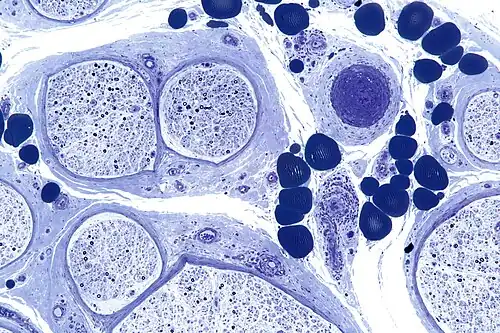 | |
| Micrograph showing a vasculitic peripheral neuropathy | |
| Medical specialty | Neurology |
Peripheral neuropathy happens when the nerves of the peripheral nervous system suffer damage due to disease, trauma to the nerves or through side effects of an illness.[1]
The four patterns of this condition are polyneuropathy, mononeuropathy, nononeuritis mp and autonomic nerve damage. The most common of these is polyneuropathy which affects the feet and legs. The actual forms may be broken down by causes. Losses of muscle bulk and muscle twitches may be seen.[2]
Damage to the sensory nerves may lead to numbness, strong tingling or burning pain that is described as electric-like, freezing and burning. Autonomic nerve damage leads to issues, such as hypertension, sexual troubles, bladder dysfunction and abnormal heart rate. Neuropathy can happen with or without the presence of diabetes mellitus.[3][4]
- ↑ Kaur, Jaskirat; Ghosh, Shampa; Sahani, Asish Kumar; Sinha, Jitendra Kumar (November 2020). "Mental Imagery as a Rehabilitative Therapy for Neuropathic Pain in People With Spinal Cord Injury: A Randomized Controlled Trial". Neurorehabilitation and Neural Repair. 34 (11): 1038–1049. doi:10.1177/1545968320962498. PMID 33040678. S2CID 222300017.
- ↑ Hughes RA (February 2002). "Peripheral neuropathy". BMJ. 324 (7335): 466–9. doi:10.1136/bmj.324.7335.466. PMC 1122393. PMID 11859051.
- ↑ Torpy JM, Kincaid JL, Glass RM (April 2010). "JAMA patient page. Peripheral neuropathy". JAMA. 303 (15): 1556. doi:10.1001/jama.303.15.1556. PMID 20407067.
- ↑ "Peripheral neuropathy fact sheet". National Institute of Neurological Disorders and Stroke. 19 September 2012. Archived from the original on 4 January 2016.