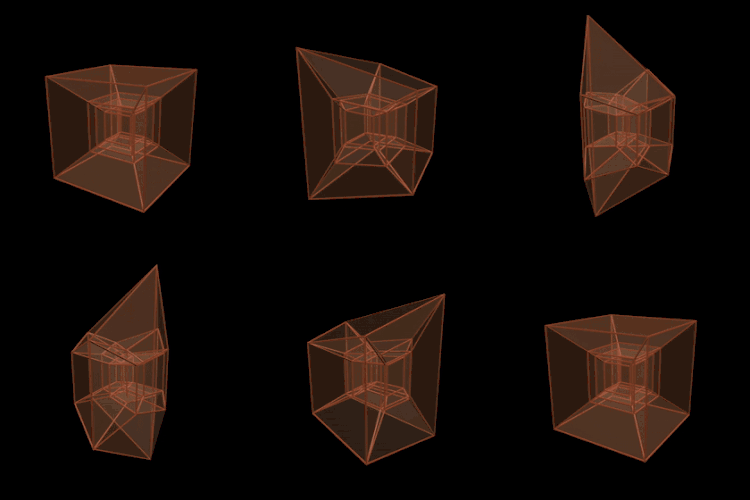
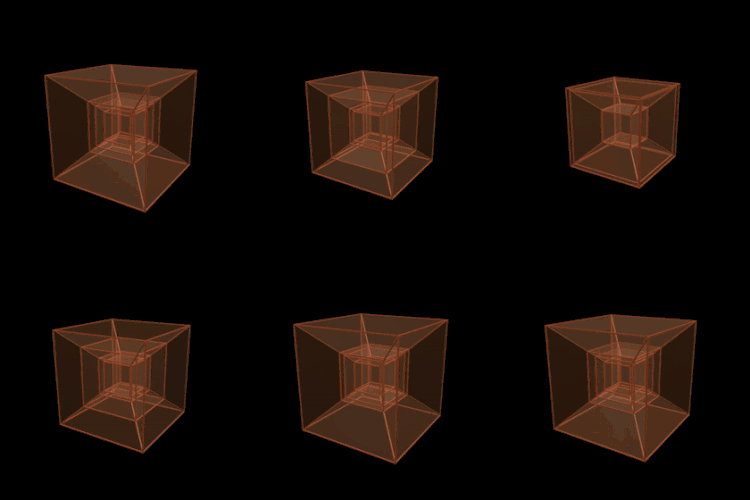
A rotating penteract (5-cube projection in 3D). A combination of 2 Tesseracts.
A penteract (also called a 5-cube) is a five-dimensional hypercube, and the 5D analogue of a cube and tesseract. It belongs to the infinite family of n-dimensional cubes (n-cubes).
Overview
The penteract exists in 5D Euclidean space and is defined as all points whose coordinates are either 0 or 1 in five dimensions. It is built by extending a tesseract into a fifth dimension.
It is represented by the Schläfli symbol {4,3,3,3}.
Elements
The structure contains:
A Rotating penteract projection undergoing a simple rotation.32 vertices (2⁵)
80 edges
80 square faces
40 cubic cells
10 tesseract 4-faces
Each vertex connects to 5 edges, one per dimension.
Construction
A penteract is formed by recursively extending lower-dimensional shapes: point → line → square → cube → tesseract → penteract.
Each step doubles the number of vertices, following the pattern of the hypercube family.
Properties
Like all hypercubes, it is highly symmetric and regular. It generalizes the structure of the square (2D), cube (3D), and tesseract (4D).
Visualization
A true 5D object cannot be visualized directly. Instead, it is studied using:
3D projections
4D slices
animated rotations of wireframes
These projections distort structure but preserve connectivity.