Parliament of Uganda
Parliament of Uganda Bunge la Uganda | |
|---|---|
| Twelfth Parliament | |
 | |
| Type | |
| Type | |
| History | |
| Founded | 1962 |
| Preceded by | Legislative Council |
New session started | 24 May 2021 |
| Leadership | |
Speaker | Anita Among, NRM since 25 March 2022 |
Deputy Speaker | Thomas Tayebwa, NRM since 25 March 2022 |
Government Chief Whip | Denis Obua, NRM since 16 August 2022 |
Leader of the Opposition | Joel Ssenyonyi, NUP since 9 January 2024 |
Chief Opposition Whip | John Nambeshe, NUP since 24 May 2021 |
| Structure | |
| Seats | 529 |
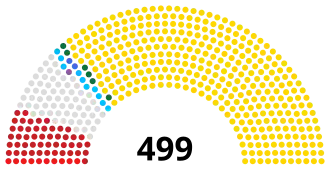 | |
Political groups | Government (359)
Opposition (77)
Others (63)
|
Length of term | 5 years |
| Elections | |
| Parallel voting: First-past-the-post voting (499 seats)[a] Indirect election (30 seats)[b] | |
First election | 25 April 1962 |
Last election | 15 January 2026 |
Next election | 15 January 2031 |
| Meeting place | |
 | |
| Parliament Avenue, Kampala | |
| Website | |
| www | |
| Constitution | |
| Constitution of Uganda | |
The Parliament of Uganda is the country's unicameral legislative body.
The most significant of the Ugandan parliament's job is to pass and ammend laws. The fiscal issues of the government, such as taxation and loans need the sanction of the parliament, after appropriate debate.[1]
Through its different committees, Parliament checks and discusses government programmes, including those mentioned in the president's State of the Nation address.[2] Matters involving money, such as taxes and government loans, must be approved by Parliament after debate.[3] Parliament also approves some people chosen by the president for government positions. It can also force a minister to resign through a motion of censure.[4]
Composition
The 11th Parliament (2021–2026) has 557 seats. Out of these, 353 members are elected from single-member constituencies using the first-past-the-post voting system. Another 146 seats are reserved for women, with each district electing one woman representative.
The remaining seats are chosen by special groups through electoral colleges. These include 10 representatives from the army, 5 from the youth, 5 from older persons, 5 from workers' unions, 5 from people with disabilities, and 28 ex officio members. At least one woman must be elected from each special group, while the army group must elect at least two women.[5][6][7][8]
In 2016, Parliament had 288 constituency representatives, 121 district women representatives, 10 representatives from the Uganda People's Defence Force, 5 youth representatives, 5 representatives of people with disabilities, 5 workers' representatives, and 17 ex officio members.[9]
History
The Parliament of Uganda was created in 1962, shortly after Uganda became independent.[10]
First Parliament of Uganda (1956–1962)
The Uganda Legislative Council (LEGCO) is seen as the first Parliament of Uganda.[11]
LEGCO was created in 1920 and replaced rule by the Commissioner's decrees. At first, all members were Europeans and the council was led by Governor Sir Robert Coryndon. In 1926, an Asian representative joined the council. On 4 December 1945, the first African members joined LEGCO. These were Michael Ernest Kawalya Kaggwa, Petero Nyangabyaki, and Yekonia Zirabamuzaale, who represented Buganda, Western Province, and Eastern Province.[11]
During the 1950s, several reforms were made to LEGCO. A ministerial system was introduced in 1956. Sir John Bowes Griffin became the first Speaker in January 1958.[11] Uganda held its first direct general elections in March 1961, which gave Africans the majority in the council. LEGCO remained in place until 1 March 1962, when self-government was introduced and the National Assembly replaced it.[11]
Second Parliament (1962–1979)
During this period, Prime Minister Milton Obote suspended the constitution and declared himself President of Uganda in 1966. This parliament also saw the abolition of Uganda's traditional kingdoms and the declaration of Uganda as a republic. The Speaker during this period was Narendra M. Patel, a Ugandan of Indian descent. The parliament ended after Idi Amin overthrew Obote's government in January 1971.
Third Parliament (1979–1980)
After Idi Amin was removed from power in April 1979, a new legislative body called the National Consultative Council (NCC) was formed to act as an interim parliament. It first had 30 members chosen in Moshi, Tanzania, but the number later increased to 120.[11] The council was chaired by Edward Rugumayo and continued until the general elections of December 1980.[11]
Fourth Parliament (1980–1985)
This period marked the return of Milton Obote and the Uganda People's Congress (UPC) after the disputed 1980 elections. The Speaker was Francis Butagira, a lawyer trained at Harvard Law School. The parliament ended in 1985 when General Basilio Olara Okello overthrew Obote's government.[11]
Fifth Parliament (1986–1996)
The Fifth Parliament was called the National Resistance Council (NRC). It was formed after the end of the Ugandan Bush War. It started with 38 historical members from the National Resistance Movement and National Resistance Army, and later expanded to include representatives from different parts of Uganda. Yoweri Museveni served as Speaker while also serving as President of Uganda.[11]
Sixth Parliament (1996–2001)
The Sixth Parliament was formed during one-party rule under the NRM. James Wapakhabulo served as Speaker from 1996 to 1998. Francis Ayume later became Speaker from 1998 to 2001.[11]
Seventh Parliament (2001–2006)
The Speaker of the Seventh Parliament was Edward Ssekandi. The most controversial law passed during this period removed presidential term limits from the constitution.[11]
Eighth Parliament (2006–2011)
The Eighth Parliament continued with Edward Ssekandi as Speaker and Rebecca Kadaga as Deputy Speaker.2006 Ugandan general election
Ninth Parliament (2011–2016)
The Ninth Parliament was led by Rebecca Kadaga as Speaker and Jacob Oulanyah as Deputy Speaker.2011 Ugandan general election
Tenth Parliament (2016–2021)
Rebecca Kadaga and Jacob Oulanyah remained Speaker and Deputy Speaker during the Tenth Parliament.2016 Ugandan general election
2017 Parliament fight
On 27 September 2017, a fight broke out during a parliamentary session. Members were debating a proposal to remove the presidential age limit of 75 from the constitution. After accusations of disorderly conduct, lawmakers began fighting inside the chamber. Chairs and microphone stands were used during the fight, and some members were removed by security officers in plain clothes.[12]
Eleventh Parliament (2021–2026)
At the start of the 11th Parliament in May 2021, Jacob Oulanyah became Speaker and Anita Among became Deputy Speaker. Oulanyah died in March 2022 while still in office.[13] After his death, Anita Among was elected Speaker on 25 March 2022. Thomas Tayebwa was elected Deputy Speaker on the same day.[14]
The Uganda Legal Information Institute (ULII) publishes Uganda's laws online for free public access.[15]
References
- ↑ "Functions of The Parliament of Uganda". The Parliament of Uganda. Archived from the original on 2012-04-19.
- ↑ "Is the State of the Nation address relevant?". VINAS Businesses. 2021-06-04. Archived from the original on 2021-06-12. Retrieved 2021-06-12.
- ↑ "Functions of The Parliament of Uganda". The Parliament of Uganda. Archived from the original on 2012-04-19.
- ↑ Mujuzi, Jamil Ddamulira (2024-12). "The Ugandan Parliament's Power to Censure a Cabinet Minister: Understanding Article 118 of the Constitution in the Light of its Drafting History". Fundamina : A Journal of Legal History. 30 (2): 125–144. doi:10.47348/FUND/v30/i2a4.
{{cite journal}}: Check date values in:|date=(help) - ↑ "Composition of Parliament". parliament.go.ug. 2018-01-18. Retrieved 2023-03-15.
- ↑ "Constitution" (PDF).
- ↑ "Electoral handbook" (PDF). Archived from the original (PDF) on 2020-11-29. Retrieved 2021-01-22.
- ↑ "Elections: Uganda National Assembly 2021". Election Guide.
- ↑ "Composition of Uganda's Parliament". The Parliament of Uganda. Archived from the original on 2018-04-21. Retrieved 2014-12-13.
- ↑ "Chronology of the Parliaments of Uganda". Archived from the original on 2017-10-29. Retrieved 2012-07-02.
- 1 2 3 4 5 6 7 8 9 10 "History of Parliament | Parliament of Uganda". www.parliament.go.ug. Retrieved 2026-04-27.
- ↑ AP Archive (2 October 2017). "Fighting in parliament as Uganda ejects MPs". YouTube. Archived from the original on 2021-12-21. Retrieved 16 March 2020.
- ↑ "Ugandan Speaker Oulanyah buried, father says he was poisoned - The EastAfrican". www.theeastafrican.co.ke. Retrieved 2026-03-04.
- ↑ "I'll use Deputy Speaker's office to serve Ugandans' interests - Tayebwa". Monitor. 2022-03-25. Retrieved 2022-03-26.
- ↑ Uganda Legal Information Institute, Welcome to the Uganda Legal Information Institute, accessed 10 June 2024
- ↑ Of the 499 seats, 353 are elected by constituency, while 146 seats reserved for women are elected by district.
- ↑ Out of the 30 seats, 10 are reserved for the Uganda People's Defence Force, while 5 seats each are allocated to the youth, the elderly, workers, and citizens with disabilities.
<ref group=lower-alpha> tags or {{efn}} templates on this page, but the references will not show without a {{reflist|group=lower-alpha}} template or {{notelist}} template (see the help page).