Paratelmatobius segallai
| Paratelmatobius segallai | |
|---|---|
Scientific classification  | |
| Kingdom: | Animalia |
| Phylum: | Chordata |
| Class: | Amphibia |
| Order: | Anura |
| Family: | Leptodactylidae |
| Genus: | Paratelmatobius |
| Species: | P. segallai |
| Binomial name | |
| Paratelmatobius segallai Santos, Oliveira, Carvalho, Zaidan, Silva, Berneck, and Garcia, 2019 | |
Paratelmatobius segallai is a frog. It lives in Brazil.[2][3][1]
Home
People see this frog on the dead leaves on the ground of forests on mountains. Scientists have observed this frog between 1036 and 1040 meters above sea level.[1]
Scientists saw this frog in a protected place, Parque Estadual Pico do Marumbi.[1]
Young
Scientists think this frog has many young at the same time, after rain.[4] Scientists heard male frogs calling to female frogs near pools of water that dry up for part of the year. The female frogs put eggs in water that does not move, and the tadpoles swim and grow there.[1]
Danger
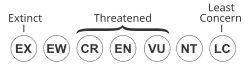
Scientists from the IUCN say they do not know if the frog is in danger of dying out. Scientists saw it in a protected park, where the frogs are safe from having their homes turned into farms or towns.[1]
References
- 1 2 3 4 5 6 IUCN SSC Amphibian Specialist Group (2023). "Paratelmatobius segallai". IUCN Red List of Threatened Species. 2023: e.T163972919A163986582. doi:10.2305/IUCN.UK.2023-1.RLTS.T163972919A163986582.en. Retrieved October 20, 2025.
- ↑ Frost, Darrel R. "Paratelmatobius segallai Santos, Oliveira, Carvalho, Zaidan, Silva, Berneck, and Garcia, 2019". Amphibian Species of the World, an Online Reference. Version 6.0. American Museum of Natural History, New York. Retrieved October 20, 2025.
- ↑ "Paratelmatobius segallai Santos, Oliveira, Carvalho, Zaidan, Silva, Berneck, & Garcia, 2019". AmphibiaWeb. University of California, Berkeley. Retrieved October 20, 2025.
- ↑ eixeira Santos MT; SH de Oliveira; TR de Carvalho; BF Zaidan; NR da Silva (2019). "A new species of Paratelmatobius (Anura: Leptodactylidae: Paratelmatobiinae) from the Atlantic Forest of southern Brazil". Zootaxa 4648 (Abstract) (3): 473–493. doi:10.11646/zootaxa.4648.3.4. PMID 31716936. Retrieved October 20, 2025.