Paratelmatobius mantiqueira
| Paratelmatobius mantiqueira | |
|---|---|
Scientific classification  | |
| Kingdom: | Animalia |
| Phylum: | Chordata |
| Class: | Amphibia |
| Order: | Anura |
| Family: | Leptodactylidae |
| Genus: | Paratelmatobius |
| Species: | P. mantiqueira |
| Binomial name | |
| Paratelmatobius mantiqueira Pombal and Haddad, 1999 | |
Paratelmatobius mantiqueira is a frog. It lives in Brazil.[2][3][1]
Body
This is the smallest frog in Paratelmatobius. The adult male frog is 14.4 to 16.7 mm long from nose to rear end. There is no webbed skin on the front feet.[3]
Home
People see this frog on the dead leaves on the ground in rainforests that were never cut down and rainforests that are growing back where the branches come together like a roof. This frog can only live high in the mountains near where streams start. Scientists have observed this frog between 1650 and 1700 meters above sea level.[1] Scientists saw this frog in a protected place, Área de Proteção Ambiental São Francisco Xavier. They think it may live in Reserva Particular do Patrimônio Natural Reserva dos Muriquis too.[1]
Young
These frogs have young in pools of water in very small streams. The tadpoles swim in the water.[1]
Danger
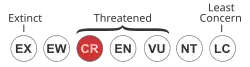
The IUCN says this frog is in very big danger of dying out. People change the places where the frog lives into towns and farms. They also take water from streams to use and make canals.[1]
Scientists found the dangerous fungus Batrachochytrium dendrobatidis on other frogs in the frog's home, but they do not know if the disease it causes, chytridiomycosis, kills P. mantiqueria.[1]
Climate change could also hurt this frog because it lives in forests high above sea level.[1] Animals that live high in the mountains cannot move to colder places if their homes become too hot because they would have to climb down into even hotter places first.
References
- 1 2 3 4 5 6 7 8 IUCN SSC Amphibian Specialist Group (2023). "Paratelmatobius mantiqueira". IUCN Red List of Threatened Species. 2023: e.T57196A172227094. doi:10.2305/IUCN.UK.2023-1.RLTS.T57196A172227094.en. Retrieved October 19, 2025.
- ↑ Frost, Darrel R. "Paratelmatobius mantiqueira Pombal and Haddad, 1999". Amphibian Species of the World, an Online Reference. Version 6.0. American Museum of Natural History, New York. Retrieved October 19, 2025.
- 1 2 Raul E. Diaz (June 4, 2004). Tate Tunstall (ed.). "Paratelmatobius mantiqueira Pombal & Haddad, 1999". AmphibiaWeb. University of California, Berkeley. Retrieved October 19, 2025.