Paratelmatobius cardosoi
| Paratelmatobius cardosoi | |
|---|---|
Scientific classification  | |
| Kingdom: | Animalia |
| Phylum: | Chordata |
| Class: | Amphibia |
| Order: | Anura |
| Family: | Leptodactylidae |
| Genus: | Paratelmatobius |
| Species: | P. cardosoi |
| Binomial name | |
| Paratelmatobius cardosoi Pombal and Haddad, 1999 | |
| Synonyms[2] | |
| |
Paratelmatobius cardosoi is a frog. It lives in Brazil.[2][3][1]
Body
The adult male frog is 17-17.9 mm long from nose to rear end. The head is wider than it is long. The nose is round. The skin of the back is light gray with black marks and a yellow line down the middle of the back. There is one orange spot on each side of the face. The belly and throat are gray with yellow and orange spots. There is one orange spot on each front leg.[3]
Home
People see this frog on the dead leaves on the ground in rainforests that were never cut down and rainforests that are growing back.[1]
Most of these frogs live in a protected place, Parque Estadual da Serra do Mar.[1]
Young
Scientists think this frog has many young at the same time. The female frog puts eggs in muddy ponds that dry up later. The tadpoles swim in the ponds before they dry up.[1]
Danger
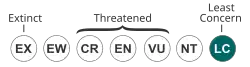
The IUCN says this frog is not in danger of dying out. Most of these frogs live in the protected Parque Estadual da Serra do Mar. The frogs that live outside the park may be in some danger. People cut down forests to make towns, farms, tree farms, and places for cows to eat grass. Long ago, people cut down many trees to get wood to build with, but they do not do this much now.[1]
References
- 1 2 3 4 5 6 IUCN SSC Amphibian Specialist Group (2023). "Paratelmatobius cardosoi". IUCN Red List of Threatened Species. 2023: e.T57195A172226988. doi:10.2305/IUCN.UK.2023-1.RLTS.T57195A172226988.en. Retrieved October 17, 2025.
- 1 2 Frost, Darrel R. "Paratelmatobius cardosoi Pombal and Haddad, 1999". Amphibian Species of the World, an Online Reference. Version 6.0. American Museum of Natural History, New York. Retrieved October 17, 2025.
- 1 2 Raul E. Diaz (June 4, 2004). Tate Tunstall (ed.). "Paratelmatobius cardosoi Pombal & Haddad, 1999". AmphibiaWeb. University of California, Berkeley. Retrieved October 17, 2025.